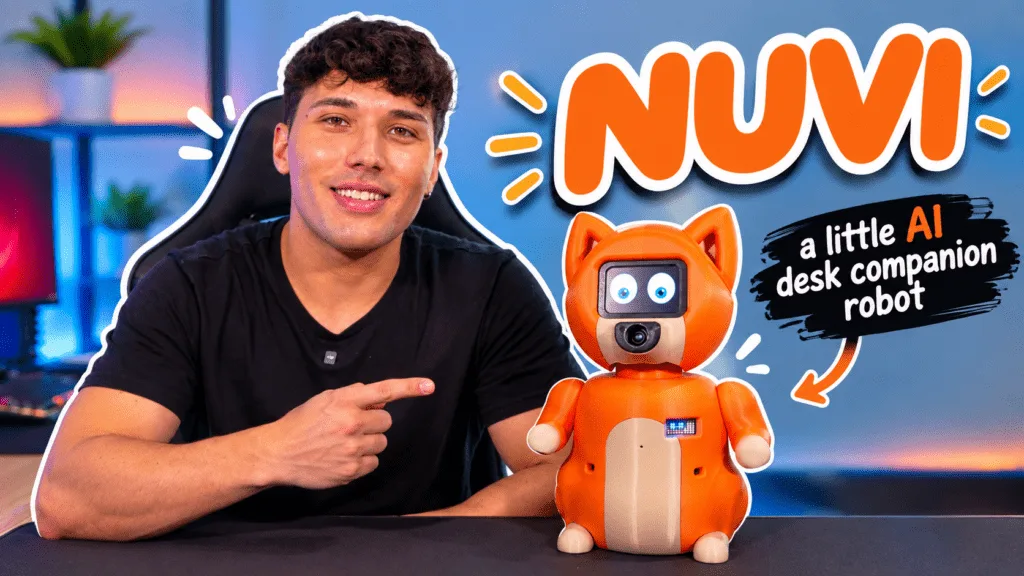
What started as a straightforward robotics project evolved into something far more engaging when maker Luca Di Lorenzo (@LucaDilo on YouTube) partnered with Arduino. The result is Nuvi, a diminutive yet personality-packed desktop companion built around the Arduino UNO Q board. The device perceives your presence, responds to voice commands, and engages in conversation—all without requiring an internet connection for its fundamental capabilities.
The inspiration behind Nuvi's charming appearance comes from an unexpected source: Kaito, a Shiba Inu that Arduino colleague Assunto occasionally brings into the Turin office. Di Lorenzo recognized that his initial prototype functioned adequately but lacked character. By drawing from Kaito's likable features, he crafted something the entire team genuinely wanted sitting on their desks.
Conversation and Smart Home Integration
Standing just under 30 centimeters tall, Nuvi manages to pack considerable functionality into its small frame. The device activates upon detecting your approach and responds when addressed by name. Its conversational abilities rely on Gemini, which processes speech comprehension and response generation simultaneously without requiring a separate transcription layer. For voice output that doesn't depend on cloud services, Nuvi employs Piper, a voice synthesis engine that runs directly on the board, ensuring responses arrive without noticeable delay. The companion can retrieve information from the web when necessary, manage smart home equipment through voice or hand gestures, and display ambient temperature and humidity readings when you show it an open palm.
Beyond its conversational prowess, Nuvi features expressive animated eyes that convey emotional states, articulated ears and arms, head movement capabilities, sensitivity to touch on its head and belly, and an entertaining dance sequence.
The Dual-Brain Architecture Behind the Design
The UNO Q board's two-processor design proved essential for bringing Nuvi to life. The real-time microcontroller manages all physical operations: four servos controlling the arms and ears, two serial servos for neck movement, the display interface, environmental sensors, and touch detection. Simultaneously, the Linux processor executes the AI pipeline, voice synthesis engine, and application software. Crucially, all processing occurs on the device itself rather than relying on an external computer, delivering both capability and independence.
Creating Your Own Version
Di Lorenzo has made the complete project documentation publicly available through Arduino Project Hub, including three-dimensional design files, circuit schematics, software code, and comprehensive assembly instructions. Builders interested in exploring how much personality can fit into a UNO Q project will find this an excellent starting point. The design remains fully customizable, allowing creators to adapt Nuvi to resemble their preferred animal companion.
The UNO Q board is purchasable through the Arduino Store and available from authorized retailers including DigiKey, Farnell, Mouser, Newark, RS Components, Robu.in, and distributors worldwide.
Source: Arduino Blog