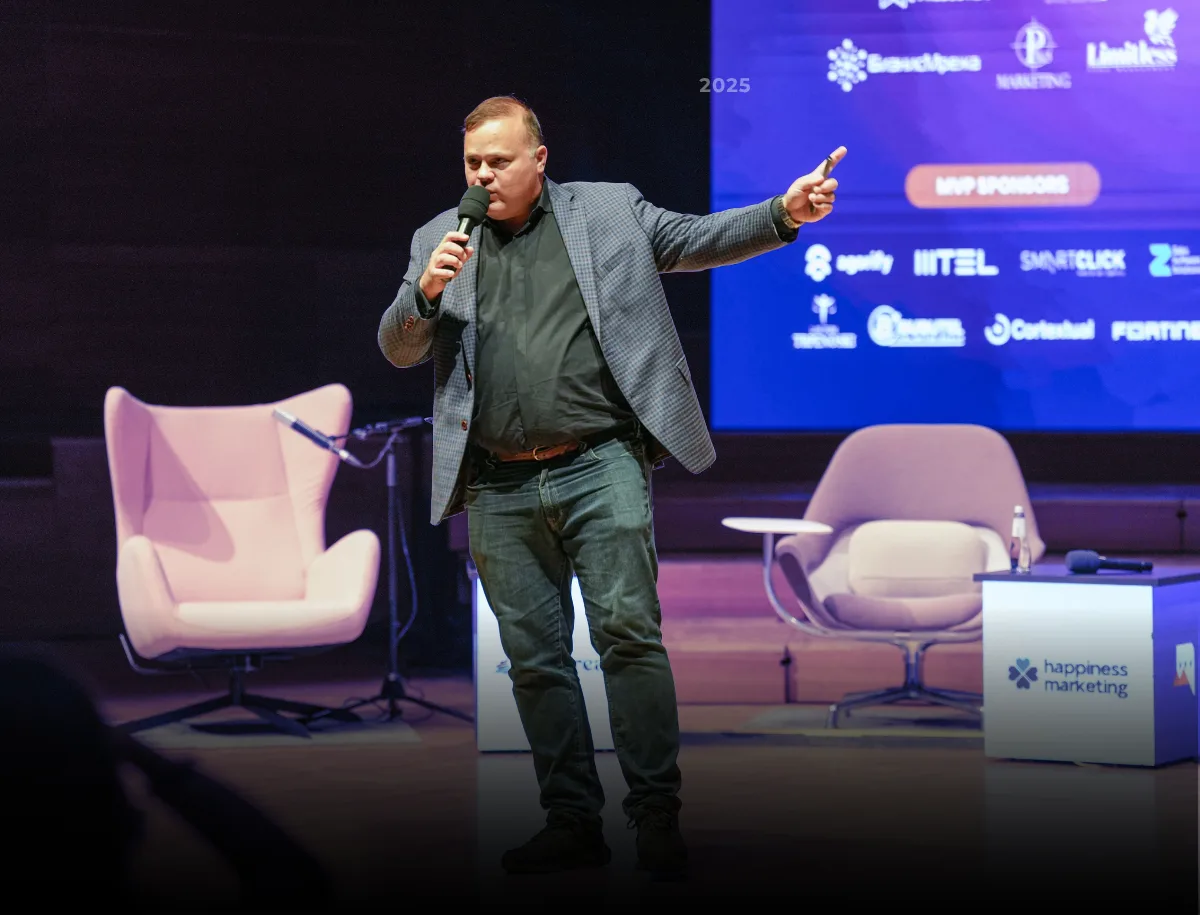
A concert hall built for the Macedonian Philharmonic became the unlikely stage for the region's largest gathering of founders and investors this October. The Startup Revolution AI Summit, running October 1–4, 2026, under the banner "Where the Next Unicorns Are Born," nearly doubled in size from its inaugural year: attendance jumped from 1,200 people representing 30 countries to more than 2,000 attendees, over 100 speakers, and 400+ startups spanning 50+ nations. The four-day program split across two stages, weaving together tracks on scaling, AI integration, cybersecurity, energy, health tech, community building, and government policy. The centerpiece was the Startup World Cup, offering a $1 million investment prize, alongside side events ranging from Fuckup Nights and The Hack for Humanity hackathon to The Women's M.I.X.E.R. and an Investor Kafana.
The venture landscape has fundamentally shifted
Ethan Mayers, a venture partner and three-time founder, opened the summit with a sobering assessment of the current VC environment. The cohort of companies that received funding during the 2022 capital surge represents, in his view, the most challenging in history—and many of those funds have yet to return capital to their backers.
Two permanent changes have reshaped the funding landscape, Mayers argued. The first: institutional capital no longer arrives at the idea stage. AI has made early-stage building so inexpensive that YouTube tutorials and personal networks can carry founders well past the initial phase, making traditional seed checks obsolete. The second shift concerns Series A rounds, which have become increasingly difficult even for companies demonstrating genuine traction.
Mayers also flagged a concentration trend that warrants attention: by the end of 2026, six firms will command 60% of all venture capital globally.
Rather than lament the VC market's contraction, Mayers proposed redefining what success means. He has identified over 160 funds operating in what he calls a "venture-adjacent" space, designed to pursue smaller outcomes—exits between $50 million and $500 million, compressed timelines, or no exit at all. These emerging models fall into three categories: nimble capital targeting exits under six years, SMV funds chasing sub-unicorn wins with majority success rates, and permanent capital flowing in from private equity.
His message to Central and Eastern Europe was direct: resist the urge to transplant Silicon Valley wholesale. Instead, build the version that serves your market.
Success is not a destination you inherit. It's the route you choose.
Ethan Mayers
Lessons from founders who have already won
The summit's most resonant sessions came from founders who have navigated the exact journey everyone in the room is attempting. Their advice diverged in useful ways—a reminder, as Mayers noted, that multiple paths now lead to success.
Branko Džakula, co-founder of Secfix, offered a close-up view of the struggle between founding and survival. The Munich-based cybersecurity compliance company began roughly five years ago with a LinkedIn message to a future co-founder and a sharp pivot from penetration-testing marketplace to compliance automation—a category barely recognized across Europe at the time. The seed round nearly ended the company. Džakula recounted roughly 200 rejections, seven or eight months of fundraising, and a single month of runway remaining as Christmas approached, while the lead investor was still completing due diligence. A €100K angel bridge carried them into January and the eventual close. By early 2026, with market validation in place and Secfix established as a category pioneer, the $12 million Series A arrived with relative ease. The company now employs around 40 people, serves more than 500 customers, and generates roughly €4 million in annual recurring revenue.
Džakula outlined his non-negotiables for any founder: understand your deeper motivation, maintain ethical standards, practice radical transparency within your team, and cultivate relentless persistence above all else.
Persistence is the only word every successful person has in common. It means getting hit, going down, and getting back up, over and over again, until 'No' finally becomes 'Yes.' That persistence should be tattooed on every founder's head.
Branko Džakula
Philipp Nieland shared his trajectory from zero to unicorn status. Nieland launched PPRO in 2006, during an era when European payments regulation barely existed and card adoption in Germany hovered around 18%. He bootstrapped the company into a global payments infrastructure spanning 90+ countries, grew the team to roughly 450 people, and eventually exited in a transaction that achieved unicorn valuation. Nieland was candid about his missteps, particularly his initial decision to build alone—a mistake he corrected in 2012 by bringing on a co-founder. Drawing from his product-building experience, he highlighted a recurring error among founders: overwhelming users with features.
I think that the most important thing, if you are building in tech, is to absorb complexity for the user. Your complexity does not need to be the complexity of the customer. And the more you do this, the more successful you will be…
Philipp Nieland
Nieland's parting counsel to founders: abandon the goal of building a unicorn. Instead, choose one vertical, perfect a single product, and relentlessly push its boundaries each day.
North Macedonia's government charts a digital leap
While founder keynotes centered on company building, policy sessions addressed how governments can keep pace with ecosystem momentum. The data tells its own story. At the summit's opening, StartupBlink announced that North Macedonia had climbed 95 positions to rank 457th among 1,500 global ecosystems, with its startup environment expanding 88.5%—the fastest growth rate in Southeastern Europe.
Stefan Andonovski, Minister of Digital Transformation, took the Philharmonic stage to argue that smaller nations can leapfrog ahead through digitalization. North Macedonia's national services portal expanded from 120 electronic services two years prior to 352 today, and user numbers grew from 110,000 to 266,000. The centerpiece of his remarks, however, was a government super app scheduled to launch from that same stage on October 28. Andonovski traced the concept to a Zurich meeting with Ukraine's former minister, whose Diia app persuaded him that small countries should not be building 20 or 30 separate government applications.
The Macedonian super app integrates a digital wallet with electronic ID and driver's license, services accessible to all citizens, and planned payment functionality—all with AI embedded throughout. Andonovski concluded with a broader lesson: digitalization stands as the one domain where nations can leapfrog regardless of infrastructure, budget, or historical constraints. Success depends on ambition, talent, and effort.
Vezilka: National AI infrastructure for the region
Complementing the government's digital vision is Vezilka (meaning "the embroiderer"), North Macedonia's national AI Factory Antenna. The roughly €6 million initiative—with approximately €3.1 million in EU funding—draws support from Horizon Europe and the EuroHPC initiative, supplemented by national co-financing from the Ministry of Digital Transformation.
Hosted by Ss. Cyril and Methodius University in Skopje and run by the Faculty of Computer Science and Engineering (FINKI), Vezilka launched in April 2026 for a 36-month operational period. Andonovski framed it as a capital project of national significance: government, universities, and industry collaborating to construct a shared national AI system rather than isolated initiatives.
The practical benefit centers on access. As an affiliated unit of the European "Pharos" AI factory headquartered in Greece, Vezilka grants Macedonian researchers, companies, and startups connections to European supercomputers—particularly Daedalus—eliminating the infrastructure expenses that have historically kept advanced AI beyond reach for smaller organizations. This access pairs with training and hands-on support.
The center prioritizes five domains: Macedonian language and cultural heritage, healthcare, energy, public administration, and agriculture. It also functions as a hub for workforce development and public AI literacy, grounded in a "trustworthy AI by design" philosophy that addresses data governance, bias mitigation, explainability, and human oversight. The name itself embodies the vision: like embroidery, Vezilka threads people, knowledge, and data into a unified whole.
CoachBot takes home the $1 million prize
The summit's closing event featured the Startup World Cup competition, with the $1 million investment prize as the headline draw. Founders pitched before a judging panel comprising Eli Zhabevska of South Central Ventures, Patrick Polak from Newion Partners, Shefqet Avdullau, Dane Atanaskovic, and Igor Mishevski of Zephyr Angels.
The finalist pool reflected the breadth of emerging sectors: a circular-fashion startup leveraging AI and proprietary hardware to sort, price, and redistribute used clothing across Etsy, eBay, and local marketplaces; EVA, a Skopje-based safety application featuring a hold-to-alert "shield" button that summons venue staff when users feel threatened; and a suite of AI-driven products spanning voice, data, and enterprise software.
CoachBot emerged as the winner. Founder Lewin Keller, who honed go-to-market expertise at Google before becoming a certified coach, framed the problem with clarity: organizations invest billions in employee training on a Tuesday, then leave workers unsupported on Thursday when difficult conversations actually occur. Professional coaching addresses this gap but remains episodic, expensive, and inaccessible to most. CoachBot's solution is an infrastructure layer enabling coaching organizations and employers to embed their own methodology and governance standards into scalable conversational AI coaching bots. As Keller described it, the platform pairs "the effectiveness of a professional coach with the accessibility of an LLM," alongside the analytics HR teams need to act on insights.
The pitch's strength lay in demonstrated traction. After beginning with individual coaches, CoachBot shifted to channel partners and achieved 15x revenue growth, accumulating roughly 34 clients (predominantly in the faster-paced US market) and approximately €104K in annual recurring revenue while still offering first-year discounts. Keller positioned the company between three alternatives it claimed to outperform: DIY bots anyone can build with an AI model in an afternoon but cannot govern or scale into HR systems, trusted-yet-unscalable human coaching marketplaces, and scalable-but-untrustworthy AI-only platforms.
CoachBot was seeking $1 million to fund 18 months of runway, enabling the company to reach enterprise readiness and move upmarket. The company departed Skopje with the summit's top prize in hand.
Source: The Recursive — Events tag