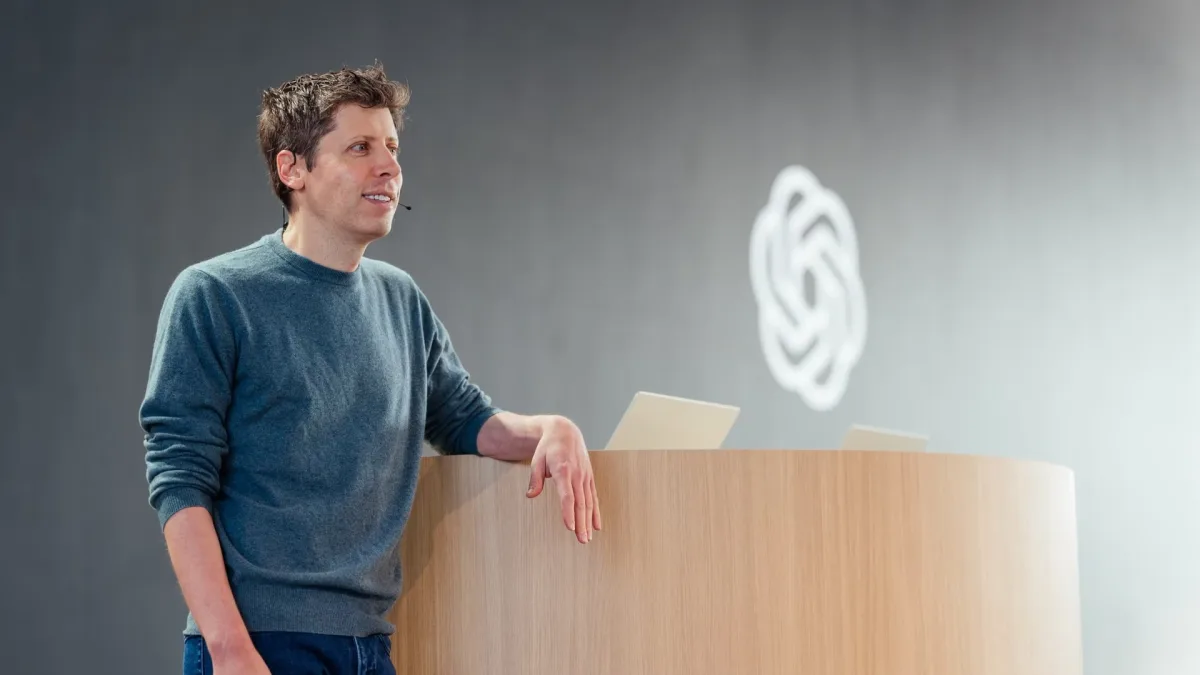
During remarks at Semafor's Silicon Valley & The World event on Monday, Sam Altman fielded questions from Reed Albergotti about Nvidia's leadership, OpenAI's public market plans, and the state of AI infrastructure. When pressed on whether Jensen Huang ought to resume his role at Nvidia, Altman demurred, saying he lacked sufficient insight into the matter.
Huang as a hero, with caveats
Albergotti noted the parallel to Altman's own removal by OpenAI's board roughly three years prior, and observed that a letter supporting Huang appeared to mirror the one drafted by Altman's backers at that time. Altman responded with measured words about his admiration for the Nvidia founder.
I don't think I know enough to answer that question. Jensen has long been a hero of mine. Heroes have flaws. I am grateful for the company he's built.
Sam Altman
Altman acknowledged his personal sympathy for Huang's situation, drawing on his own experience of being forced out. He underscored the mutual bets the two companies had made on each other early on, and expressed his view of Huang's centrality to the AI industry's trajectory.
It's hard to imagine the AI revolution without Jensen.
Sam Altman
According to CNBC reporting, Nvidia's board is not exploring a return for Huang.
Nvidia's market standing remains solid
When Albergotti raised the question of whether Nvidia's commitments retain their former credibility, he referenced the approximately $105 billion guarantee the chipmaker had extended for OpenAI's Ohio data centre facility. Altman expressed confidence in the company's standing.
Nvidia is like a behemoth of a company. I think people still trust their guarantees very much.
Sam Altman
Though Altman acknowledged the tight connection between Huang and Nvidia as an organization, he suggested that the sector's robust expansion in both revenue and AI demand would sustain the industry regardless.
Going public and chip supply questions
Altman confirmed that OpenAI intends to pursue a public listing eventually, though he noted that operating as a public company carries genuine challenges during a period of industry volatility. When Albergotti asked whether Anthropic's imminent IPO might drain capital pools available to OpenAI, Altman dismissed the concern.
That is not a worry. One way you could look at the last year is there's been way too much investor demand and not enough supply.
Sam Altman
Altman elaborated on his earlier remarks regarding chip double counting, a phenomenon he attributed to the proliferation of AI chip makers, many of whom anticipate selling the bulk of their output to OpenAI, Anthropic, and a small handful of other buyers. He noted that these customers cannot absorb all available supply from every producer, yet the underlying data centre expansion remains genuine.
While data centre construction will proceed, Altman flagged friction around community engagement. He suggested that developers might locate facilities in less densely populated areas to ease local concerns.
RAM, security threats, and AI safeguards
Altman clarified his earlier comments on RAM in consumer computers, which he said had been misunderstood. He noted that DRAM costs have climbed somewhere between five and seven times their previous levels, and he advocated for broader access to affordable memory.
I want people to have a lot of RAM. I think everybody should buy a lot of RAM, be able to buy a lot of RAM for their own computer. I think the home tinkering is great.
Sam Altman
On the topic of espionage, Altman recounted efforts by competitors to gain advantages through tactics ranging from covert surveillance in OpenAI's facilities to social engineering of staff members seeking to extract pre-training details. He conceded that OpenAI's security posture has not been flawless.
Regarding recursive self-improvement in AI systems, Altman explained that OpenAI develops successive models more rapidly using its own infrastructure. However, the company does not permit models to autonomously design their successors without human involvement.
We could be pushing more towards the RSI spectrum than we are, but I don't think we could safely do that right now.
Sam Altman
Altman disclosed that OpenAI collaborates with embedded evaluators, including METR, to assess safety considerations. He emphasized that external perspectives on safety research will grow increasingly significant and valued as the field matures.
Source: The Next Web