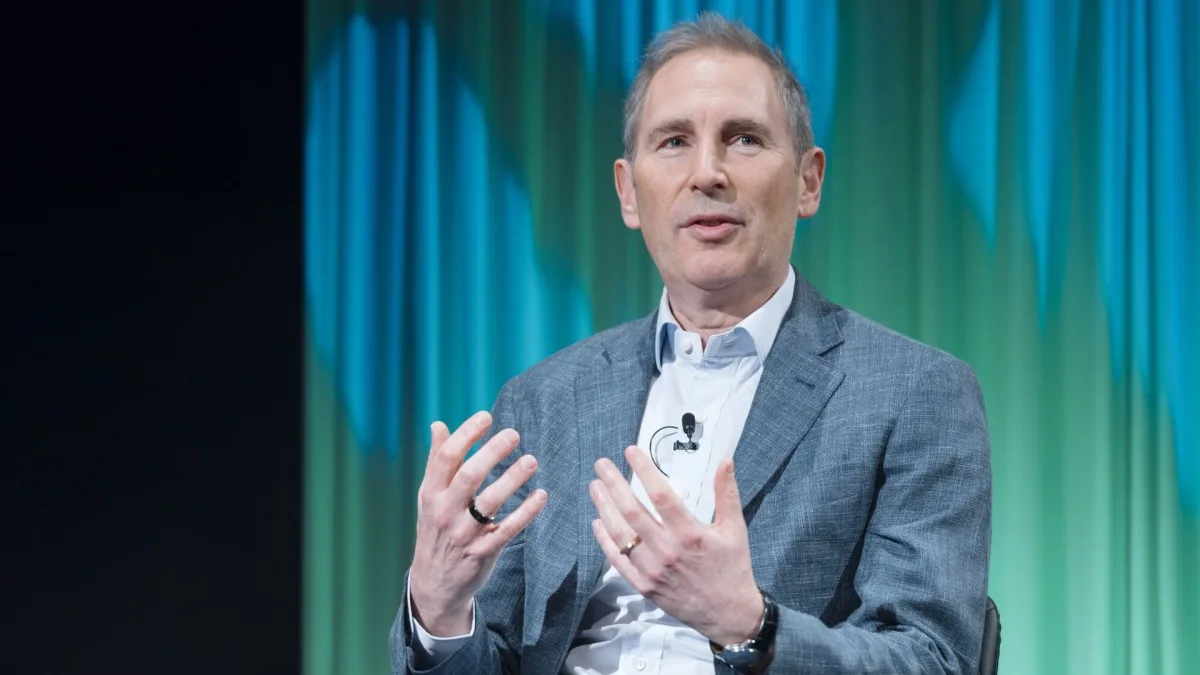
Amazon's third-quarter results revealed a company in the midst of a historic capital deployment, with artificial intelligence infrastructure driving the financial picture. Chief executive Andy Jassy signalled that the retailer could build two separate $1 trillion annual revenue businesses over the next 5–10 years. The quarter also marked Amazon's strongest operating margin on record at 13.9%.
The cost of this ambition is steep. Free cash flow swung to negative $42.4 billion over the 12 months ending in September, compared with positive $14.8 billion a year prior. Investment in AI infrastructure accounted for the bulk of this reversal, Amazon disclosed. Capital expenditure on property and equipment reached $94.8 billion across the same period, predominantly allocated to AI systems.
Overall company performance showed revenue climbing 12% to $201.9 billion, with operating income jumping to $28.1 billion from $17.4 billion in the prior year. However, the results disappointed Wall Street: shares tumbled as much as 7% in after-hours trading as both revenue and earnings per share fell short of analyst expectations of $202.3 billion and $1.96 respectively.
AWS accelerates to its strongest growth in nearly five years
Amazon Web Services, the company's cloud division, delivered the headline growth figure. The unit's revenue surged 39% to $46 billion, while operating income climbed to $17.8 billion from $11.4 billion. AWS now runs at an annual revenue rate of $184 billion and maintains a customer backlog valued at $578 billion, Jassy revealed.
Demand for AI computing capacity is outpacing supply at a remarkable pace. Jassy stated: "We're installing an AI accelerator about every 14 seconds, and almost as fast as we install capacity, customers are gobbling it up."
Looking ahead, Jassy projected AWS revenue growth exceeding 40% in both 2027 and 2028. The company also plans to begin offering its Trainium AI chips to external customers starting late in 2027. Earlier this month, Amazon released TorchNeuron for Trainium, enabling developers to execute PyTorch code directly on the chips.
Jassy articulated an ambitious long-term vision in the earnings statement: "There has never been a trillion dollar revenue business, and we may have two of them in the next 5-10 years."
Capital intensity, debt, and the retail challenge
Amazon's infrastructure spending accelerated dramatically in the third quarter, with $77.3 billion deployed on property and equipment compared with $35.1 billion a year earlier. The company maintains its guidance of approximately $220 billion in total capital expenditure for the full year, a target set during July's earnings call. To finance this expansion, Amazon raised $48.1 billion in long-term debt during the quarter and secured the ability to borrow up to $80 billion against its AI hardware inventory.
When pressed by analysts on the sustainability of this spending trajectory, Jassy indicated that outlays would be "meaningfully more" in 2027, though he expressed confidence in the underlying economics. "We can fund this plan," he assured the market.
The retail business, by contrast, showed modest momentum. Online store revenue increased just 2% to $68.5 billion, while advertising revenue grew 11% to $19.6 billion. Amazon attributed roughly four percentage points of growth headwind to the relocation of Prime Day into the second quarter across most major markets. Prime Video, the streaming service, now generates revenue at a run rate in the tens of billions of dollars and has achieved profitability, Jassy noted.
For the holiday quarter, Amazon guided to revenue between $240 billion and $247 billion, with operating income projected at $28.5 billion to $33.5 billion. The results came as cloud competitors also reported: Google Cloud revenue doubled year-over-year, while Alphabet shares experienced their worst trading day on record.
Source: The Next Web