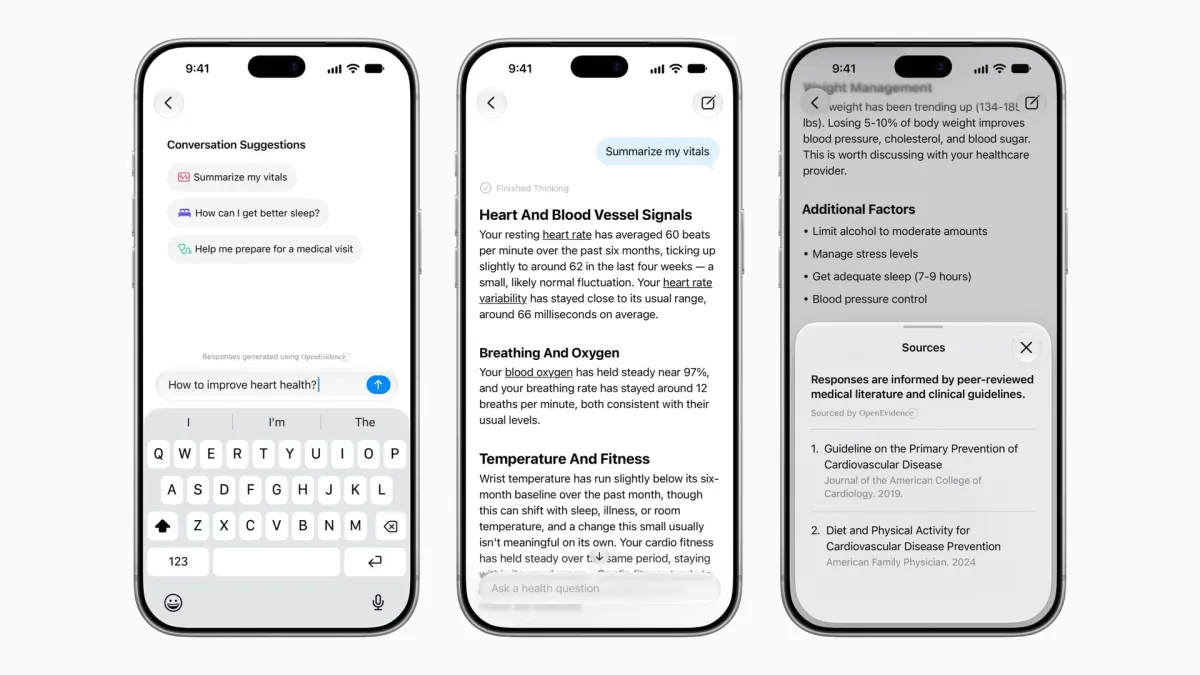
Apple has unveiled a dedicated research programme alongside a new iPhone application designed to investigate how individuals approach AI when seeking answers to health-related questions. The Apple Health AI Usage Study, announced on Sunday, operates as a collaboration with OpenEvidence, a clinical AI platform used by medical professionals across the United States.
The research aims to examine the factors that influence whether people feel confident relying on health AI, assess the quality of responses generated by such systems, and evaluate how well users comprehend and act on the information they receive. Apple intends to use these insights to guide the development of health AI applications across its own products and throughout the broader industry.
At Apple, we believe responsible innovation starts with scientific rigor and clinical grounding. Health is deeply personal, and conducting a dedicated research study is the most thoughtful way to understand how people engage with, comprehend, and evaluate health AI in everyday life.
Sumbul Desai, Apple's vice president of Health and Fitness
How the app works
Study participants pose everyday health questions to the application, which delivers responses in accessible language accompanied by links to peer-reviewed clinical research. OpenEvidence sources its information from publications including The New England Journal of Medicine, the Journal of the American Medical Association and Nature.
Participants have the option to contribute HealthKit information such as resting heart rate, physical activity levels, sleep patterns or laboratory test results. Apple is investigating whether incorporating this personal health context enhances the relevance and comprehensibility of the responses provided. The research will additionally examine whether the tool assists users in preparing for consultations with their healthcare providers.
The application appears in the App Store under the name Apple Health Study App. Its listing identifies additional capabilities: contextualizing personal health information and generating customized fitness or nutrition recommendations.
Consumer-facing health tools powered by large language models frequently produce responses that lack completeness or clarity, according to Apple. This observation motivated the company to undertake research into more effective methods for communicating health information.
Privacy and guardrails
Apple has committed that information collected through the study will not be used to develop or refine AI models. Study participants retain full control over whether they contribute HealthKit data or complete survey questions. The application incorporates safeguards designed to identify potentially serious health concerns and prompt users to consult with a medical professional.
The application remains separate from Siri and Apple Intelligence, according to reporting by Steve Dent for Engadget. The App Store listing explicitly states that the application and study do not constitute medical advice, diagnosis or treatment.
Patients and clinicians are both turning to AI, but the tools they use are being built and tested in separate worlds.
Robert Wachter, chair of UCSF's Department of Medicine
Who can join
Eligibility for the study extends to up to 200,000 individuals aged 21 and older residing in the United States. Participants must own an iPhone 15 Pro or newer model running iOS 26 or later—the devices capable of running Apple Intelligence.
OpenEvidence previously partnered with Anthropic in September to provide complimentary medical AI services to physicians. OpenAI introduced ChatGPT Health in January, followed by Microsoft and Perplexity launching Copilot Health and Perplexity Health respectively in March.
Source: The Next Web