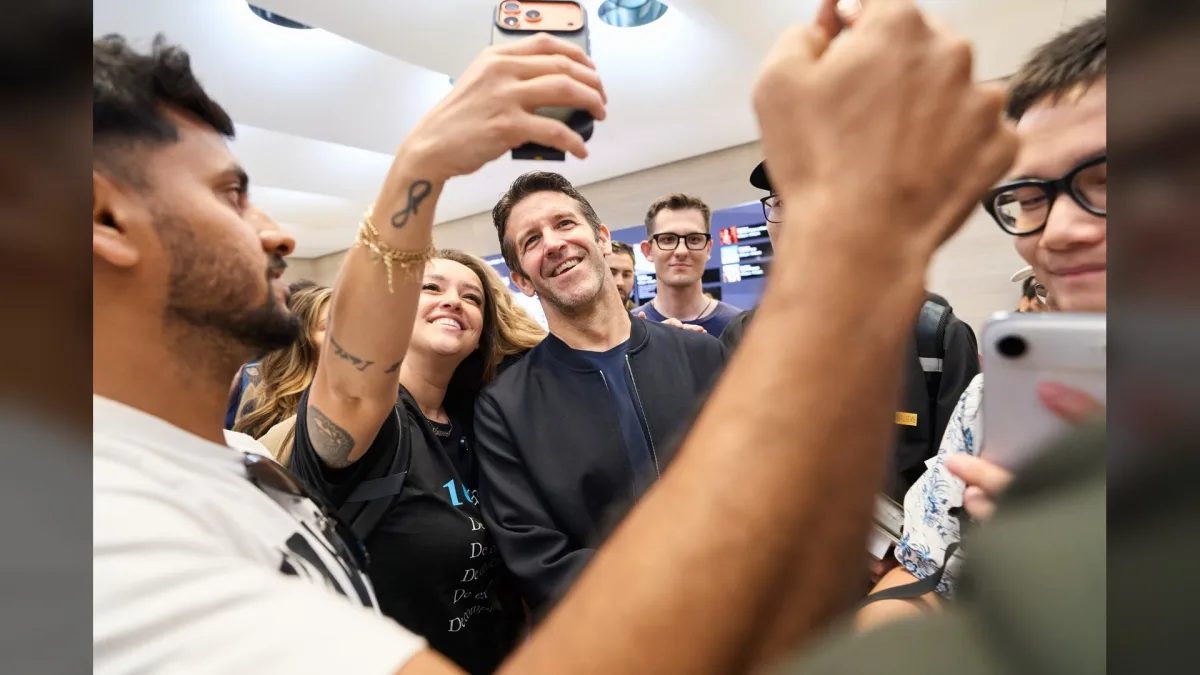
According to reporting by Mark Gurman at Bloomberg published on Sunday, Apple's chief executive John Ternus has recently applied pressure on software chief Craig Federighi to accelerate the company's artificial intelligence initiatives. Ternus is eager for Apple to expand its ambitions beyond simply refining Siri, and has grown frustrated with what he perceives as the company's hesitancy to match the competitive intensity of rivals in the AI space. The two executives held a private meeting in recent weeks to discuss the matter. TNW has not independently confirmed the details of this report.
Ternus has presented a more measured public stance on the subject. During Apple's recent earnings call, he offered praise for the newly redesigned Siri artificial intelligence system. In an interview with WIRED last month, he stated that Apple would not introduce AI features merely for their own sake.
It's primarily request-based today, but as we talked about at WWDC, it's built on a modern orchestrator-driven architecture that gives us real room to expand its capabilities over time. As far as agentic capabilities, we think these are promising tools for users.
John Ternus, on Apple's earnings call
An AI sceptic in charge of Apple's AI
Federighi took on the role of Apple's AI chief during the previous year, following the company's decision to remove John Giannandrea from his position as the former AI leader. Despite this appointment, Federighi maintains a reputation for skepticism toward artificial intelligence, according to Gurman's reporting. His concerns centre on potential consequences for privacy, security, societal impact and employment.
Bloomberg sources within Apple characterize Federighi's management approach as highly engaged, often limiting space for alternative viewpoints. Additionally, his planning horizon typically spans 12 to 18 months, which contrasts with the longer multiyear timelines that guide Apple's hardware development teams.
Federighi oversaw the effort that delivered a functional Siri artificial intelligence system alongside iOS 27. The updated Siri relies on models derived from technology that Apple has licensed from Google.
Mike Rockwell, who serves as Apple's vice president of Siri engineering, is seriously weighing whether to depart from his position during the coming year, according to Bloomberg's sources. His departure could involve either leaving the specific role or exiting Apple entirely. Should this occur, two individuals would likely absorb much of his responsibilities. Amar Subramanya, a former Google employee whom Apple brought on board last year, represents one candidate. The other is Sebastien Marineau, a direct report to Federighi. Within Apple's ranks, some view Marineau as a potential future candidate to eventually succeed Federighi.
From in-app actions to an agentic Siri
The iOS 27.3 beta version enables Siri to execute specific operations within Apple's proprietary applications. The assistant can reorganize open Safari tabs, rearrange folder contents in the Files app, and reverse the sending of an iMessage. Additionally, it can perform multi-step photo editing and distribution tasks. Gurman anticipates this functionality reaching the broader user base no later than December through the iOS 27.3 public launch.
Integration with applications from third-party developers will likely emerge subsequently during spring months, potentially arriving with iOS 27.5 or iOS 27.6, according to Gurman's analysis. This expansion would enable Siri to handle reservations through OpenTable or process food orders via Uber Eats.
At this stage, however, Siri would remain reactive, responding only to explicit user requests. By contrast, OpenAI's ChatGPT Dots, Meta's Muse and Grok possess the capability to undertake ongoing assignments, monitor progress toward objectives and maintain continuity across separate sessions.
Apple ultimately wants to go in this direction, I'm told, and I believe the company could make Siri more like an agent as early as next year.
Mark Gurman
Gurman also highlighted a significant gap in Apple's toolkit: the company currently lacks a computer-use capability. Both ChatGPT and Claude already provide this functionality, which permits the systems to interpret screen content, manipulate cursor positioning, activate buttons and input text into various applications.
A new schedule for iOS 28
Bloomberg reports that Apple has modified its development methodology for the operating systems launching next year. The standard approach divides each development phase into a four-week coding period followed by a four-week phase dedicated to system integration. For the initial milestone of iOS 28, iPadOS 28 and macOS 28, the company allocated six weeks for coding activities and just two weeks for integration work. Staff members have responded positively to this adjustment, according to Gurman's sources. The second development milestone, during which Apple will begin solidifying feature sets, commences on Monday.
Source: The Next Web