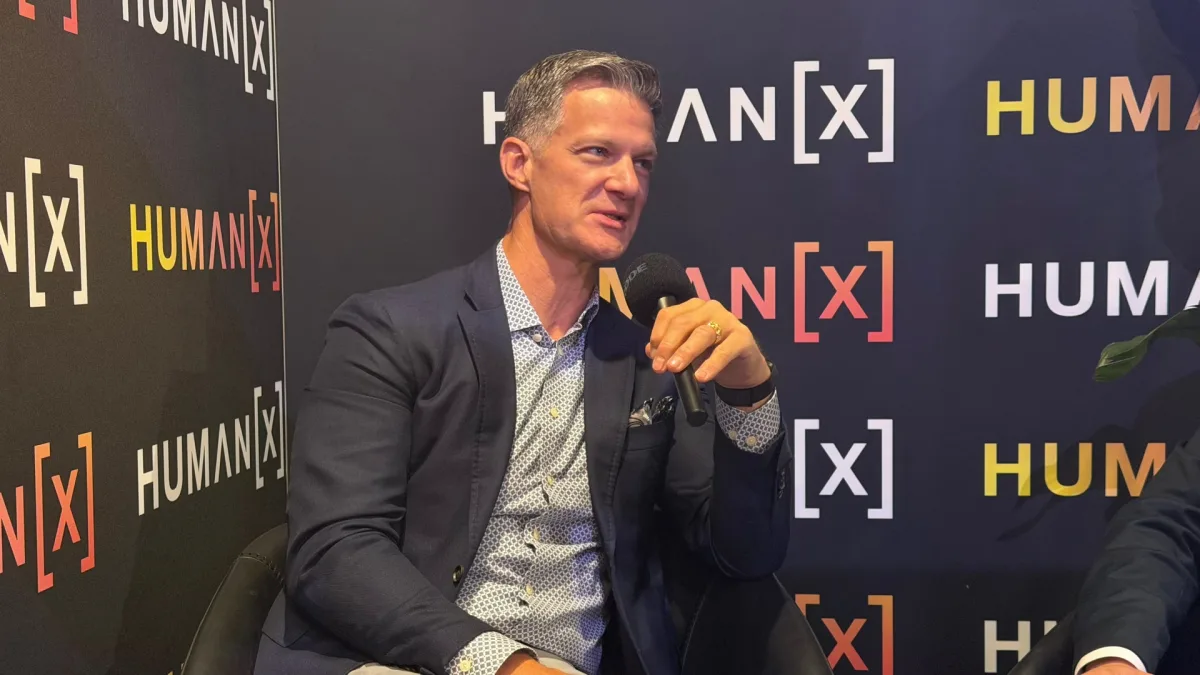
Steve Lucas, chairman and chief executive of Boomi, pushes back against predictions of widespread job losses from artificial intelligence. Speaking at HumanX in Amsterdam on 24 September, he outlined a more nuanced view of how transformative technologies reshape work rather than eliminate it.
The integration company is nearing $1 billion in annual recurring revenue, having tripled its top line during the four years since Lucas joined in 2022. The company's positioning in data infrastructure has made it a beneficiary of the trillion-dollar annual spending on AI systems. "AI needs data," Lucas explained, and Boomi's core business of connecting applications, databases and APIs sits squarely at the intersection of both.
Lucas brings decades of experience in enterprise software. He began his career at Microsoft, demonstrating Windows 3.1 and Office at trade shows while still a student. He later spent ten years at Business Objects and SAP, led Marketo before Adobe's acquisition, and ran iCIMS, a recruitment software platform. In April 2025, he published Digital Impact, examining the human dimensions of AI transformation.
AI in the Back Office
Within Boomi itself, artificial intelligence now handles roughly half of accounts payable reviews and decisions, though humans remain involved in the process. Finance functions such as accounts receivable are gradually shifting toward automation as well. However, Lucas cautioned that simply instructing staff to adopt AI tools yields limited results. Instead, organisations must identify concrete business problems where AI delivers genuine value, then expand from that foundation.
Boomi serves more than 30,000 companies through its integration, automation and AI offerings. The company's primary function remains helping organisations enable their disparate systems to communicate effectively.
The Productivity Paradox
Rather than fearing technological displacement, Lucas draws on historical precedent. Every major innovation—from assembly lines to robotics—has prompted humans to invent new categories of work. He has not experienced a slowdown in his own workload.
I think there's going to be 10 times more work before there's 10 times less work.
Steve Lucas, Boomi chief executive
He dismisses the narrative of a "SaaS apocalypse" as exaggerated. Since AI democratises software creation, he anticipates more applications entering the market over the next five years, not fewer. This expansion benefits Boomi's integration business. The typical large enterprise already operates more than 350 productivity applications—a number that will likely grow.
Don't you find it ironic that productivity software is called productivity software?
Steve Lucas
Data Quality and Agent Reality
Lucas identifies data as a critical bottleneck. Machine learning models perform only as well as their inputs allow, meaning data must be accessible, reliable and protected. Without these foundations, even sophisticated algorithms underperform.
He expresses scepticism about inflated claims regarding agents deployed in production environments. Genuine value emerges from agents that influence business decisions and generate measurable returns, not from systems built merely to satisfy industry hype.
Anyone can have millions of agents deployed if they do meaningless work.
Steve Lucas
On the question of artificial general intelligence, Lucas remains uncertain about the definition itself. By conventional measures, he argues the industry has already achieved it. A decade ago, he would have classified today's models from OpenAI or Anthropic as AGI. His personal benchmark is simpler: he will recognise true AGI when his own job becomes easier.
Integration as Life Necessity
Lucas has type 1 diabetes and relies on a glucose sensor worn on his arm and an insulin pump on his back. The seamless operation of these devices depends entirely on their integration—a reality that mirrors his professional focus. "My life depends on integration and it's also what I do for a job," he noted.
Boomi, founded just over two decades ago, takes its name from a Sanskrit term meaning earth. The company was built on the foundational principle that all things are fundamentally connected.
Building for Scale and Focus
Boomi employs between 2,200 and 2,300 people. Lucas aims to increase their productivity tenfold, effectively operating as a 10,000-person organisation. The company reaches customers through its own direct sales team and a network of more than 800 partners, who contribute 30 to 40 percent of total revenue.
Lucas identifies the discipline of saying no as his most difficult lesson. Upon arrival, the company had dozens of active projects. He eliminated roughly ten of them to maintain strategic focus on integration. Currently, Boomi faces intense pressure to move into AI infrastructure work, but Lucas insists on governance as the priority—monitoring AI systems, verifying their behaviour, and preparing for regulatory audits.
For students entering the field, Lucas recommends sustained investment in programming skills. Understanding sound architecture and grasping what AI actually does remain essential.
Curiosity will be the number one skill set coming out of university.
Steve Lucas
Source: The Next Web