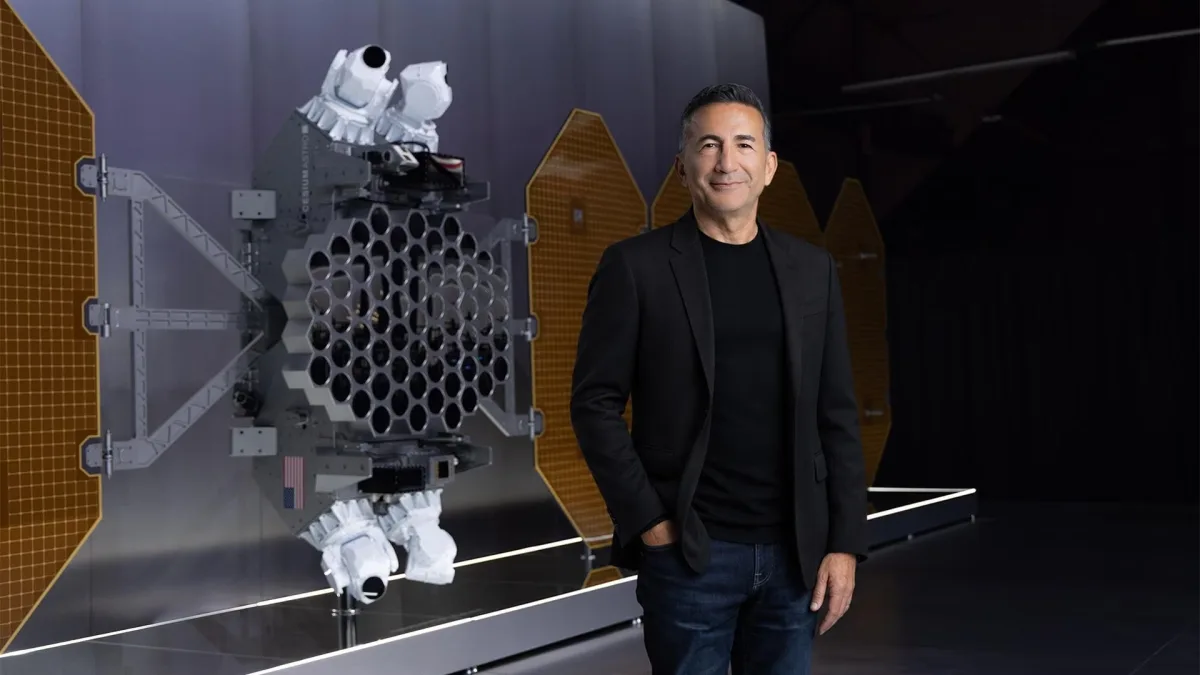
CesiumAstro, an Austin-based developer of satellites and space communications infrastructure, has secured $730M in Series D funding, pushing its valuation beyond $4.5bn. The company announced the round on Thursday, simultaneously revealing Synchronicity, an intended constellation of 737 satellites equipped with artificial intelligence, aimed at commercial, sovereign and defence customers.
Janus Henderson anchored the funding round, with participation from Insight Partners, Sands Capital, Sumitomo Corporation of Americas, Toyota's venture arm Woven Capital, Incharge Capital, Magnetar, AV and NewSpace Capital. The equity raise was accompanied by $100M in debt financing from the Export-Import Bank of the United States (EXIM) and JPMorgan.
CesiumAstro disclosed that it has brought in more than $1.2bn in fresh capital during the current year. According to Bloomberg, which first covered the funding announcement, the company's cumulative capital raised stands at $1.4bn.
With our technology proven on orbit, on the ground and in the air, a significantly expanded set of capabilities, and more than $1.2 billion in new capital raised this year, we are positioned to take the next major step in our growth
Shey Sabripour, CesiumAstro founder and chief executive
From antenna systems to operating its own network
The company's primary offering has traditionally been phased-array antennas designed for satellites. These systems emit directed beams of radio waves that operators can adjust to cover different terrestrial regions.
During 2024, CesiumAstro introduced Element, a satellite platform it manufactures and operates for customers. The inaugural unit, Element-1, launched in October aboard a SpaceX Falcon 9 rideshare flight and is currently operational. Eight spacecraft are planned in total, with launch slots already secured for the remaining seven.
Synchronicity represents a significant expansion: CesiumAstro will manage the entire constellation directly. The network will leverage Ku-, Ka- and V-band frequencies and perform onboard data processing. Artificial intelligence will oversee network operations and manage bandwidth allocation. According to Bloomberg, the constellation will function at two distinct altitudes within low Earth orbit. The company has not disclosed a launch schedule.
Three acquisitions completed over the past year support this vision. Jariet Technologies specializes in millimetre-wave radio chips. 1Aardvark develops mission software for defence applications, while Vidrovr creates AI systems for real-time signal processing.
We designed the silicon, the active phased array, the payload, processors, the spacecraft, ground terminals, and the network as one system
Shey Sabripour
Government demand for independent constellations
In conversations with Bloomberg, Sabripour emphasized that the company's client base encompasses both commercial enterprises and state actors seeking "sovereignty over their own constellation." Governments spanning from Canada to Europe are investing in independent satellite networks amid apprehension regarding Elon Musk's influence, Bloomberg reported. Europe's IRIS² network exemplifies this trend. Such concerns intensified following scrutiny of Starlink's involvement in the Ukraine conflict.
They're not necessarily competing with Starlink, but they don't want to be part of a proprietary system
Shey Sabripour, speaking to Bloomberg
SpaceX maintains market dominance with over 11,000 Starlink satellites already deployed. Amazon's Leo constellation, which recently achieved its 1,000th satellite, will ultimately comprise more than 3,000 units. Sabripour noted that CesiumAstro holds access to radio spectrum bands beyond those regulatory authorities granted to SpaceX and Amazon.
The company intends to invest $500M across five years in expanding its Austin headquarters, encompassing acquisition of roughly 25,000 square metres of manufacturing capacity. The expansion strategy targets 550 additional positions, bringing the Austin metropolitan workforce to over 1,000 by 2030. CesiumAstro maintains additional facilities in the United Kingdom, Germany, Switzerland, Taiwan, Singapore and Japan. This funding round follows Xona's $250M Series B for a low Earth orbit GPS alternative announced the previous month.
Source: The Next Web