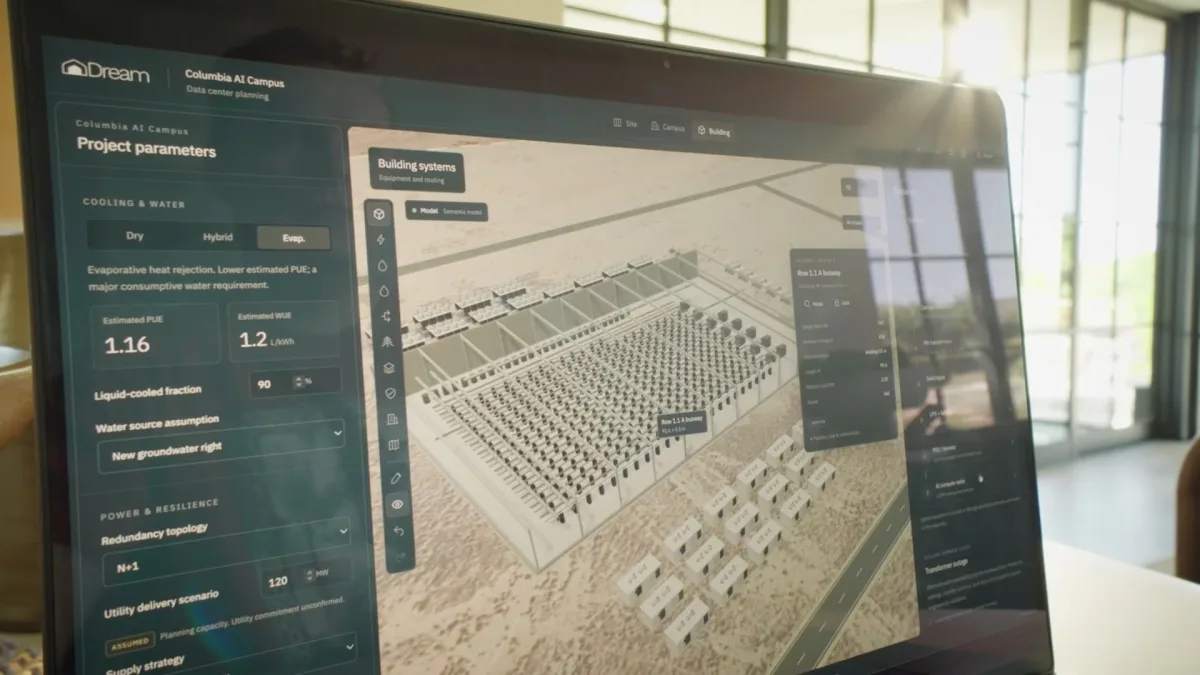
Dream, a San Francisco-based venture that leverages artificial intelligence for building design and engineering, announced its emergence from stealth mode on Thursday alongside a $17 million seed funding round. The investment was led by Andreessen Horowitz (a16z), with participation from SV Angel, XYZ, and Zigg Capital.
The startup is targeting the architecture, engineering, and construction sector, an industry historically resistant to digital transformation. Its initial efforts concentrate on commercial projects including retail spaces, office buildings, and data centre facilities.
Dream has developed what it terms built world models—artificial intelligence systems designed to comprehend physical environments and how building components interact, such as the path of mechanical systems through structural elements. These models have been trained using data from over 100 million square feet of actual, permitted buildings across the United States, encompassing commercial offices, residential apartments, and single-family homes. The company asserts that its outputs generate construction drawings with sufficient accuracy for contractors to execute directly from them.
The emphasis on accuracy stems from addressing the limitations inherent in large language models, particularly their tendency to generate inaccurate information. Andy Elder, one of Dream's co-founders, articulated this distinction: "A hallucination in an LLM is a typo. A hallucination in a building is a structural fault."
Elder and fellow co-founder Arjun Mathur both studied at Stanford and spent roughly ten years at Palantir. Elder previously oversaw the company's worldwide product design operations, while Mathur developed its manufacturing and supply chain division and played a role in establishing Skywise alongside Airbus.
Dream has already assumed the role of architect of record—the entity bearing legal responsibility for a design—across 10 projects spanning California and Texas. One undertaking, a residential property in Austin, has progressed through completion. Collectively, the company reports involvement in property developments valued at $20 million.
Dream enters a competitive landscape of startups integrating AI into the construction sector, alongside design platform Gendo and construction-focused Conxai. Broader enthusiasm for world models has also attracted substantial capital this year.
AI that can reason in three dimensions is the next frontier
Kimberly Tan, investing partner at a16z
Looking ahead, Dream envisions extending its models to additional three-dimensional design applications beyond the built environment.
Source: The Next Web