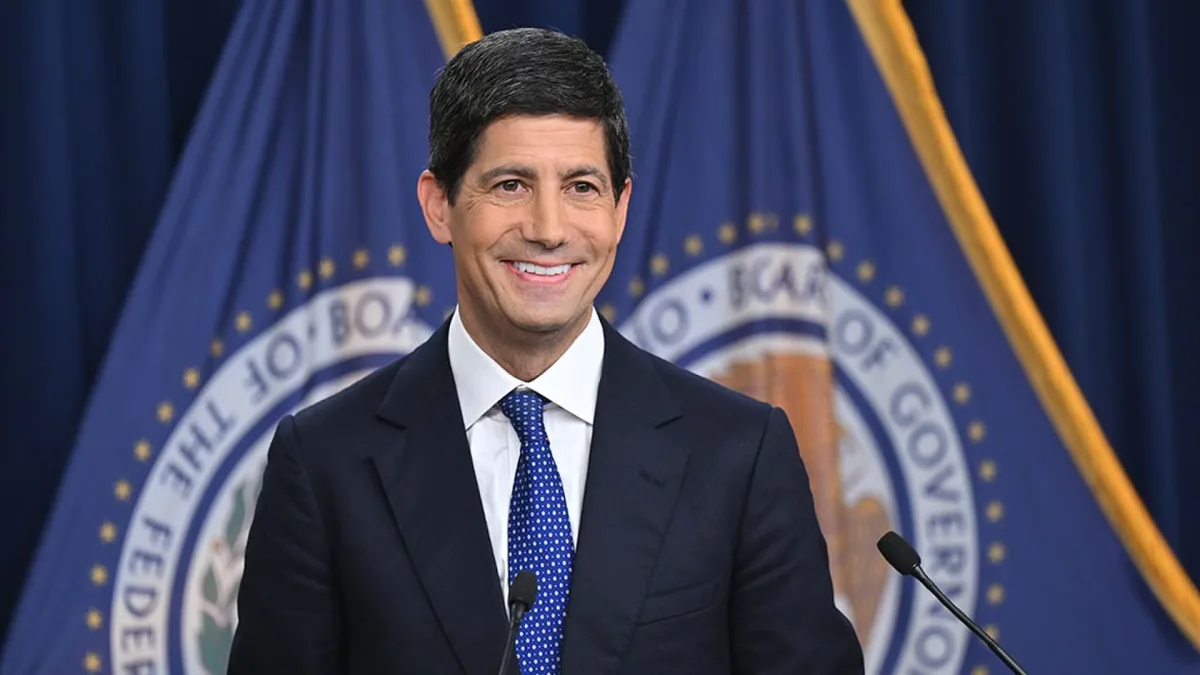
At the Federal Reserve's Productivity and Jobs Task Force Conference in San Francisco on Monday, chairman Kevin Warsh unveiled that the central bank's staff has begun constructing scenarios to model potential outcomes of AI's integration into the American economy. Warsh cautioned that these frameworks are illustrative rather than predictive. During a subsequent panel discussion, Palo Alto Networks CEO Nikesh Arora highlighted the urgency of what he termed a "technology rebuild moment" as organizations scramble to address emerging vulnerabilities.
Warsh emphasized a critical concern: artificial intelligence extends capabilities to malicious actors alongside legitimate users. He stated, "SI empowers all, including bad actors. So, we're thinking especially of critical infrastructures and their vulnerabilities." The chairman adopted the term "SI" for super intelligence, following the US government's adoption of this terminology through Trump's executive order. The Federal Reserve has made his prepared remarks publicly available.
Three pathways for the economy
The Board's staff constructed their analysis using stylized, model-based frameworks to generate scenarios. Warsh stressed these are illustrative tools rather than forecasts or predictions.
The first scenario envisions AI boosting productivity with gains distributed across both workers and capital owners. Real GDP would expand beyond its historical average, and the nation would maintain near-full employment conditions.
Under the second scenario, above-average growth persists, yet AI functions as a job displacing force rather than a complementary one. Labor market friction and automation would drive unemployment above full-employment thresholds.
The third scenario assumes AI underperforms expectations. Following substantial investment and equity market appreciation, anticipated returns could reverse, valuations might contract, and the economy could enter a slowdown accompanied by rising joblessness. Recovery would eventually occur, Warsh noted, though without the anticipated productivity improvements.
Warsh underscored a fundamental principle: "Humans are the designers and the builders, and humans must be the deciders." He refrained from discussing interest rate policy and did not address AI's potential inflationary effects, a notable omission given that several Federal Reserve officials have linked data center expansion to price pressures, as the Associated Press observed.
Security threats and workforce shifts
Warsh moderated a panel featuring Palo Alto Networks CEO Nikesh Arora, Stripe co-founder Patrick Collison, and Affirm CEO Max Levchin. When asked about cybersecurity concerns, Arora pointed to AI's newly acquired ability to identify vulnerabilities in code spanning five decades of software development.
Arora observed, "It's not that the hackers have become smarter. The technology has become so good even bad hackers have become okay." He noted that Mythos, released six months prior, has become accessible to most malicious actors through open-source implementations. External security services are overwhelmed, he explained, as organizations across sectors defend against intrusion attempts. He characterized the coming two to three years as a critical "technology rebuild moment."
Collison concurred with this assessment, citing how even the Linux TCP stack—among the most carefully examined software components—harbored numerous exploitable flaws. Levchin took a different view, characterizing the attackers' current advantage as temporary and predicting that more resilient software would eventually emerge.
Regarding employment effects, Levchin reported that Affirm's engineering workforce has achieved roughly five times greater productivity while maintaining "zero layoffs due to AI." Collison disclosed that Stripe is reducing hiring for administrative positions while expanding recruitment of engineers and sales professionals. He added that new businesses launching on Stripe each week have roughly doubled year-over-year.
Market reaction
Equity markets extended losses connected to AI sector concerns on Monday. The Nasdaq 100 fell nearly 3%, with selling intensity increasing in afternoon trading as investors digested Warsh's remarks, according to Business Insider. Nvidia is scheduled to release third-quarter earnings on Tuesday, while Anthropic plans to price its initial public offering on Wednesday.
Source: The Next Web