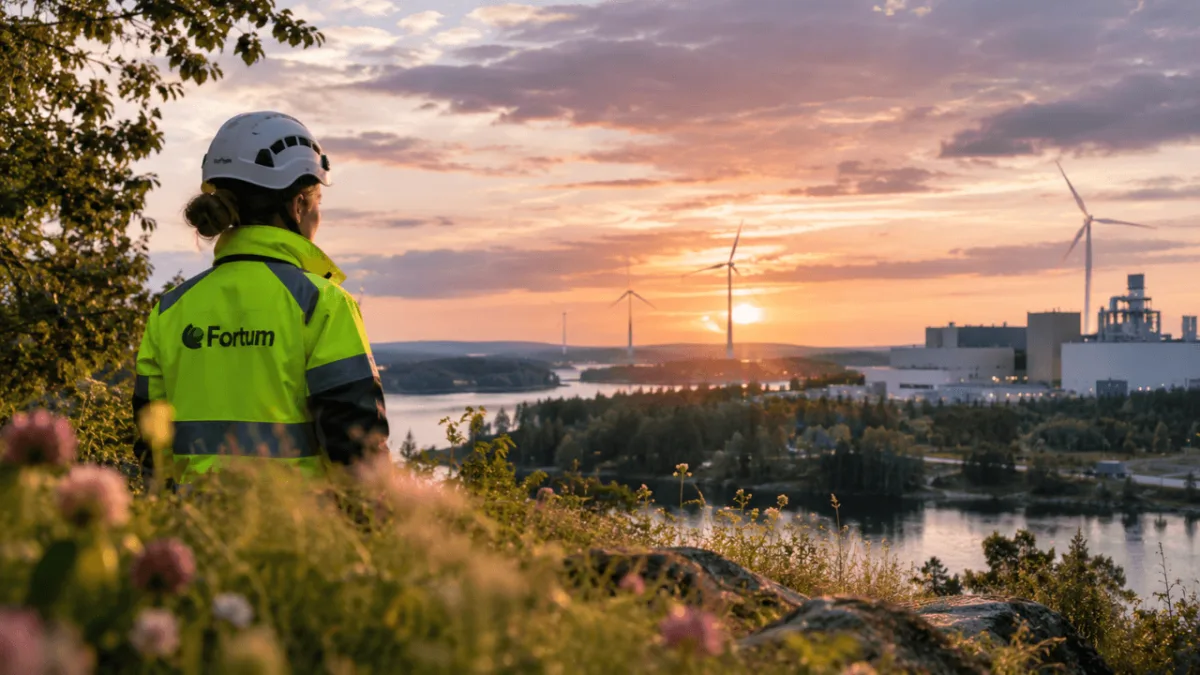
As power grids shift toward renewable sources and electrification accelerates across transport, heating and industry, utilities face mounting pressure to balance surging demand with the inherent volatility of wind and solar generation. For Fortum, one of the Nordic region's largest energy producers, this inflection point represents both a challenge and a chance to reimagine how the sector invests in and deploys emerging technologies.
We spoke with Gustav Eilertsen, VP of Innovation & Venturing, and Annemari Kirppu, Director of External Venturing, to understand how Fortum is reshaping its investment approach and why the company believes innovation must begin with customer needs rather than technological possibilities.
A €200 million portfolio spanning three investment models
Fortum's Innovation & Venturing arm has spent more than 15 years building relationships across the energy startup ecosystem. The division now manages approximately €200 million in capital, maintains stakes in roughly 80 companies across the Nordics, continental Europe and North America, and deploys tens of millions of euros each year through a team of 28 people based in Helsinki, Stockholm and Oslo.
The investment approach rests on three complementary pillars: direct investments in startups, partnerships with venture capital funds, and internal venture building. Direct investments typically range from €1 million to €5 million and focus on Series A and Series B stage companies. Recent commitments illustrate the breadth of Fortum's bets:
- Steady Energy, a Finnish developer of the LDR-50 small modular nuclear reactor designed for district heating, received €2.1 million from Fortum in January 2026 alongside a framework agreement to strengthen operating and maintenance capabilities, with potential expansion to nuclear heating plants in Finland and Sweden.
- Fifty Energy, a Swedish startup building AI-driven energy optimisation tools, works with Fortum both as an investor and commercial partner on Fortum Optimizer, an internally developed platform launched in 2024 that helps businesses manage electricity consumption amid market volatility.
- AskKauko, a Finnish startup behind ImpactOS, a supply chain sustainability and ESG reporting platform, received backing in November 2024.
- The portfolio also includes Hiven Energy (energy management software), Puro.earth (carbon removal marketplace) and Equilibrium Energy (US-based energy technology).
Three strategic pillars guiding investment decisions
Unlike traditional venture capital firms, Fortum's investment thesis is tightly aligned with its corporate mission. Despite recent turbulence, Eilertsen emphasises that the company's fundamental purpose has remained unchanged.
Our long-term aim, whatever happens and whatever turbulence there is, is to power a world where people, businesses, and nature thrive together. It's about making sure that society has enough fuel, basically energy, to do what it needs to do, and that we're able to create that in a way that is sustainable for both society and nature. That's the balancing act that goes on in many of our conversations internally.
Gustav Eilertsen
Fortum's strategy rests on three pillars. The first involves supplying reliable, clean and affordable electricity to customers and the broader Nordic energy system—a task more complex than it initially appears. Serving everyone from single households to advanced industrial customers like steel producers requires accommodating diverse and often competing needs.
We serve the full spectrum, all the way from a single household apartment to the most advanced industrial customers that exist out there. Whether you're a steel producer or another industrial player, we have that full spectrum within our reach.
Gustav Eilertsen
The second pillar focuses on helping customers eliminate fossil fuels from their operations—a goal that also strengthens Fortum's commercial position by expanding demand for its products and supporting long-term growth.
The third pillar centres on transformation and development, acknowledging that solving the energy transition's complexities demands new technologies, business models and operational approaches.
If we use the same medicine as in the past, we will get the same outcomes.
Gustav Eilertsen
With the majority of its generation already coming from clean sources, Fortum has sharpened its Innovation & Venturing focus to align more closely with these priorities.
Why have we sharpened our focus? It's to be clearer for ourselves, but also for the outside world, about what people can expect when they talk with us.
Gustav Eilertsen
Three investment areas beyond electricity generation
Translating corporate objectives into investment decisions requires looking beyond power production itself. Fortum's refreshed strategy targets three interconnected domains:
- Solutions for the future energy system
- Digitalisation and intelligent operations
- Customer decarbonisation
The first category spans the entire energy value chain, from generation and storage through trading, distribution and consumption. This encompasses novel approaches to producing, storing and trading electricity, as well as new methods for transporting it. It also extends to technologies deployed at customer sites that help businesses decarbonise industrial processes, shift electricity consumption to periods of lower demand and reimagine their operations.
The second priority reflects the growing maturity of artificial intelligence and data-driven technologies and their capacity to enhance efficiency across energy systems.
There have never been more opportunities within that space, now that AI and data have evolved and shown themselves in practical ways. But, yet again, it needs real use cases. Where can it actually happen? How can we reduce friction in the overall value chain?
Gustav Eilertsen
The third priority, customer decarbonisation, underpins Fortum's broader innovation philosophy. This means anticipating customer needs before they fully recognise them and identifying technologies that address emerging challenges while ensuring the energy system can respond effectively.
We try all the time to force ourselves to start with the customer.
Gustav Eilertsen
However, Eilertsen cautions against narrowing customer decarbonisation to heavy industry alone. Residential customers matter equally, particularly as transport and heating electrification spreads across Europe. Norway's electric vehicle adoption—now exceeding 90 per cent of new car sales—demonstrates how rapidly consumer-led decarbonisation can unfold. Residential heating presents another major opportunity, as many European households still rely on natural gas, heating oil and other fossil fuels despite the availability of heat pump technology.
It's not something that we do on the side. It's something we're driving. It's embedded. This makes sense in the long haul if we're going to be a relevant player in the ecosystem. That's why we exist, in a sense.
Gustav Eilertsen
The convergence of two system-wide challenges
Fortum's strategic refresh reflects a fundamental shift in electricity generation and consumption patterns. Growing reliance on intermittent renewables coincides with surging demand from transport electrification, heating decarbonisation and industrial processes. For Kirppu, this creates an urgent need to identify technologies addressing both challenges simultaneously.
That's why, especially as I see it, this is a really critical time for us as an energy company to be on the lookout for what the future is going to look like. How do we solve these two huge, system-wide challenges? At Fortum, we employ the best technology, so we need to be on the lookout for startups who are developing new technologies, things that could be really disruptive and really change the landscape.
Annemari Kirppu
Investment priorities include technologies delivering stable, low-carbon baseload power, particularly small modular nuclear reactors. Energy storage—especially long-duration storage and alternative battery chemistries like flow batteries—ranks high as a means to balance intermittent renewable generation. Flexibility solutions enabling customers to optimise consumption in response to renewable fluctuations and shift demand to periods of greater availability are equally important. Technologies accelerating electrification itself, particularly in industrial applications still dependent on fossil fuels, also attract Fortum's attention.
Rising demand reshapes the innovation landscape
New sources of electricity demand are transforming the commercial environment for energy innovation. Eilertsen points to a significant shift in market dynamics.
There are now, for the first time, at least in the Nordics, real signs that demand is picking up. That's something that's a bit different from earlier.
Gustav Eilertsen
Industrial customers, hyperscalers and neocloud providers, combined with transport electrification, are creating fresh demand for energy solutions. This emerging market dynamic is reshaping customer behaviour.
Against that backdrop, you have customer demand for new solutions, and they're willing to try new technologies to make that happen and meet it.
Gustav Eilertsen
This shift is driving renewed momentum in energy innovation, including AI-powered grid optimisation and accelerated electricity access. For data centre operators, speed to power has become a critical competitive advantage.
Time to power is one of the most important things right now to be competitive and drive the AI boom we're currently living through.
Gustav Eilertsen
Rising demand is also changing customer willingness to pay. Energy has shifted from abundance to scarcity, making customers more receptive to paying premium prices for reliable, clean power when they need it.
We're living in a period where energy is becoming more of a scarce resource than it was not that long ago. That means customers are willing to pay for reliable, clean energy when they need it.
Gustav Eilertsen
Simultaneously, the rapid expansion of renewable capacity over the past three years has introduced greater volatility into electricity markets, creating headaches for both customers and system operators.
No one really likes that, in the sense that you have really cheap electricity one day, and then you have really high prices another day.
Gustav Eilertsen
For Eilertsen, these market shifts reinforce why understanding customer needs must precede technology selection.
I think that's why it's so important to have the customer lens on when we talk about energy. It shouldn't start with the technology, which historically, in an industry like ours, if you think from a utility point of view, is usually where we begin.
Gustav Eilertsen
Geopolitics reshapes the investment calculus
Beyond rising electricity demand, geopolitical pressures are reframing the rationale for clean energy investment. Eilertsen argues that defence and energy security are no longer separate considerations.
When you ask about defence and security of supply and those types of things, I don't think it's an either-or question anymore.
Gustav Eilertsen
For Eilertsen, regional access to clean energy is essential to Europe's long-term resilience.
If we don't have access to this close to home, or if we don't have renewable solutions, this will be a challenge for us as a society.
Gustav Eilertsen
He also observes growing willingness among energy producers, customers and regulators to collaborate on solutions balancing technological feasibility with commercial viability.
I think this dialogue now is picking up more and more, and people are willing to meet and figure out good solutions when you sit across the table from each other.
Gustav Eilertsen
Industrial heat: approaching commercial viability
Industrial heat decarbonisation represents one area where shifting energy economics is creating fresh investment opportunities. For Kirppu, the challenge is not insufficient demand but the scarcity of commercially viable solutions. With corporate climate targets drawing closer and many industrial processes still powered by fossil fuels, pressure to find economically feasible alternatives is mounting.
In order to fulfil and meet all the targets, which are now looming closer and closer, getting to 2030 and 2035, we have a lot of these climate targets that have been set and ambitions, but no one really has a way to actually get there in an economically feasible or manageable way.
Annemari Kirppu
However, shifting fossil fuel prices could accelerate adoption of alternative technologies.
That will need to happen, and we're already seeing it start to move. Especially with fossil fuel prices, oil prices and gas prices going up, the economics are actually starting to click into place, and then it will start to really accelerate.
Annemari Kirppu
Build, invest or partner: the decision framework
Identifying promising technology areas is just the beginning. Fortum must then decide whether to invest in an existing startup, establish a commercial partnership or develop capabilities internally. The process begins with priority areas such as nuclear fusion, vehicle-to-grid solutions and industrial heat pumps. The team then assesses the market to evaluate technological maturity, existing solutions and potential gaps.
If we find that there are plenty of really good startups that have come far and have developed some good technologies, then, of course, it doesn't make sense for us to start building something similar in-house.
Annemari Kirppu
When Fortum identifies market gaps, it evaluates whether its existing assets and capabilities provide a competitive edge. Fortum Charge & Drive, an EV charging network that originated as an internally incubated venture in the 2010s, exemplifies this approach, positioning the company as an early mover in electric mobility before mainstream adoption.
Fortum's venture capital fund partnerships include Valo Ventures (established 2018), Energy Impact Partners (2020) and, most recently, Norrsken Evolve. These relationships provide exposure to earlier-stage companies, international markets like the US, and adjacent technologies including AI. Kirppu emphasises that value extends beyond financial returns.
We really see all the funds as our partners. It's not just about a single fund investment from a financial perspective, which is part of it; the broader context is that we partner and build relationships.
Annemari Kirppu
These partnerships allow Fortum to combine its industry expertise with investors' insights into emerging technologies and capital flows.
We can share thoughts and perspectives on what's happening in the energy market from a corporate perspective, but also from a VC investor's perspective. How do they see where the funding is flowing and so forth?
Annemari Kirppu
Patient capital for capital-intensive ventures
Energy technology innovation often involves lengthy development cycles, substantial capital requirements and intricate commercialisation paths. Fortum's structure provides advantages that traditional venture funds lack.
Of course, we're not in the typical fund structure, so we can be a bit more patient with capital.
Annemari Kirppu
As an established energy producer familiar with large infrastructure projects, Fortum can support capital-intensive investments when a clear path to joint value creation exists.
We can lean into some CapEx-heavy investments if we see that there is a clear link and path towards creating joint value.
Annemari Kirppu
Beyond capital, Fortum offers startups access to decades of operational expertise, energy trading capabilities, infrastructure, industrial customer networks and opportunities to validate technologies in real-world settings.
User experience as a competitive differentiator
Behind the increasingly sophisticated technologies managing the energy transition lies an equally crucial dimension: user experience.
No one wants to have 10,000 different apps and manage these systems. Everyone just wants to have electricity.
Annemari Kirppu
Kirppu anticipates greater consolidation across the energy technology market, creating an opportunity for Fortum to become a unified provider for customers' energy requirements. What remains clear is that energy innovation has transcended the energy sector itself. As electricity access increasingly determines where companies can establish operations, expand and compete, utilities will play a far more significant role in shaping Europe's next generation of industries.
Source: Tech.eu