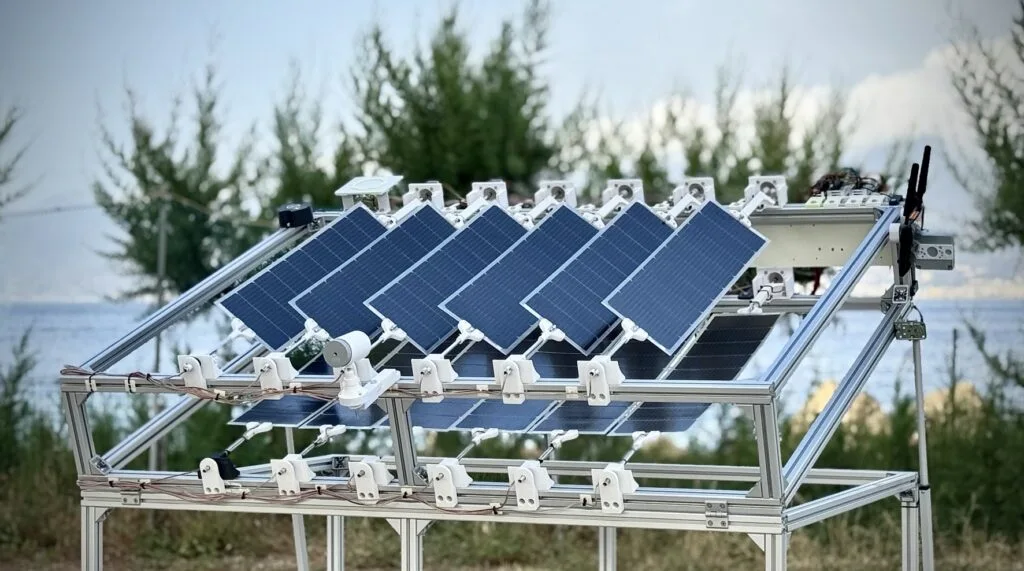
The push toward renewable energy deployment worldwide has created an urgent problem for solar engineers: extracting greater power output without requiring additional land. This spatial constraint has prompted Cosimo Borrello and Ferdinando Gioia, who lead the Italian photovoltaic technology company A.M.P.S., to collaborate with researchers at the "Mediterranea" University of Reggio Calabria on a novel approach. Their work centers on a prototype featuring two photovoltaic layers stacked vertically, engineered to maximize electrical generation across a single ground footprint.
Addressing the land-use problem
Traditional solar installations with single-layer arrays demand substantial gaps between rows to prevent upper panels from casting shadows during solar tracking operations. Although tracking mechanisms boost per-module output, this spacing requirement cuts into the total energy harvested per unit area. The A.M.P.S. team tackled this by positioning two layers of bifacial solar mini-modules vertically within the footprint normally occupied by one layer alone. Rather than accepting the shadowing that naturally occurs between layers, they equipped each layer with its own solar tracking system. This independent motion control allows the setup to continuously reposition both layers to minimize mutual shading while simultaneously collecting direct sunlight, scattered light, and reflected radiation on all active surfaces.
The Arduino GIGA R1 WiFi at the system's core
The experimental installation in Reggio Calabria relies on an Arduino GIGA R1 WiFi board mounted on a purpose-built control circuit board. This single device orchestrates the entire system's operation:
- Coordinating twelve Nema23 stepper motors through DM542T drivers to independently rotate twelve bifacial mini-modules positioned across both layers
- Gathering instantaneous current data from twelve INA260 sensors connected to each module to monitor power generation
- Processing synchronized current measurements and transmitting experimental results to a remote server for further study
Cosimo explained the selection rationale: "We chose the GIGA R1 WiFi because it brings together everything a prototype like ours needs, with lots of I/O, a fast dual-core microcontroller and built-in Wi-Fi on a single board. We had to drive twelve stepper motors independently, read twelve limit switches and twelve current sensors, and send the data to a remote server, and very few boards can handle all of that on their own. Having used an Arduino Mega board in many past projects, GIGA R1 was the natural next step, with the same familiar format and far more power and connectivity. It gave us a reliable control platform quickly, so we could focus on the photovoltaic research rather than on the electronics."
Performance outcomes and potential uses
Testing conducted under clear skies, with the upper layer following the sun's path and the lower layer remaining stationary, revealed substantial gains in short-circuit current—a proxy measurement distinct from overall energy production—when compared to a fixed single-layer system occupying identical ground space:
- Approximately +42% improvement versus a monofacial single-layer setup
- Approximately +27% improvement versus a bifacial single-layer setup
- Approximately +39% and +25% respectively using a simplified open-loop tracking approach based on a five-parameter sigmoid function, which the team reported aligned closely with closed-loop control outcomes
The research team sees multiple deployment scenarios for this technology, spanning from space-efficient rooftop installations in densely built urban areas to large-scale commercial solar farms and agrivoltaic systems. In farming applications, the independent motion of both layers could enable operators to regulate the quantity of natural light reaching crops below, though such applications were not part of the current field evaluation.
By furnishing a dependable control framework, the Arduino GIGA R1 WiFi enabled rapid progression from initial design through real-world testing—illustrating the capacity of open-source hardware platforms to accelerate research in sustainable energy and land optimization.
Source: Arduino Blog