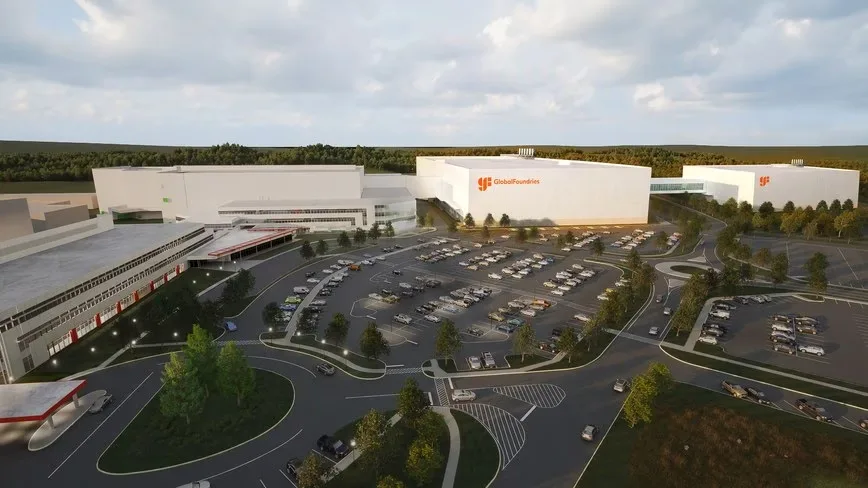
GlobalFoundries announced on 14 October that Japan will invest up to $21bn into two new semiconductor manufacturing facilities at its Malta, New York location. The chipmaker will serve as both technology provider and operator for both plants. This funding stems from Japan's $550bn investment commitment to the United States, negotiated as part of its trade arrangement with the Trump administration.
Under a separate arrangement, the US Commerce Department will acquire approximately 4% of GlobalFoundries' equity. According to CEO Tim Breen, speaking to Reuters, the government's overall stake in the company will expand from 3% to 7%. Reuters also reported that the US government and Japanese interests will jointly own the manufacturing facilities themselves. The talks had been previously disclosed by Nikkei in September.
Right now, the whole industry is in short supply
GlobalFoundries CEO Tim Breen, speaking to Bloomberg
Phased construction and market conditions
Approximately $10bn will accelerate the construction of the first 300mm fabrication plant, scheduled to become operational in 2029, according to GlobalFoundries. A second facility would receive roughly another $10bn in funding. The company plans to begin ground-breaking on the initial fab before the end of this year. Reuters reported that executives informed investors the partners will make a final decision on the second facility before the conclusion of 2028.
Of course, it will be market-dependent. We're not going to do it if the market isn't there, but every indicator I see today is flashing green around market demand.
Tim Breen, speaking to Bloomberg
Each fabrication facility would contribute approximately 900,000 300mm wafers annually to US production capacity. GlobalFoundries projects the initiative will generate roughly 27,000 jobs in construction and related sectors, along with more than 1,000 manufacturing positions. The facilities will produce semiconductors for automotive applications, industrial equipment and telecommunications infrastructure. Breen indicated to Reuters that Renesas and Apple are among the early customers.
Financial terms for GlobalFoundries
GlobalFoundries will receive fees from the arrangement for a minimum of 20 years, as disclosed by company executives during an investor presentation reported by Reuters. These fees are anticipated to generate $50m in the coming year as GlobalFoundries oversees construction of the first plant. Bloomberg reported that the company expects approximately $3bn in adjusted free cash flow from the transaction over a decade.
Additionally, GlobalFoundries will redirect $955m from its existing CHIPS Act funding toward silicon photonics, silicon-germanium technology and advanced packaging capabilities. This allocation will support operations at its Malta facility and its Burlington, Vermont location.
President Donald Trump stated on Truth Social that the government's 7% stake carries a value exceeding $2bn, according to Reuters. The government had previously awarded GlobalFoundries $1.63bn in grants. The administration also maintains an equity position in Intel, which was established by converting CHIPS Act grants into ownership stakes. Bloomberg noted that Abu Dhabi's sovereign wealth fund Mubadala controls nearly three-quarters of GlobalFoundries.
Japan's investment framework
Under the bilateral framework, the Trump administration selects which projects to pursue, while Japan retains the option to reject initiatives that lack commercial feasibility, according to Bloomberg. Washington will receive 90% of profits once Japan recovers its principal investment and interest payments. Japanese Trade Minister Ryosei Akazawa addressed concerns that the arrangement subordinates Japan to US interests, Reuters reported, emphasizing that projects undergo thorough bilateral evaluation processes.
In the competition surrounding AI, they say that the ability to supply electricity and semiconductors will determine the outcome
Japanese Trade Minister Ryosei Akazawa, speaking to reporters in Tokyo, according to Bloomberg
Source: The Next Web