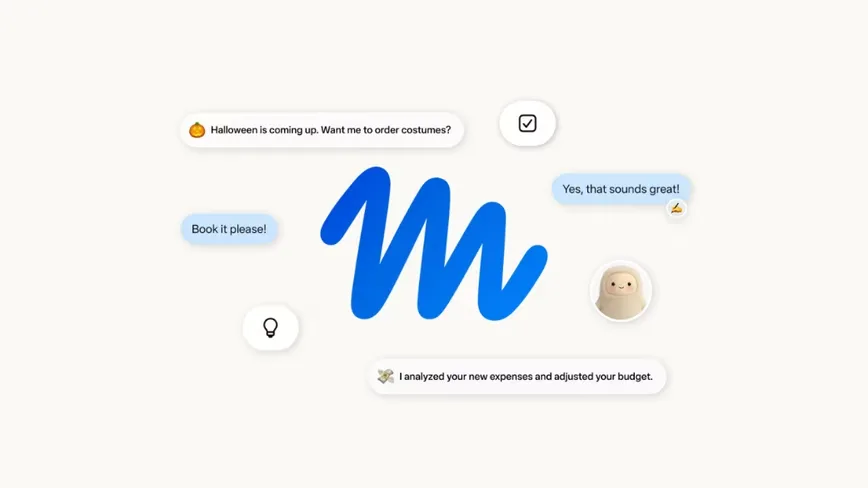
Meta has introduced live voice capabilities to Muse, enabling users to converse with the personal AI agent through speech rather than text input. The rollout includes an animated avatar that displays facial expressions and gestures synchronized with the conversation's emotional tone.
The voice feature is now accessible through the Muse app on mobile devices, web browsers and Mac computers, though availability is currently limited to the United States. Initiating a voice session requires tapping the phone icon positioned in the app's upper-right corner.
During conversations, users maintain full control—they can interrupt Muse at any moment and receive immediate responses. The agent continues processing tasks in the background while users engage in dialogue, such as when taking a walk or multitasking.
The accompanying avatar demonstrates dynamic reactions, including facial expressions and body language that reflect the conversation's context. The avatar responds in real time even while the user is speaking.
Customization options allow users to adjust their experience. They can opt for voice-only interaction, display the avatar alongside the conversation transcript, or expand it to full-screen view. A library of hundreds of voice options with distinct personalities is available, with the ability to switch between them instantly.
During its Connect conference, Meta announced that users would gain the ability to customize voices through natural language descriptions, requesting modifications such as altered speed or accent.
Meta positions the feature as useful for several activities: generating creative ideas, organizing travel plans, rehearsing job interviews, and preparing presentations.
The avatar technology powering these interactions is Muse Realtime Avatar, developed by Meta Superintelligence Labs, the company's primary AI research division. Meta first demonstrated this technology at its September Connect conference.
In evaluations conducted by Meta's internal raters, the company's avatars outperformed comparable offerings from competitors Runway and HeyGen. Meta acknowledged, however, that certain public demonstrations may not accurately represent the avatars currently deployed in the application.
Muse itself debuted in September as Meta's competitive response to AI agents including ChatGPT. The assistant operates on the Muse Spark family of models, introduced by Meta in April, and already supports shopping through retailers, email composition, and Mac application control.
This launch reflects Meta's substantial investment in artificial intelligence infrastructure, exemplified by projects such as the Hyperion data centre facility in Louisiana.
Voice functionality will eventually extend to Meta's AI-enabled glasses and Muse Charm, a compact clip-on device unveiled at Connect. The company has not announced specific timelines for these deployments.
Source: The Next Web