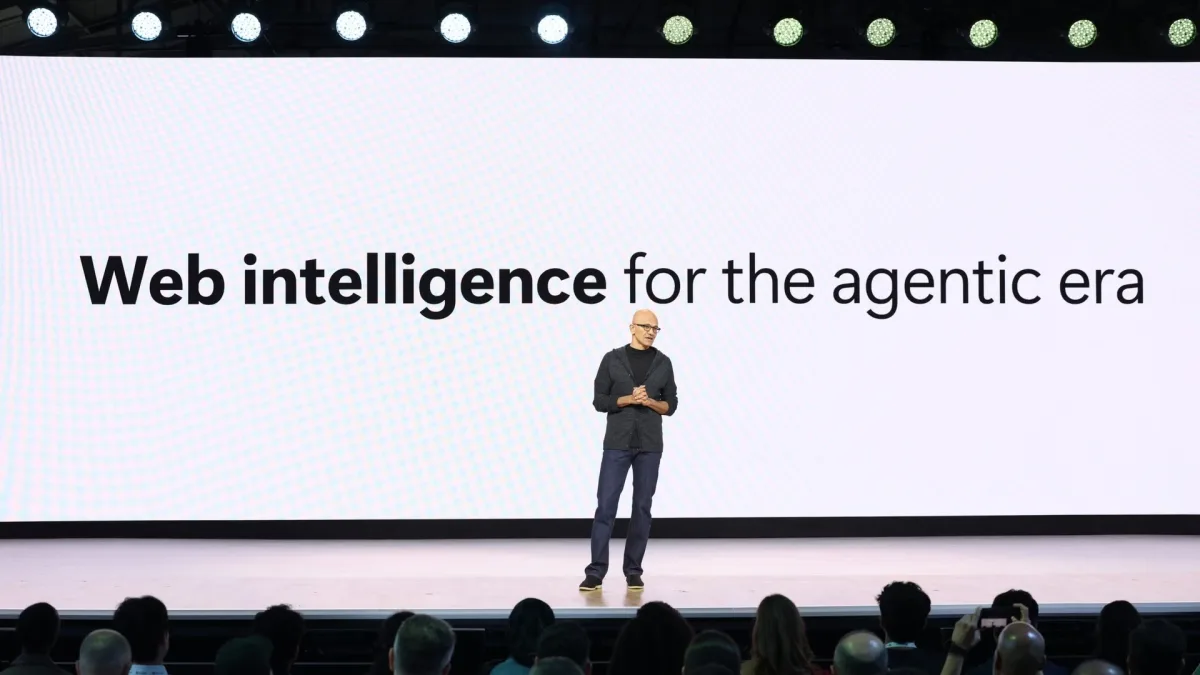
During an appearance on The Pragmatic Engineer podcast, Satya Nadella reflected on how Anthropic's Claude Code disrupted Microsoft's expectations around developer tooling. Speaking with former Microsoft engineer Gergely Orosz in Redmond, Nadella discussed the rapid shift away from traditional code editors toward command-line interfaces, as well as broader questions about workforce strategy and AI verification.
'AI-first product building is unforgiving'
When Orosz pressed Nadella on why Microsoft—despite owning GitHub Copilot and VS Code—lacked an immediate response to Claude Code's 2025 launch, Nadella traced the company's initial positioning. Copilot started as a code-completion tool, he explained, and Cursor later introduced a capable agent mode that Microsoft subsequently replicated. But the underlying technology shift proved harder to anticipate.
The thing that hit us was obviously the great work that Anthropic did with their model, which then truly made the CLI the form factor
Satya Nadella
Within roughly half a year, the traditional IDE "kind of faded away," Nadella told Orosz. He attributed this to the nonlinear nature of model improvements, which force rapid changes in how software gets built and used.
When model jumps happen nonlinearly, the form factor has to change quickly. AI-first product building in that sense is unforgiving. Don't be in love with what you built.
Satya Nadella
Looking ahead, Nadella suggested the IDE might stage a return if developers begin embedding decision models directly into their applications. He likened these models to stored procedures, a foundational concept in the intelligence era.
Voluntary exits and junior hiring
Orosz asked whether Microsoft's voluntary exit programme signalled impending mass layoffs. Nadella sidestepped a direct answer but framed the initiative as an effort to give employees greater control over their careers. The programme allows people to pursue roles that align with their long-term financial interests, he said.
If you're in a team where you feel stuck professionally, you can vote with your feet. I wish I could just sit here and say it'll all be the same. I cannot.
Satya Nadella
Many opportunities exist elsewhere within Microsoft itself, Nadella noted. He acknowledged that not all divisions have fully embraced the company's transformation agenda. Across Microsoft's workforce of 200,000 people, team structures and operational patterns will shift. Forward-deployed engineers represent one of the company's fastest-expanding job categories.
Regarding early-career hiring, Nadella said teams must first reorganise and establish their new "software factories" before bringing on recent graduates. He cautioned against drawing firm conclusions from the current slowdown in junior recruitment, calling such assessments premature. Microsoft has partnered with Carnegie Mellon University on a mentoring initiative called PRAISE to support engineers at the start of their careers.
Verification is the hard part
In a world where code generation has become cheap, what has become hard is verification
Satya Nadella
Nadella highlighted a critical challenge: models trained to review code can harbour alignment issues. His preference is cross-model verification, where one model family checks the work of another. He also advocated for production traces to feed back into a verification loop—a practice he termed his "RSI."
Companies should treat AI agents as potential insider threats, Nadella cautioned. While models grow more capable, they do not necessarily become more trustworthy—a concern he had raised previously on the 20VC podcast. He called for audited, tamper-proof logs documenting how agents reason through decisions.
Nadella also urged organisations to keep agent software, memory, and models architecturally separate to avoid vendor lock-in. His litmus test: a firm should be able to swap any model while still improving performance on its internal benchmarks.
If you can't do that, then you have to ask yourself how are you a sovereign firm
Satya Nadella
Unmetered intelligence on the PC
Nadella noted that frontier models from the previous year can now run on laptops, while last quarter's models fit on desktops. He expects routers like GitHub Copilot Fusion to intelligently distribute workloads—sending some tasks to local models and others to cloud infrastructure. This hybrid approach, he said, marks the beginning of a "hybrid intelligence era," with local models providing what he calls "unmetered intelligence."
For engineers, Nadella's advice was straightforward: spend less time consuming AI content and more time building with it.
If I could change the ratio of my talk to do, I would do it. This is the time
Satya Nadella
Source: The Next Web