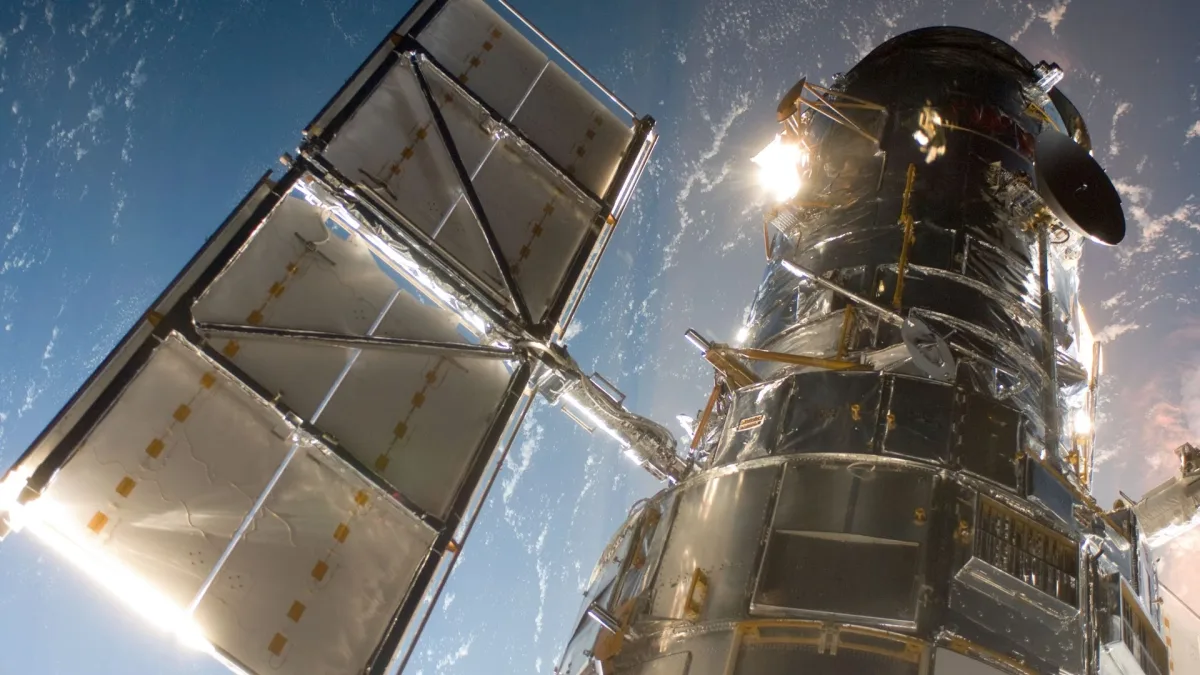
With the Hubble Space Telescope gradually losing altitude and facing re-entry within the next decade, NASA has turned to the commercial space industry for solutions. The agency issued a call for proposals on 29 October, seeking responses by 30 November from companies willing to undertake a rescue mission before 2032—ahead of Hubble's predicted plunge in 2033 or 2034. The 36-year-old observatory lacks its own propulsion system and continues to sink through the atmosphere, making intervention increasingly urgent.
NASA's request comes as the smaller Swift observatory faces imminent destruction. Swift's science operations ended on 20 October, and the space agency now expects the telescope to re-enter Earth's atmosphere within days. The agency had contracted startup Katalyst Space to retrieve Swift and raise it to a higher orbit, but the rescue robot encountered technical difficulties and never reached its target. Most of Swift will burn up during re-entry, though some dense components including tungsten parts and mirror segments may survive the descent.
If there are innovative and cost-effective ways to extend the life of an asset already on orbit, we owe it to the American taxpayer and the scientific community to explore them.
Jared Isaacman, NASA Administrator
Three paths forward for Hubble
NASA's request for information outlines three distinct approaches that commercial operators might pursue. Companies could elevate Hubble to a higher orbital altitude, perform maintenance and upgrades to enhance its capabilities, or execute a controlled deorbit to bring it down safely. Any altitude boost must lift the telescope to at least 600 km without causing damage to the instrument. Participating companies would be responsible for providing the launch vehicle, the servicing spacecraft, mission operations, and crew if required.
Currently orbiting at approximately 470 km, Hubble last received an altitude boost during Space Shuttle Columbia's final servicing mission in 2002, when it was raised to 583 km. NASA's statistical models indicate a 10 percent probability of re-entry by September 2032, climbing to 50 percent by December 2033. Given Hubble's substantial mass, an uncontrolled re-entry poses a modest but real risk to populated areas below.
Notably, NASA has not committed to funding any mission and currently has no budget allocated for such an undertaking. The agency is essentially seeking to understand what options exist in the commercial marketplace rather than guaranteeing a contract.
History of rescue attempts
This is not NASA's first attempt to explore commercial solutions for Hubble's predicament. In 2022, when Isaacman was still a private astronaut, he offered to finance most of a crewed servicing mission using SpaceX's Dragon spacecraft. That same year, NASA solicited industry proposals and received eight responses. However, by 2024, the agency decided against pursuing a reboost at that time.
A crewed mission appears less feasible now than it did two years ago. SpaceX intends to retire its Crew Dragon vehicle by 2030, and NASA has already shifted its astronaut transportation contracts toward Boeing. Isaacman believes the current request will attract attention from robotics specialists and companies developing in-orbit servicing capabilities. Several emerging ventures are already securing funding to build hardware for orbital refueling and maintenance operations.
Hubble's unique advantages
Unlike Swift, Hubble possesses a significant structural advantage that could facilitate rescue efforts. During the final crewed servicing mission in 2009, astronauts installed a soft-capture mechanism designed to simplify docking procedures for future spacecraft. This feature may prove instrumental in enabling either a robotic or crewed approach to servicing or repositioning the telescope.
The scientific community has strong incentives to preserve Hubble's operational life. No successor instrument offering comparable capabilities in visible and ultraviolet wavelengths is expected to launch before NASA's Habitable Worlds Observatory arrives in the 2040s, leaving a significant gap in observational astronomy if Hubble falls silent.
Source: The Next Web