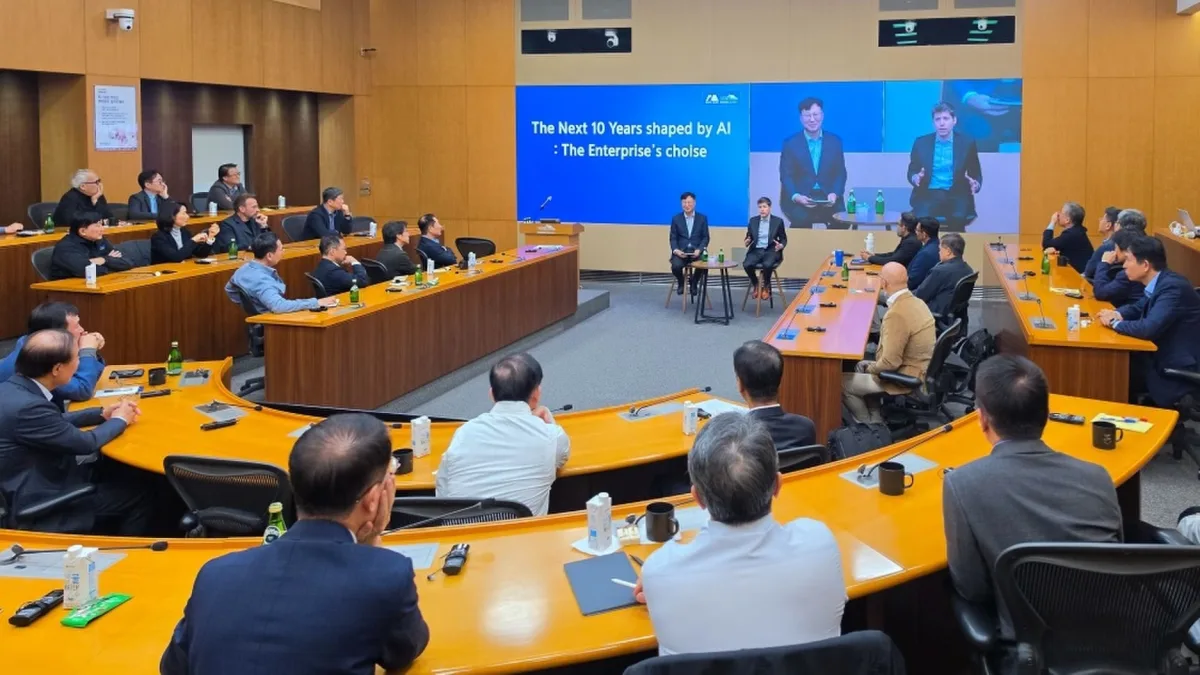
Samsung Electronics brought OpenAI chief executive Sam Altman to its training centre in Yongin, south of Seoul, on Saturday for discussions with approximately 50 of the company's presidents. The gathering came two days after Altman appeared on a podcast to argue that storing memory chips in individual computers represents wasteful use of the world's limited DRAM supply.
The presidents attending represented Samsung's electronics, finance and biotech divisions. Samsung disclosed the event through its Korean newsroom but did not reveal specific remarks made during the session or identify the executives present.
Focus of the Samsung meeting
The gathering centred on artificial intelligence's anticipated transformation of business over the coming decade and the strategic choices companies must make in response. Participants examined emerging AI technologies, their practical applications, and the commercial possibilities they might unlock.
Discussion also covered how AI will reshape organisational decision-making and operations, along with the competencies managers will require in this evolving landscape. Samsung framed the event as part of its executive development programme, grounded in the belief that organisational success in the AI era depends on leadership quality and operational execution.
Before the Altman session, the presidents completed a hands-on generative AI course—their second such training after participating in one during June. Participants used AI tools to organise scattered management documents into structured knowledge systems and practised applying AI to business decisions.
According to Bloomberg's reporting, Altman joins a growing list of American technology executives visiting South Korea. Nvidia's Jensen Huang and AMD's Lisa Su have each made two trips to the region since the previous year to reinforce supply chain relationships.
Samsung and OpenAI's expanding partnership
Samsung Electronics and OpenAI formalised their collaboration through a letter of intent focused on AI infrastructure in October 2025. Following this agreement, Samsung has been providing memory chips destined for OpenAI's Stargate data centre initiative.
The partnership extends beyond chip supply. Samsung SDS will collaborate with OpenAI on building and operating AI data centres and delivering AI services to enterprise clients. Additionally, Samsung C&T and Samsung Heavy Industries are jointly developing floating data centre facilities with OpenAI. Samsung Electronics chairman Lee Jae-yong visited OpenAI's San Francisco office in July, the company noted.
In June, OpenAI announced that Samsung Electronics would deploy ChatGPT Enterprise and Codex across its South Korean operations and its global Device eXperience division.
Samsung has been integrating AI across research, manufacturing, marketing and customer support functions since June. The company has established dedicated AI teams within each business unit. To date, approximately 2,300 executives have completed AI training, with the company targeting full employee participation by February 2027.
Altman's remarks on memory allocation
During an appearance on the Cheeky Pint podcast hosted by Stripe co-founder John Collison, released Thursday, Altman discussed the economics of memory chip production. When asked why elevated prices for memory and semiconductors had not yet stimulated greater supply, Altman noted that memory manufacturers would soon generate approximately $100 billion in annual free cash flow. He attributed their cautious capital spending to historical experience with near-insolvency following periods of factory overexpansion.
Altman then addressed the growing interest in running AI models on personal computers.
A lot of people want local inference. And somehow, they assume that the problem is solved now
Sam Altman
These individuals anticipate that open-source models will operate effectively on their own machines, thereby reducing data centre requirements. However, Altman presented a different perspective on resource efficiency.
From a global allocation perspective, actually, it's quite terrible to have everybody have a bunch of the world's limited supply of DRAM sitting in their own computer and being used 5% of the time
Sam Altman
You want maximum utilization in the cloud if you're trying to deal with this very supply constrained environment
Sam Altman
Altman acknowledged that most people's intuition contradicts this position. Later in the conversation, he argued that chip and energy costs must decline, which requires that supply "got to go way up".
The memory shortage landscape
SK Hynix announced this week that memory shortages will persist through 2030. Samsung reported record quarterly profits driven by demand for AI memory chips on Thursday. Apple chief executive John Ternus has characterised the shortage as a crisis, according to TIME.
Source: The Next Web