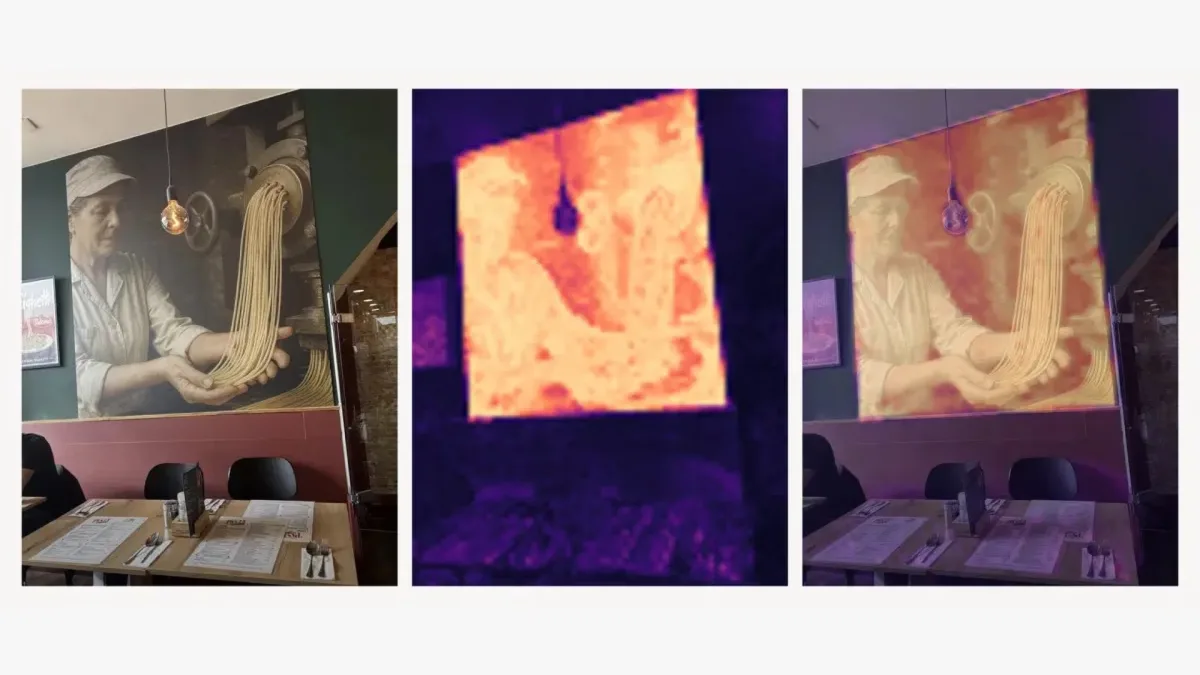
Pangram, the startup behind AI-written text detection systems, unveiled two fresh detection models on Wednesday aimed at identifying synthetic images and video content. The company introduced Pangram Image 1.0 for still images alongside Pangram Image Flash 1.0, a lighter variant designed to process video frame by frame.
The Image 1.0 model generates heatmaps that pinpoint where artificial elements appear within an image, such as fabricated objects inserted into genuine photographs. According to Pangram's own measurements, the tool detects 99.2% of AI-generated images while producing false positives on just 0.27% of authentic images.
Pangram conducted its own evaluation by creating synthetic versions of 100 real photographs using 12 prominent image generation tools, with prompts carefully matched to the originals. On this internally designed test, Image 1.0 achieved 99.96% accuracy. The company also tested Flash 1.0 against DF26, an academic benchmark comprising 2,691 video clips of people speaking directly to the camera that was published in September. Pangram reports that Flash 1.0 achieved 98.7% accuracy on DF26, outperforming the next-best detector by 29 percentage points.
Both models are accessible through Pangram's web application and API. The Image 1.0 model has also been integrated into the company's Chrome extension, which alerts users to synthetic content appearing on social media, e-commerce, and rental platforms. The web app now permits video uploads, while the API has been expanded to handle both image and video formats.
The detection tools can now process smaller images, scaling down to 256 by 256 pixels compared to the previous 512 by 512 minimum. Results from images below 512 pixels include a lower-confidence warning. Pangram states that its models have been trained to maintain effectiveness despite compression artifacts, blur, and noise—techniques that platforms and bad actors use to evade detection.
The company raised $9 million in a funding round led by Menlo Ventures in July, at which point it first demonstrated its image detection capabilities. Pangram's text detection system is already deployed on Substack. Meanwhile, other platforms are taking action: Snapchat has begun limiting recommendations for AI-generated videos on its Spotlight feature.
Despite these advances, AI detection systems continue to struggle with accuracy in real-world conditions. In August, Pangram's text detection tool flagged an opinion piece written by a Berkeley professor as partially AI-authored, a claim the author contested. Meta's own image detector failed to identify cropped versions of images from its own generator in more than half of cases tested by Reuters. On YouTube, a network featuring real actors reading scripts written by AI successfully evaded the platform's detection systems.
Source: The Next Web