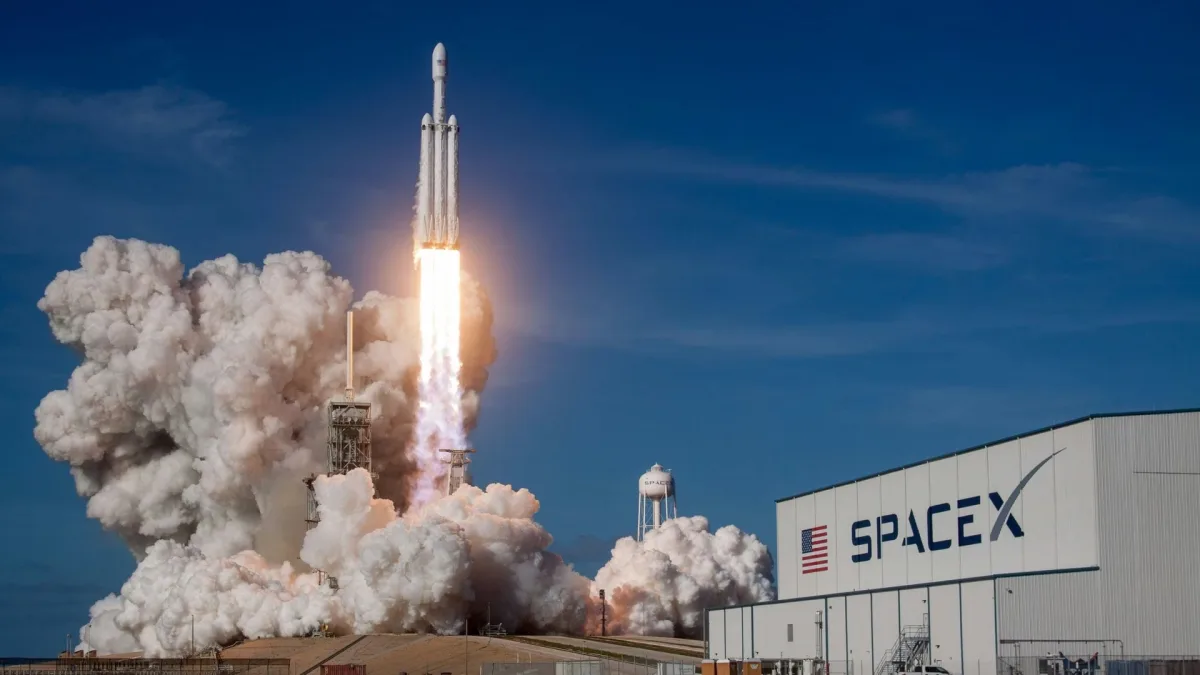
The US Federal Communications Commission has issued conditional approval allowing SpaceX to establish an orbital data centre network comprising up to 1 million satellites designed to support artificial intelligence workloads. This represents a regulatory first: the FCC has never before authorised an orbital data centre constellation of this scale.
SpaceX's project, designated Starmind, would operate at altitudes between 500 and 1,002 kilometres. The satellite network would rely primarily on laser communication links to exchange data with one another and with SpaceX's existing Starlink constellation, while maintaining radio connections for ground-based command and control functions.
The company submitted its initial application in January, shortly before merging with Elon Musk's artificial intelligence venture xAI. Under the FCC's authorisation, SpaceX must deploy its first operational satellite by 2033 and complete the full constellation deployment by 2040.
By moving compute capacity beyond Earth, SpaceX and the many competitors working on their own orbital data centers are meeting the moment
FCC chairman Brendan Carr
https://x.com/BrendanCarrFCC/status/2125623026918002860?ref_src=twsrc%5Etfw
Elon Musk responded to the approval on X, stating: "Much appreciated. This will be a great asset to America and the world."
Unresolved regulatory matters
Despite granting approval, the FCC has not yet authorised SpaceX's approach to managing orbital debris generated by satellites operating above 600 kilometres altitude. This remains a significant outstanding issue.
SpaceX has also requested an exemption from existing regulations requiring satellites operating below 2,000 kilometres to re-enter Earth's atmosphere within five years of mission completion. The company proposes instead to relocate certain decommissioned satellites to alternative orbital positions around Earth or the Sun.
The proposal encountered resistance from multiple parties, including the American Astronomical Society, satellite communications provider Viasat, and Amazon, which operates its own satellite internet service. Amazon's formal objection characterised the application as "a lofty ambition rather than a real plan."
The FCC dismissed these objections, determining that concerns regarding potential impacts on astronomical research fell beyond its regulatory scope. The American Astronomical Society expressed disappointment with the decision.
Competitive landscape
Other companies are pursuing comparable orbital infrastructure projects. Blue Origin has filed an application for 51,600 satellites, while Starcloud has sought approval for 88,000 satellites. The FCC indicated it would evaluate these competing proposals according to its standard regulatory procedures.
Remaining technical and commercial challenges
SpaceX, which completed its Nasdaq listing in June, continues to face substantial engineering and economic hurdles. The company must substantially reduce manufacturing and launch expenses for these satellites while simultaneously developing effective thermal management solutions for processing equipment operating in the space environment.
Source: The Next Web