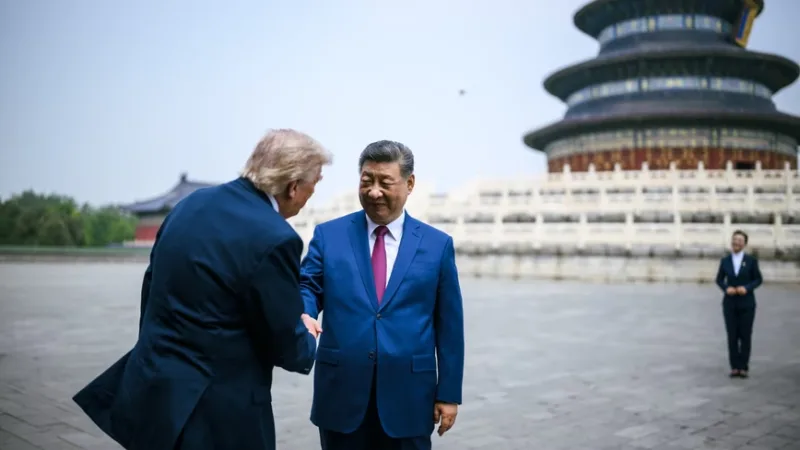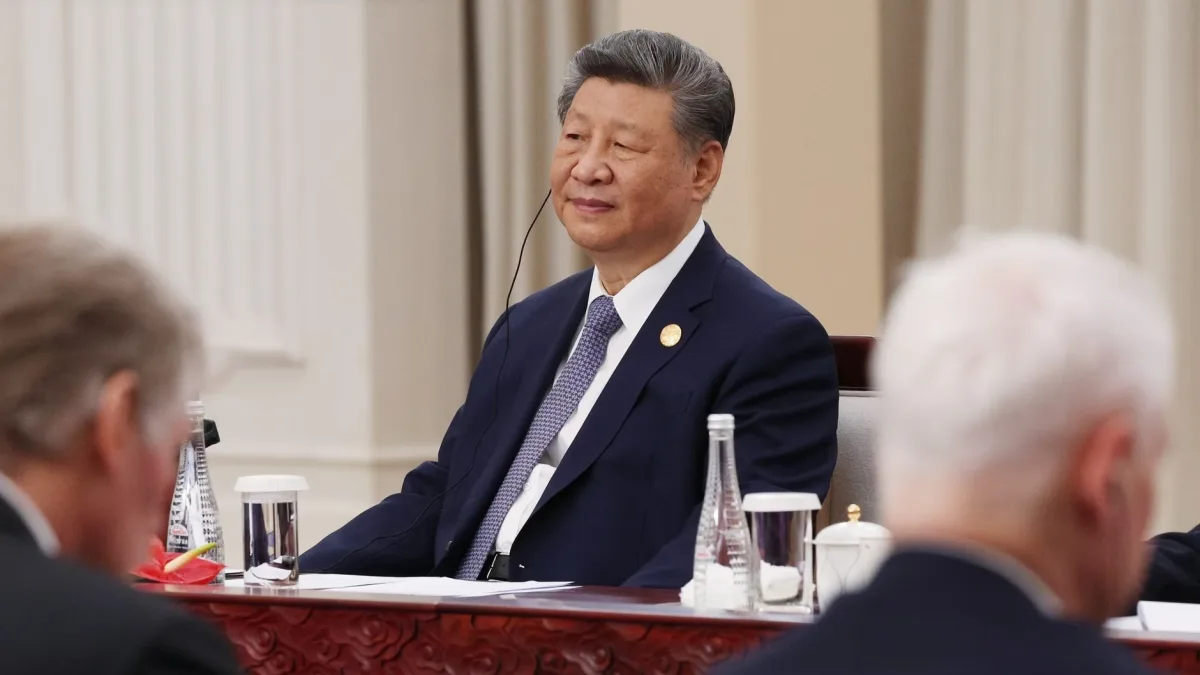
On Wednesday, Chinese President Xi Jinping urged Asia-Pacific nations to strengthen their collaboration around artificial intelligence and the digital economy. His remarks came in Shenzhen, just hours before Donald Trump arrived for Thursday's summit with Xi and Russia's Vladimir Putin. The gathering will mark the first occasion when all three leaders convene simultaneously.
At the APEC CEO Summit, Xi highlighted the rapid expansion of the AI sector across the region. According to an official English translation, he stated: "Unicorn companies and large AI models have emerged in large numbers and many innovations have empowered hundreds of trades and industries and reached millions of households."
Trump has indicated his intention to address nuclear weapons and the Ukraine conflict during the meeting. However, artificial intelligence governance is expected to feature prominently in the discussions, according to reporting by the Associated Press.
Nvidia remains off the table
According to statements made to CNBC by US officials, Trump does not intend to bring up Nvidia during his talks with Xi. This extends to allegations surrounding Jensen Huang and claims of involvement with a Chinese intelligence operative. Officials indicated that discussions would instead concentrate on implementing the trade agreement reached in the previous year. Huang stepped down from his position as CEO on 12 November, while Beijing has rejected characterizations of the woman in question as a spy, the Associated Press reported.
Ker Gibbs, who previously served as president of the American Chamber of Commerce in Shanghai, offered his perspective to Politico's Phelim Kine: "This scandal will be in the room even if semiconductors aren't discussed."
Huang is scheduled to participate in a private session with three House committees on 1 December. During Wednesday's welcome banquet, CNBC correspondent Evelyn Cheng observed minimal evidence of tension related to Huang. In contrast to a September gathering in Washington where Huang and Elon Musk had dined alongside Trump and Xi, neither figure was present at this event. Although CNBC had previously reported that Musk would accompany Trump's delegation, Cheng did not observe him at the evening reception.
Semiconductor restrictions and diplomatic channels
The summit takes place shortly after the United States implemented restrictions on remote access to artificial intelligence chips via international data centers. China has signaled its intention to pursue retaliatory actions. The current trade arrangement between the nations remains in effect through January.
Reema Bhattacharya, who directs Asia research at risk analysis firm Verisk Maplecroft, suggested to CNBC that this week's discussions could potentially establish an AI security hotline. She elaborated: "If there is room for genuine U.S.-China cooperation this week, it's on managing risk rather than sharing advantage."
Earlier in Manila, Trump joined the leaders of Australia, India and Japan in endorsing the "Quad SI Accelerator." According to Nextgov, this initiative will allocate more than $85 million toward expanding artificial intelligence access throughout the Indo-Pacific region. The Trump administration has designated AI as "super intelligence."
Trump commented at the US-ASEAN Summit dinner: "We have the world's most powerful SI ecosystem. We're leading everybody by a lot."
Infrastructure disruptions during the trip
A series of outages affecting major American systems have coincided with Trump's international travel, according to the Associated Press. The disruptions have impacted Microsoft, JPMorgan Chase, a classified NSA network and the Federal Aviation Administration. Secretary of State Marco Rubio stated there was "zero" evidence suggesting these incidents were connected to one another or attributable to foreign adversaries, hackers or criminal organizations.
Rubio explained: "Sometimes when you are going in to fix your system because you've identified a vulnerability, it creates a short-term disruption."
In Washington, Jay Clayton, the Director of National Intelligence, testified before the House Homeland Security Committee regarding the outages. He characterized them as neither coordinated nor state-sponsored in nature. Clayton indicated that the incidents appear to stem from separate causes tied to routine maintenance and technical modifications.
Source: The Next Web