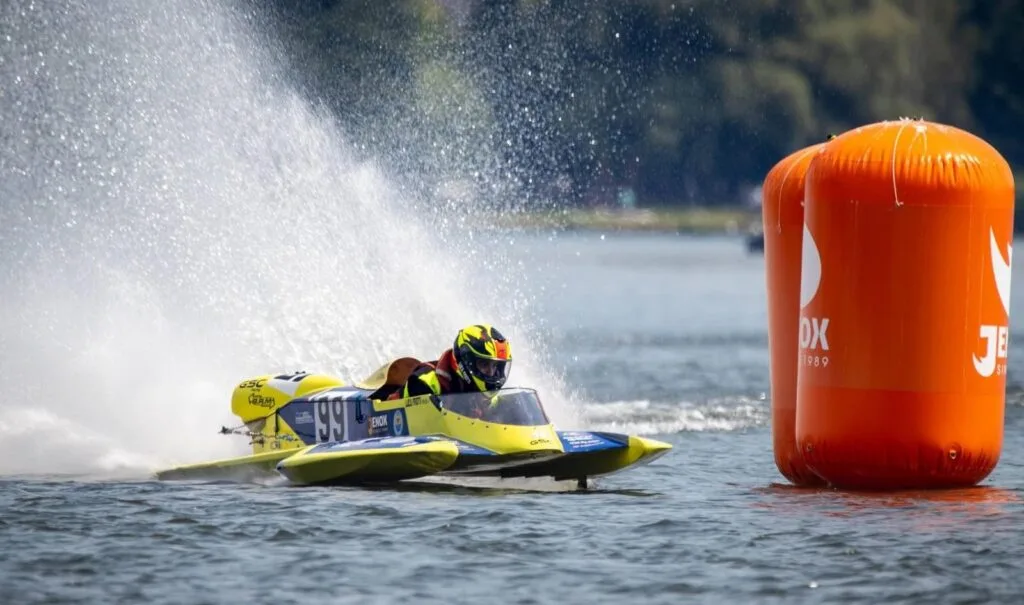
Luca Finotti holds multiple identities: world champion in F125 motorboat racing, student of industrial automation engineering, and professional programmer specializing in programmable logic controllers. Yet he also describes himself as someone passionate about crafting various gadgets with Arduino, and he chose to blend this enthusiasm directly into his racing pursuits.
The outcome has been a suite of purpose-built electronic systems that, in Finotti's assessment, have enhanced his performance during races. These innovations emerged not from regulatory mandates, but from his recognition of untapped potential and his determination to pursue it.
The path from spectator to engineer
Finotti's entry into motorboat racing traces back to his father, who introduced him to motorsport competitions starting when he was two years old. His competitive debut arrived in 2016, when the Italian Motorboat Federation opened a public test day that he eagerly joined. From that point forward, his focus expanded beyond mere velocity to encompass deeper insight into how his vessel actually performed.
I started creating projects for use in competitions because I believe electronics can give you an extra edge. In Formula 1 and MotoGP, electronics have become fundamental. I wanted to try to create devices that could give me advantages, assistance, and supervision of on-board systems.
Luca Finotti
The racing categories where Finotti competes feature minimal electronic infrastructure, and their rulebooks remain sufficiently permissive to permit substantial experimentation.
His initial Arduino undertaking involved constructing a thermocouple selector—a straightforward device enabling rapid switching between exhaust temperature and cooling water temperature data via a button press. This addressed a limitation his existing instrumentation couldn't overcome and a cost his budget couldn't absorb through commercial alternatives. However, the venture that delivered the most substantial impact centered on air density measurement.
Air density influences engine carburetion calibration. Miscalibrated carburetion can degrade engine output and heighten the likelihood of engine deterioration. Finotti engineered a custom air density gauge providing immediate guidance on carburetion configuration before launching into the water. According to his account, this tool streamlines carburetion selection prior to water testing and conserves time during practice and qualifying sessions.
He subsequently constructed an in-race carburetion variator. Within his competitive category, carburetion adjustments are permitted exclusively when the vessel sits stationary at the launch platform. Once racing commences, modification becomes impossible. Finotti's apparatus—incorporating buttons, a display screen, and a stepper motor—circumvents this constraint. It permits fine-tuning of carburetion settings while the boat is actively racing.
In the last round of the world championship, I had decided to go with a conservative setup to avoid engine failure and not risk losing the title. But this conservative approach turned out to be a disadvantage, so I was able to vary the carburetion while racing and shift the engine to a more aggressive setup to recover positions. Then, by reconfiguring the carburetion, I managed to reduce the risk, finish the race in first position, and win the world title.
Luca Finotti
Finotti deployed this device during the concluding race of his 2023 world-championship campaign. His subsequent 2025 season reinforced the validity of his strategy: he secured the Italian championship, achieved third place in the European standings, and finished as runner-up internationally, all within the F125 category.
Engineering challenges on the water
Constructing electronics for motorboat competition differs fundamentally from workshop development. Moisture and mechanical stress present perpetual obstacles, and a device functioning reliably on the bench may behave unpredictably when subjected to racing speeds on water. Finotti's methodology has matured alongside his technical capabilities: he has incorporated resin-based 3D printing into his workflow, paired with CAD design proficiency acquired through his academic training. Bespoke housings, shock-absorbing components, and specialized fastening systems now form integral elements of each creation.
His preferred microcontroller platforms are the Arduino Nano for space-constrained, minimal-input applications and the Arduino UNO for workshop prototyping—selections driven equally by dimensional constraints and operational requirements. On a racing hull, every ounce carries significance.
Looking ahead
Finotti's upcoming initiatives demonstrate considerable ambition. He is assembling a test bench integrating PLC and Arduino technologies to replicate and record engine parameters in the workshop—a framework intended to permit evaluation of specific modifications before water trials, potentially curtailing on-water testing duration. Additionally, he is developing an airflow variator incorporating a mass flow sensor, capable of unlocking supplementary air passages within the hull while compensating through elevated fuel delivery to preserve the proper air-to-fuel proportion. His longer-term vision encompasses designing a proprietary engine control unit to supplant the carburetor mechanism entirely with fuel injection, orchestrated by his own electronic architecture.
Electronics is the future and it's within everyone's reach. It's a world so vast that it allows you to find a solution to any problem. Don't give up, and believe in every project to the end. Failure is normal. But a failure will always remain one if you give up at the first difficulty. The satisfaction of seeing something work that previously existed only in your imagination is something extraordinary.
Luca Finotti
This is his counsel for competitors lacking his engineering foundation but interested in incorporating Arduino into their athletic pursuits.
Source: Arduino Blog