Communications strategists occupy a unique vantage point from which to observe how founders navigate the intense pressures of building companies. They witness firsthand whether internal strain either undermines leadership or catalyzes the transformation from competent operator to market-defining visionary.
For decades, venture investors have attempted to identify exceptional founders by analyzing unit economics, burn multiples and product-market fit metrics. Yet the true competitive advantage of elite founders frequently hinges on something less quantifiable: their psychological capacity to absorb, process and redirect the stress inherent to startup leadership.
Clara Armand-Delille, Founder of ThirdEyeMedia, recently shared her perspective on founder stress management and the communications strategies that transform internal pressure into external market positioning.
Six stress archetypes for founders
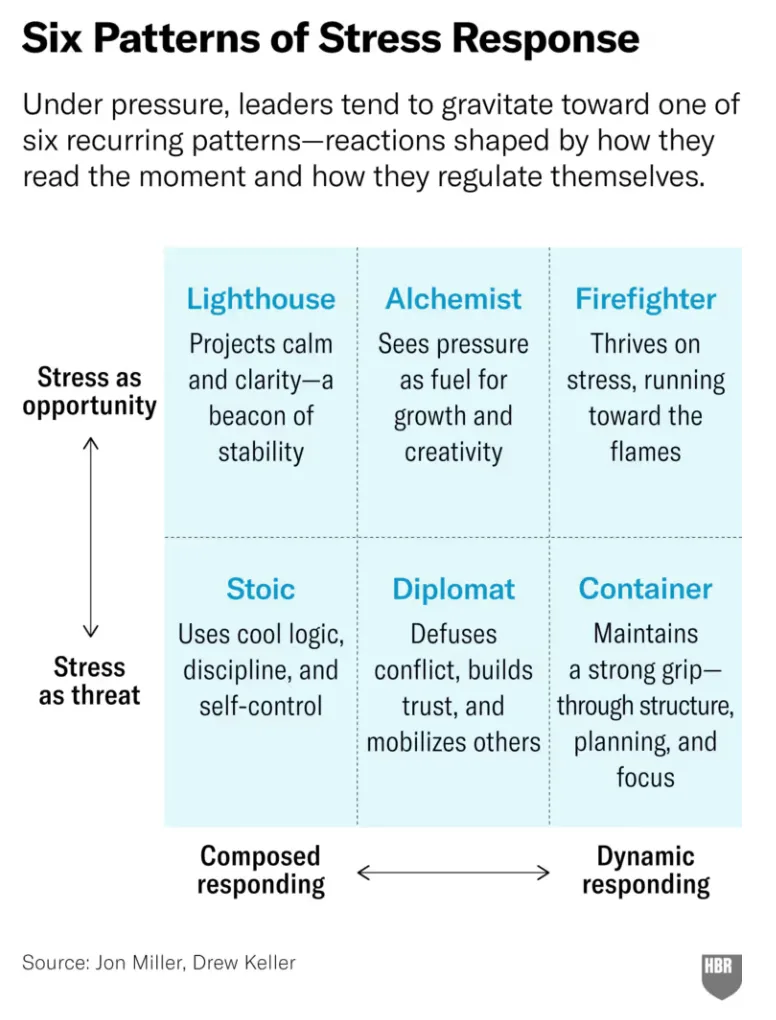
Executive coaches Jon Miller and Drew Keller, writing in Harvard Business Review, identified six distinct leadership stress responses. These archetypes exist along two dimensions: whether stress is perceived as a threat or an opportunity, and whether the response emphasizes composure or active intervention.
- The Lighthouse: maintains composure and provides clarity, functioning as a stabilizing force amid uncertainty
- The Alchemist: interprets pressure as a catalyst for growth, innovation and creative breakthroughs
- The Firefighter: performs optimally under acute stress, drawn instinctively toward crisis situations
- The Stoic: navigates challenges through rational analysis, disciplined execution and emotional restraint
- The Diplomat: prioritizes conflict resolution, relationship building and collective mobilization
- The Container: maintains control through narrative management, organizational structure and strategic focus
Founders who remain locked in reactive patterns tend to adopt defensive stances that limit their effectiveness. The most successful founders, by contrast, demonstrate psychological flexibility—the capacity to shift between these archetypes as circumstances demand. The optimal operating mode, according to this framework, centers on the Alchemist orientation.
The Alchemist as the ideal founder archetype
The Alchemist founder transcends mere tolerance of pressure; instead, they harness it as a source of strategic advantage. When facing competitive threats or macroeconomic headwinds, they resist the urge to react defensively. Rather, they leverage tension as an opportunity to refine market positioning, reinforce their core value proposition and mobilize their organization around an expanded vision.
Exceptional founders rarely operate from a single archetype. They combine the steady vision of the Lighthouse with the decisive action of the Firefighter and the analytical rigor of the Stoic, shifting fluidly between modes as situations evolve.
Converting internal psychology into market authority
The way a founder processes stress directly influences how external audiences—media, investors, customers—perceive their leadership. Strategic communications work to translate these internal psychological patterns into public positioning that builds credibility and trust.
Growth phases
During periods of scaling or market expansion, the Alchemist and Lighthouse archetypes become most relevant. Communications teams convert the operational intensity of rapid growth into bold thought leadership, distinctive press narratives and investor signals. When working with Celo on stablecoins expansion across Europe and Brazil, the communications strategy centered on translating co-founder Rene Reinsberg's long-term Web3 perspective into language accessible to mainstream audiences while simultaneously establishing credibility with institutional stakeholders.
Crisis management
During crises—whether data breaches, service outages or public setbacks—leadership must shift operational modes. Internally, communications adopt the Diplomat archetype, crafting messages that acknowledge concerns and restore team alignment. Externally, the Container archetype takes precedence, constructing a disciplined response framework that prevents market panic from spiraling.
Stress as competitive differentiation
Pressure remains an inescapable feature of high-velocity technology ventures. The distinguishing factor between startups that collapse under strain and those that establish durable market leadership lies in the emotional intelligence and adaptability demonstrated by their founders.
Founders who achieve sustainable success do not pursue stress elimination; instead, they cultivate the capacity to navigate between states of calm deliberation and purposeful action. Through collaboration with communications professionals who understand how to externalize these internal psychological capacities, founders can convert the pressure designed to break them into a source of lasting competitive strength.
Source: Startup Reporter