A year of growth by the numbers
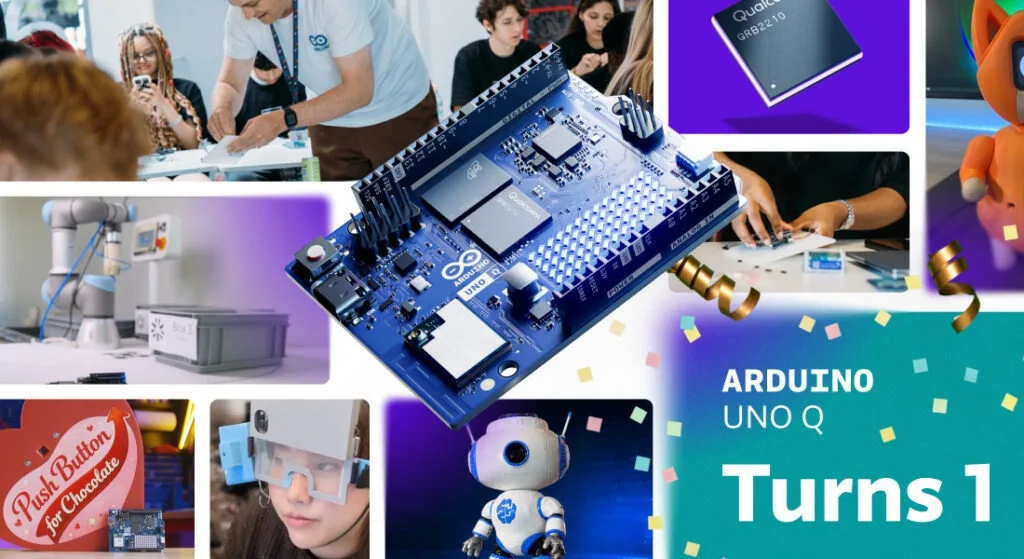
The Arduino community's response to the UNO Q has exceeded expectations. The board, which pairs a Qualcomm Dragonwing QRB2210 microprocessor with an STM32U585 microcontroller, shipped over 270,000 units globally in its first year. Beyond hardware sales, the ecosystem flourished with 400+ events, 4,000+ contest entrants producing 250+ official builds, and 850+ forum discussions dedicated to the platform.
The broader Arduino community continued expanding alongside UNO Q's launch. Project Hub submissions nearly doubled year-on-year, while library downloads grew approximately 50%, reaching 244+ million in the past 12 months compared to 165+ million previously. The Arduino IDE itself achieved 35+ million downloads.
Dual processors, unified development
The UNO Q's defining feature combines two processing worlds on a single board. The Qualcomm Dragonwing QRB2210 handles Linux, AI models, and graphics-intensive tasks, while the STM32U585 manages deterministic real-time control. This pairing enabled Arduino App Lab, a development environment allowing Arduino sketches on the microcontroller to work alongside Python programs on the microprocessor as a unified application.
Throughout the year, the development experience expanded. Debian Linux arrived as a curated environment for the board's processor side, while Qualcomm Linux provided an alternative path into the Qualcomm ecosystem. In August, Agentic Mode introduced AI-assisted development to Arduino's desktop IDE for the first time.
Community creativity across domains
Makers and developers applied UNO Q to diverse challenges spanning computer vision, local language models, healthcare, and smart devices. The community's standout projects included:
- JBR-001, a desktop companion robot
- XGO-Duck, a fully open-source robot
- DIY-ECG, exploring real-time health monitoring
- Local LLMs and VLMs on UNO Q
- NetraHz: Camera-free fall detection
- DIY Synth
- Gesture Detection
- Arcade Cabinet
- Inverted Pendulum
- Local Weather Station
- Smart Mirror
- AI Plant Guardian
The Invent the Future with Arduino UNO Q and App Lab contest, run with Hackster, concluded with winners announced on October 9.
Openness at the core
Arduino's integration into Qualcomm raised questions about its open-source commitment. One year in, that commitment remains unchanged. Arduino continues operating under open-source licenses—MPL, AGPL, and GPL—with open hardware schematics. Arduino App Lab itself became available on GitHub for community contribution and development.
Beyond UNO Q, Arduino released the Starter Kit R4, Nesso N1, and eight new Modulino nodes: Motors, Joystick, Latch Relay, Light, LED Matrix, Vibro, Hub, and Extender. These modular components enable rapid functionality expansion, as demonstrated in the UNO Q DIY synth bundle and Arcade bundle. Arduino Cloud also received enhancements, while Arduino Core on Zephyr reached version 1.0, transitioning from beta to provide a stable real-time operating system foundation for Arduino boards including the new VENTUNO Q.
From prototype to production
The partnership between Arduino and Qualcomm extends beyond hardware. Developers can prototype on UNO Q or VENTUNO Q, then scale to production-grade solutions while retaining their existing tools and applications. The broader Qualcomm Dragonwing family supports industrial and production deployments.
Supporting this pathway are complementary services and programs:
- Arduino App Lab for building and packaging applications
- Edge Impulse for production-grade pipelines
- Foundries.io for secure updates and fleet management at scale
- Qualcomm AI Hub for optimized models
Works with Arduino, a new certification program, allows partners to qualify System on Modules and enables developers to deploy apps built on UNO Q or VENTUNO Q to compatible hardware without code changes. Applications packaged as App Releases transition from prototype to production-ready hardware in minutes rather than weeks, opening the 33M+ Arduino developer community to hardware partners.
Community moments and industry presence
Arduino and Qualcomm showcased UNO Q at major industry events including CES, MWC, and the Mission44 Workshop, connecting with developers, makers, students, and industry leaders. These gatherings demonstrated the capabilities of this new generation of Arduino-powered computing to a global audience.
Looking ahead
Year one validated that powerful, open, and simple can coexist. The platform demonstrated what emerges when advanced tools reach a curious, creative community. The second year ahead promises expanded tooling, additional partners, and new pathways from concept to implementation.
Source: Arduino Blog