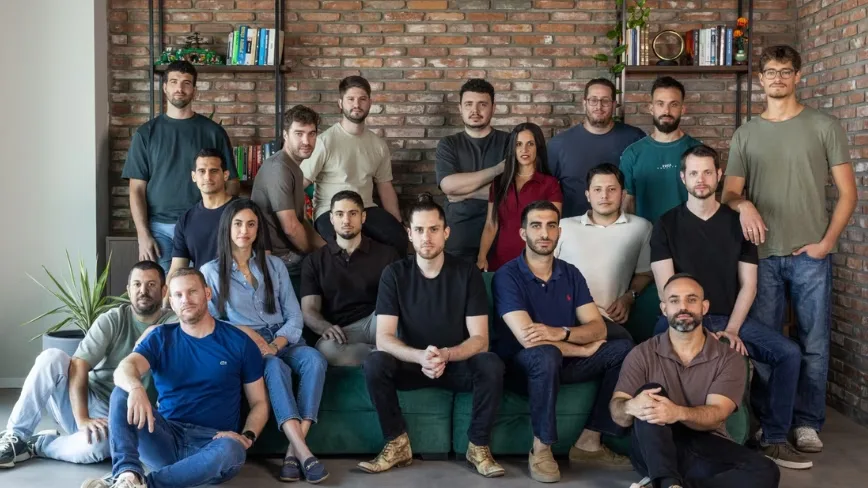
Cybersecurity firm Corma has secured $125m in Series A funding at a $1bn valuation, just three months after emerging from stealth with a $60m seed round. New Enterprise Associates (NEA) led the round, with returning investors Sequoia Capital, Khosla Ventures and Coatue also participating. The funding brings Corma's total capital raised to $185m.
Scaling to meet enterprise demand
Since launching publicly in August, Corma has experienced explosive demand from large enterprises across healthcare, financial services, energy, critical infrastructure, retail and telecommunications sectors. The company has expanded its server infrastructure by a factor of 24 to accommodate this growth.
Since we came out of stealth, demand from the world's largest organizations has been overwhelming, and one of our hardest problems has been securing capacity fast enough to keep up with the demand
Alon Pluda, Corma co-founder and chief executive
Pluda, speaking to Calcalist, emphasized the velocity of the company's growth trajectory. "Our revenue is growing very rapidly, to the point that anything we say today might already be outdated," he stated. The fresh capital will be directed toward scaling the company's AI models, expanding computational resources and carefully growing the team. Pluda noted in a blog post that organizations are currently on a waitlist as Corma adds capacity.
The defence-versus-offence gap
Corma frames its Series A timing around what it sees as a critical imbalance in the cybersecurity landscape. The company points to Black October, when a cascade of serious software vulnerabilities and security breaches surfaced in October, prompting warnings from governments worldwide.
Cybersecurity is now a battle of intelligence against intelligence, and Black October made that impossible to ignore
Alon Pluda
The startup argues that as AI-powered coding models improve at identifying and exploiting security weaknesses, defensive capabilities must evolve in tandem. Effective defence requires analyzing audit logs, security events and network traffic to detect subtle anomalies over extended periods. Corma has built its own AI models specifically for this task, packaging them as autonomous agents that integrate with existing enterprise security infrastructure.
Our agents work with all these products, and the entire process is fully autonomous, with no human intervention involved
Alon Pluda, speaking to Calcalist
A challenge to the AI establishment
Corma's marketing materials take aim at what the company views as a troubling trend in the broader AI industry. The company's homepage argues that billions of dollars are flowing into models designed to enhance offensive capabilities each month, without naming specific firms.
Some of these companies are happy to profit from those offensive capabilities while preaching safety
To demonstrate its defensive prowess, Corma displays a benchmark called DefenseBench V5, positioning its v0.4 model ahead of Claude Fable 5.2, Gemini 4 Carbon, GPT-6 Astra, GPT-6.1 Sol, GPT-6.1 Terra, Kimi K3.1 Pro and Grok 4.7 on both defensive task performance and execution speed.
Corma is the only company taking this on in a way that is scalable across organizations to prevent the next big cyberattack
Aaron Jacobson, partner at NEA
The team behind Corma
Corma currently operates with approximately 25 employees. Pluda is a former member of Israel's Unit 8200 intelligence unit, and the company's roster includes researchers from Google DeepMind alongside additional cybersecurity specialists from Unit 8200. Pluda has signalled that the next iteration of Corma's models will be released in the near term.
Source: The Next Web