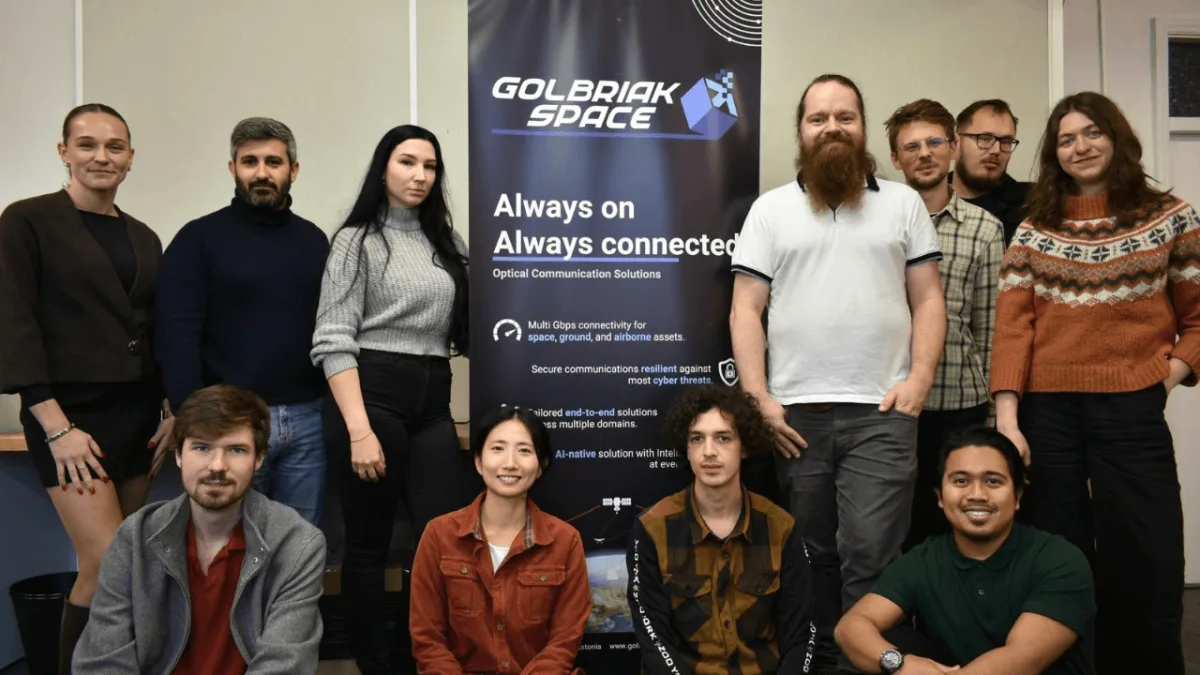
Golbriak Space, based in Estonia, has landed €4 million in new funding to boost manufacturing capabilities and speed up the industrialisation of its optical communication technology. The capital injection comes as the company's customers prepare to deploy optical terminals across satellite networks at unprecedented scale.
The spacetech firm develops, manufactures and engineers laser communication systems intended for space and airborne use. Its approach aims to simplify integration complexity and enable optical communications to be more straightforward to produce, operate and roll out across diverse platforms, networks and operational scenarios.
Join Capital and PhotonVentures co-led the seed round, alongside Takeoff, the acceleration programme run by the CDP Venture Capital National Accelerator Network for aerospace and advanced hardware companies through Plug and Play. The funding went into Golbriak Space's Italian holding entity, Iribits S.r.l., to support the Estonian subsidiary Golbriak Space OÜ.
The financing arrives as Golbriak progresses commercial discussions for initiatives spanning several thousand terminals.
Why optical communications matter at scale
The technical merits of laser-based communications have been recognised for many years. Optical links transmit substantial data volumes without consuming the increasingly strained radio-frequency spectrum.
Their narrow, directional beams make them substantially more resistant to interception or jamming—an attacker would typically require direct access to the beam path or precise receiver alignment. The real challenge has centred on creating terminals that can be produced cost-effectively in volume and easily integrated by end users.
Interest in optical terminals is accelerating as satellite networks grow larger, become more densely interconnected and handle greater data volumes. Individual constellation programmes may eventually need hundreds or thousands of terminals.
Golbriak's design reduces reliance on the pointing precision of the host satellite, aircraft or drone, simplifying integration and permitting multiple terminals to coexist on the same platform.
The company handles the optical, electronic, mechanical and software design of its systems internally. This vertical integration of the communications chain enables Golbriak to fine-tune performance, integration, manufacturability and reliability as production expands. The firm is ramping two main product lines: ERMESAI+ for space missions and ARES for airborne operations. Both rely on a shared, software-defined foundation intended to streamline high-capacity optical communications integration, operation and deployment across varied platforms and networks.
Closing this round marks a turning point for Golbriak. Years of research, specialised engineering and customer validation have gone into solving the practical challenges that determine whether laser communications can operate reliably at scale. We have addressed the key challenges required for large-scale deployment of optical communications. We have functioning products, paying customers and demand that is now expanding towards programmes involving thousands of terminals.
Nicola Garzaniti, founder and CEO of Golbriak Space
Golbriak already has functioning technology, paying customers and clear demand from operators planning the next generation of satellite networks. Years of specialised engineering have created a significant technological and commercial lead. This investment accelerates the company's ability to manufacture at the scale its customers will require.
Jan Borgstädt, Founding Partner at Join Capital
Golbriak combines advanced photonics with a highly scalable architecture. With demand moving towards constellation-scale deployments, we see significant potential for Golbriak to become a leading supplier of optical communication terminals for the global space industry.
Pieter Klinkert, Co-founder and General Partner at PhotonVentures
Golbriak is currently in talks for programmes that collectively encompass several thousand systems. Customer-funded deployments across multiple commercial space initiatives will broaden the company's operational presence starting in 2027, while additional ARES terminals are being readied for airborne deployment.
Source: Tech.eu