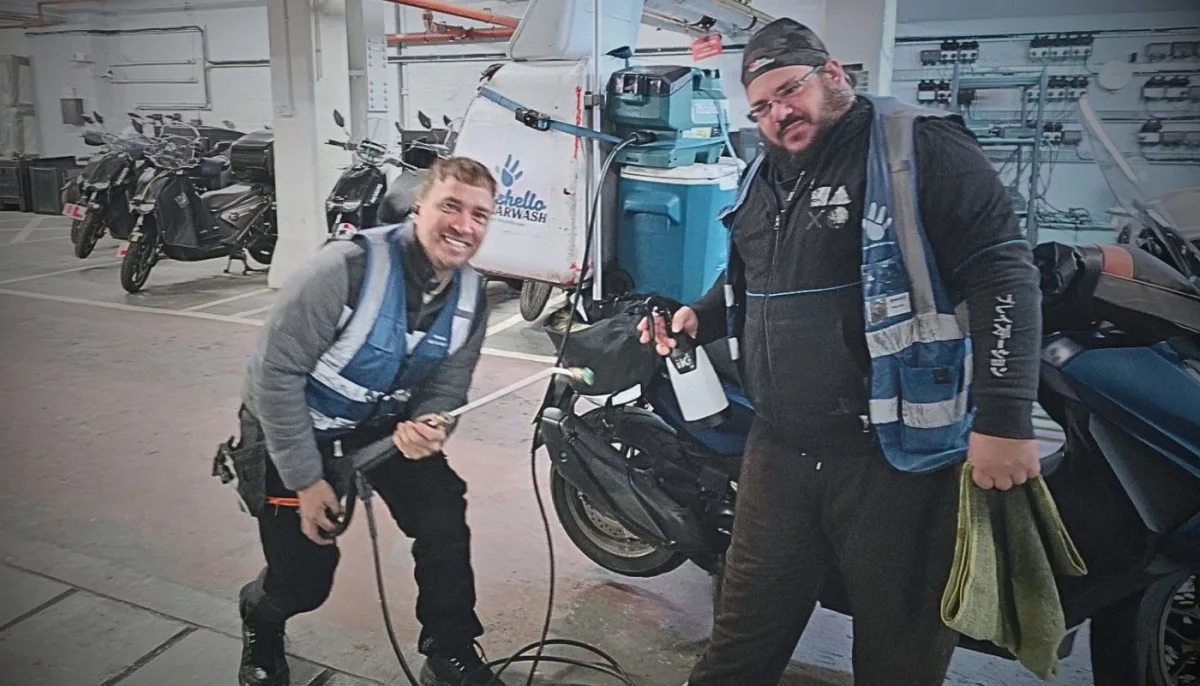
The typical London driver faces a familiar predicament: spending an entire weekend afternoon queuing at a car wash. James Allen saw an opportunity to flip this model on its head, launching his mobile valeting service from the back of a scooter instead. Washello emerged in 2016 from nothing more than a sketch on paper, eventually becoming a trusted operation serving thousands of Londoners—all bootstrapped without external funding.
The core innovation lies in abandoning the traditional van. By operating from scooters, Washello maintains pricing that starts at £19.95, with full valet services at £89.95—significantly undercutting competitors charging £130 or more. The company now operates two scooters, one petrol-powered and one electric, and has processed more than 3,000 bookings through its website since November 2022. During London's summer hosepipe restrictions, Washello continued operating by carrying its own water supply to each job.
The service has attracted high-profile partnerships, including becoming Freenow's official valet partner for the ride-hailing platform's electric black cab drivers. Allen's vision extends beyond car cleaning, with plans to scale the scooter-based model to other services.
Building from Scratch
Allen's journey began with a 12-volt pressure washer mounted on a repurposed pizza delivery scooter, charging £5 per wash while working Deliveroo shifts. Early attempts at customer acquisition—leaving flyers on car windows—proved demoralizing when residents demanded their removal. The turning point came when Allen recognized that his pricing failed to reflect the service's actual value.
The lesson I had to learn was that my prices should reflect the value of the service. Raising them to something affordable but fair was the way forward.
James Allen
Once Allen established fair pricing, bookings stabilized through word-of-mouth recommendations and mentions in local WhatsApp groups. This organic growth strategy has remained central to the business model.
The Economics of Two Wheels
Scooter-based operations eliminate numerous overhead costs that plague traditional van services. Fuel expenses, London's congestion charge, and ULEZ fees disappear entirely. Insurance and general running costs plummet compared to van operations. Additionally, scooters navigate traffic more efficiently and require no parking space outside customer locations—savings that translate directly into lower prices.
Allen maintains transparency about operational limitations, declining jobs involving heavy mud or sand. This focused approach allows the team to execute remaining work with confidence and consistency.
Equipment and Power
Each Washello scooter carries a Makita battery-powered pressure washer paired with a 40-litre water tank mounted on wheels behind the rider. A Milwaukee wet and dry vacuum and cleaning supplies occupy a large delivery box at the rear, while a rotary polisher for scratch removal and finishing work sits beneath the seat. The entire operation runs on batteries—two Makita units for the pressure washer and five Milwaukee batteries for the vacuum and polisher—eliminating the need for generators or customer property connections. Water consumption ranges between 20 and 40 litres per vehicle, all supplied by the company.
Adapting to Restrictions
Thames Water's summer hosepipe ban unexpectedly benefited Washello by driving customers toward alternative cleaning methods. Beyond immediate business gains, Allen emphasizes the environmental dimension of the operation. Traditional car washing wastes significant water while allowing harsh chemicals to contaminate groundwater—practices Allen views as indefensible. Customers increasingly value companies that minimize water consumption and avoid harmful chemical runoff.
The Freenow Partnership
The collaboration with Freenow began at the platform's annual driver conference, where attendees received complimentary Washello valet services. Reasonable pricing enabled the relationship to evolve into discounted rates for Freenow drivers. The partnership reflects Washello's ability to work within tight time constraints—a 45-minute break allows the team to complete a full clean and return the cab to service quickly.
Cleaning a cab between fares is about getting as much done as possible in a small window of time. We want to get the cabbie back on the road as soon as we can, which means getting every last McDonald's chip out from between the seats.
James Allen
Scaling Without External Capital
Reaching 5,000 cleaned vehicles and adding a second rider while maintaining complete financial independence required strategic decision-making. Allen identifies advertising as the most challenging aspect of bootstrapped growth—every marketing pound comes from personal reserves, making each investment feel consequential.
Google advertising proved ineffective, as potential customers rarely search for mobile car cleaning services, and tight margins make paid search uneconomical. Instead, Allen prioritizes direct customer referrals and business card exchanges. Leafleting, when deployed, uses hotel-style door hangers that remain secure and avoid environmental waste.
Memorable Moments and Lessons
Allen's most significant early job involved cleaning an Aston Martin DB6—a high-stakes assignment that tested both technical skill and nerve. Working in an underground car park precluded extensive water use, forcing meticulous panel-by-panel work. The successful completion led to additional business from the same owner, including an Jaguar E-Type.
It taught me that just because you don't look like the competition doesn't mean people will treat you differently. If anything, being unique gives you the edge.
James Allen
Beyond Car Valeting
Allen views car cleaning as merely the foundation for a broader scooter-based services platform. Window cleaning, bin cleaning, and driveway pressure washing all represent potential expansions. The underlying principle remains consistent: if a service fits on a scooter and leverages existing skills, it becomes a viable business opportunity.
We can go anywhere with this idea: window cleaning, bin cleaning, driveway pressure washing. It's more about knowing the skills than the equipment. If we can fit it on the back of a bike, why can't we build a business around it?
James Allen
Advice for Bootstrapped Founders
Allen's guidance for entrepreneurs launching without capital centers on competitive intelligence, leveraging available resources, and undercutting established players on price. Above all, he emphasizes maintaining a full refund guarantee for dissatisfied customers—a commitment that builds trust and protects reputation.
Daily Operations and Technology
Allen maintains a 5am start, handling contract clients before sunrise. Regular bookings commence around 9am, with winter schedules compressed to accommodate daylight constraints. The operation relies on automation to function efficiently as a two-person business.
Incoming orders distribute automatically based on rider location and availability, with each booking slot assigned a fixed duration to prevent scheduling conflicts. The customer-facing booking calendar appears simple, but substantial backend logic powers its functionality. Before adopting AI tools, Allen outsourced website development and maintenance to Fiverr contractors at considerable expense. While AI arrived too late to reshape the original build, it now streamlines operations and focuses spending on priorities.
Five-Year Vision
Allen envisions Washello expanding with local operators managing their own territories, potentially entering new cities. Service diversification remains possible, though he acknowledges that significant growth may require external investment. Regardless of scale, Allen remains committed to avoiding zero-hours contracts and maintaining transparent employment terms. His goal centers on building a company where staff grow alongside the business within a family-oriented culture.
Source: TechRound