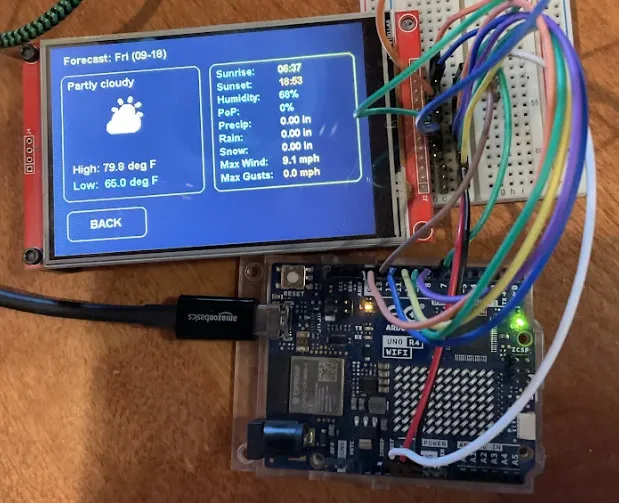
The Arduino GIGA R1 WiFi represents the upper tier of the company's development board lineup, built around a dual-core STM32H747XI processor running at speeds up to 480 MHz with 1 MB of RAM at its disposal. Community members KurtE and Merlin513 leveraged this processing muscle to create a weather station application using ZephyrOS, and they've now shown the same software functioning on far less capable hardware: the UNO R4 WiFi.
Building on the GIGA platform
ZephyrOS serves as a real-time operating system, selected as the path forward after Mbed's active development concluded in 2024. The Arduino Core on Zephyr 0.90.0 has reached official stability, offering the infrastructure needed for process management, task scheduling, and real-time functionality.
The weather application that KurtE and Merlin513 created for the GIGA R1 WiFi pairs with a touchscreen display—such as the GIGA Display Shield—to present meteorological data through an interactive interface. Users can tap through the display to access detailed forecasts for individual days, all rendered through a polished graphical environment.
While the application demanded considerable resources by microcontroller standards, the GIGA R1 WiFi's specifications were engineered precisely to handle this kind of workload.
Adapting to tighter constraints
The UNO R4 WiFi operates in a fundamentally different resource envelope. Its Renesas RA4M1 processor runs as a single core at 48 MHz, paired with just 32 kB of RAM and 256 kB of flash memory—a stark contrast to the GIGA R1 WiFi's 2 MB of storage.
These limitations created two distinct problems: fitting the application into the available flash space and managing the minimal RAM allocation. The solution to the first constraint, however, addressed both simultaneously. KurtE tackled this by switching display libraries and streamlining the visual design. The approach centered on reducing the number of colors in use and compressing image dimensions wherever feasible.
Following these modifications, KurtE confirmed the weather application could execute on the UNO R4 WiFi, characterizing its performance as operating "reasonably well."
The discipline of constrained design
Refactoring applications for limited hardware transcends simple code reduction—it embodies an engineering philosophy that values deliberate problem-solving. Whereas high-capacity boards permit expansive thinking, fitting a complete RTOS, graphical layer, and live data handling into 32 kB of RAM showcases how practical boundaries can unlock inventive approaches.
Projects adapted to smaller platforms expand what's possible with modest hardware, illustrating that sophisticated, responsive applications don't necessarily demand enormous computational resources. Developers with comparable work to share can post on the Arduino Forum or document their efforts through Arduino Project Hub, allowing the broader community to learn from and extend their innovations.
Source: Arduino Blog