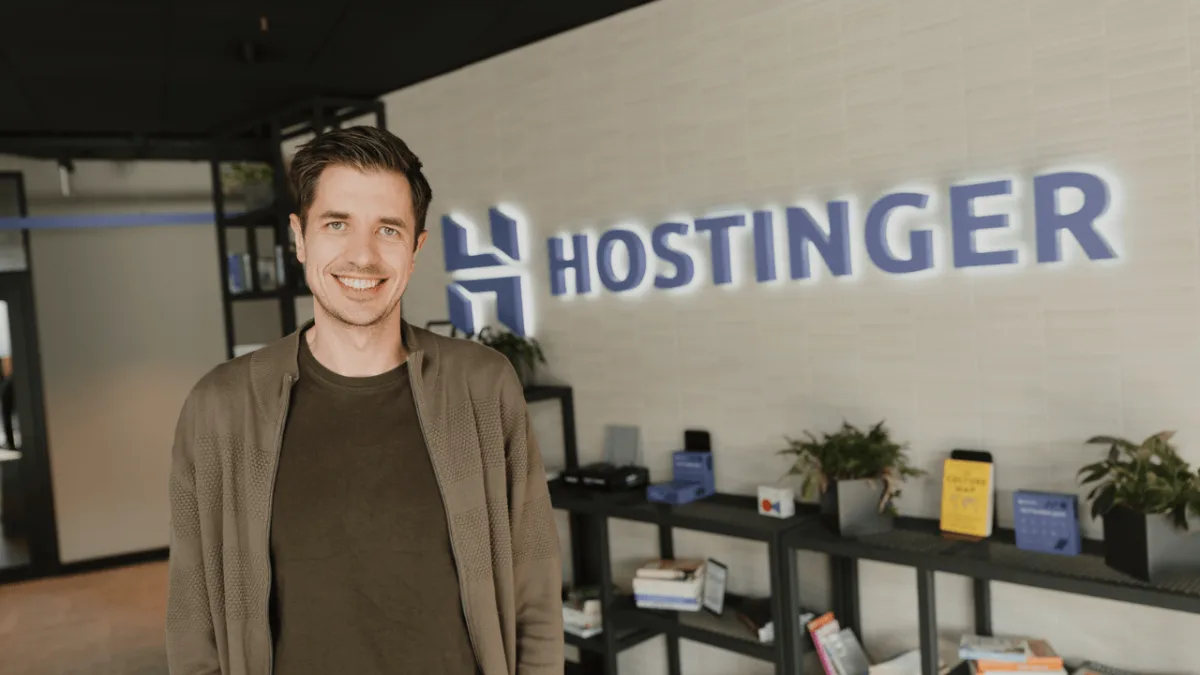
Building websites, launching products, and creating software businesses have never been simpler—no coding required. Yet despite rapid technological progress, adoption remains sluggish. For Hostinger, the Lithuanian company pivoting from traditional web hosting toward an AI-first business platform, bridging this divide is essential. We sat down with CEO Giedrius Zakaitis to explore the company's transformation and the forces shaping its strategy.
From web hosting to helping people run businesses
Hostinger began as a straightforward web-hosting provider. Zakaitis recalls the early days when WordPress installation demanded users manually upload files, establish databases, and handle configuration themselves. Managed hosting later simplified this to a single click.
The company eventually recognised its true purpose: translating complex technical processes into something accessible to non-technical users. According to Zakaitis, the nature of the challenge has fundamentally shifted.
Today, hosting itself is almost an abstraction. You don't really talk about hosting anymore; you simply expect things to run. Ten years ago, if you had an idea, the question was: can you build it? You needed to be a developer, hire one, or have the budget to pay someone. Now building isn't really the question anymore. It's becoming incredibly easy to build something. The question is shifting towards: can you actually run the business?
Giedrius Zakaitis
This reorientation drives Hostinger's current direction: enabling people to launch ventures, then supporting them through AI-powered business operations.
Virtual private servers (VPS) are gaining relevance as AI agents become more prevalent. Rather than executing agents locally or purchasing dedicated hardware, customers can deploy them on virtual infrastructure with complete control. Zakaitis also identifies expanding potential in tools that individuals construct for their own needs.
I spoke to a customer recently who had been injured and was given a recovery plan. They built themselves a really nice interface that simply asks: did you do your stretches? Did you do this exercise? It gives them a way to track the recovery plan and keep themselves accountable.
Giedrius Zakaitis
Small enterprises are increasingly developing proprietary tools instead of adopting off-the-shelf solutions. These span booking management, email handling, quote generation, and ecommerce operations. Zakaitis notes a particularly significant development: entrepreneurs are constructing SaaS businesses themselves, a relatively novel category for Hostinger's customer base.
Historically, Hostinger's users created websites or online stores. Software development typically required hiring specialists and arranging deployment infrastructure. Today, individuals are independently building marketplaces and software products—a use case experiencing rapid expansion.
While Zakaitis acknowledges uncertainty about AI's appearance five years hence, he remains convinced that demand for accessible business-launching mechanisms will persist.
That's why we're moving beyond 'can I build and publish this?' towards 'can I run my business?' That could mean giving you an overnight report telling you what you should do next or analysing your competition. We're moving far beyond the traditional idea of simply giving someone a web presence.
Giedrius Zakaitis
When anyone can build software, who keeps it secure?
Democratising software development and deployment for non-technical users introduces significant challenges, particularly regarding security vulnerabilities that developers may not recognise.
Zakaitis points to OpenClaw as an illustration of how Hostinger reconciles customer enthusiasm for emerging technologies with security imperatives.
We saw huge demand from existing customers who wanted to try OpenClaw, but getting started was quite difficult, so we made it much easier to install. However, that also meant addressing the security implications. OpenClaw was originally intended for personal use, and some of its default settings weren't secure enough for how customers were actually using it.
Giedrius Zakaitis
For instance, authorisation was not activated by default initially. Hostinger modified the setup, introduced token-based authorisation, and added protective measures.
As a company, we can identify potential attack vectors and put guardrails in place rather than simply handing customers a VPS and leaving them to figure everything out themselves. We know our customers will use these tools, but they don't necessarily have the resources or expertise to understand everything happening under the hood. That's why we need dedicated teams monitoring the security landscape, identifying emerging threats, and responding to new vulnerabilities.
Giedrius Zakaitis
How bootstrapping shaped Hostinger's global ambitions
Zakaitis contends that certain historical limitations faced by Lithuania have actually benefited its technology sector.
Historically, Lithuania didn't have access to very much capital. If you compare that with somewhere like San Francisco, it's the opposite end of the spectrum. So a lot of Lithuanian companies were bootstrapped because we couldn't easily raise money. That meant we had to become much smarter about how we used our resources.
Giedrius Zakaitis
Hostinger itself expanded by reinvesting its own earnings rather than securing external funding for operations.
Hostinger has grown entirely through its own revenue and reinvestment. We have never raised external capital to fund the business.
Giedrius Zakaitis
The company's ownership structure has evolved differently from traditional fundraising. Zakaitis distinguishes between these developments and capital raises.
"Our shareholder base has changed over the years: Tesonet became a shareholder in 2018, and ConHostinger in 2021. Both were share purchases from existing shareholders, not funding rounds." Terms remain confidential, as is customary for private equity transactions.
Early on, Hostinger's customers functioned as an informal financing source through multi-year subscription agreements.
They would buy four-year plans, which gave us the cash flow to invest in the product, infrastructure, servers, and marketing for the next customers.
Giedrius Zakaitis
Lithuania's modest domestic market has also fostered international orientation from inception.
If you have any real ambition, you can't build only for Lithuania. Mathematically, it doesn't make sense. So global ambition was there from the beginning.
Giedrius Zakaitis
A further advantage stems from limited direct competition among Lithuanian technology firms, facilitating knowledge exchange.
"It's a small ecosystem. You go for lunch and bump into people and ask: what are you working on?" Zakaitis explains. "We learned a lot from being bootstrapped, and then we shared a lot of what we learned."
Bootstrapping provides what Zakaitis characterises as a "huge luxury"—freedom from the pressures accompanying venture capital.
Funds have their own cycles and eventually need to generate returns, and that can create pressure on the startup to raise prices, move upmarket, do this or that. I don't have that pressure. Almost every public software company talks about going upmarket because customers there pay more and have a higher average value.
Giedrius Zakaitis
But there are millions of people who want to start businesses. Individually they might not pay as much, but there are so many of them. We can build for those customers for the long term without somebody pushing us to move upmarket. That's a huge luxury.
Giedrius Zakaitis
Why scaling globally takes more than translation
A critical lesson from Hostinger's worldwide expansion that Zakaitis believes startups frequently underestimate: localisation demands far more than converting text into different languages. Organisations must employ people who grasp local customs and sensibilities.
Words can have different meanings, and even emojis can be interpreted differently.
Giedrius Zakaitis
Zakaitis recounts an instance when Hostinger's customer-support ratings declined in a particular region. After examining the support operation, product features, and data centre infrastructure, the company uncovered an unexpected cultural factor.
Eventually we spoke to the local team and discovered that people simply weren't choosing the heart-eyes emoji for a positive rating because, culturally, it meant something closer to 'I love you.' They weren't going to tell customer support that they loved them.
Giedrius Zakaitis
Pricing strategy represents another crucial element.
You can't simply convert €20 into the equivalent number of rupees and call that localisation. You need to create packages and pricing appropriate to that market. We've seen big brands enter markets, struggle to understand why people aren't buying, and the basic subscription turns out to represent something like 30 per cent of the average monthly income.
Giedrius Zakaitis
Localisation clearly extends considerably beyond language conversion.
Why digital sovereignty matters beyond the AI debate
Zakaitis also shared his perspective on digital sovereignty, particularly as Europe increasingly debates which technology infrastructure components the continent should govern. For Hostinger, the question transcends AI infrastructure to encompass everyday services.
One area where we've noticed this particularly strongly is email. There aren't actually that many European email providers, and we're seeing more people asking us specifically: where are my emails going to be stored? That's some of your most personal data. So there are parts of the stack where people are becoming much more conscious about sovereignty and where their data actually sits.
Giedrius Zakaitis
AI is moving faster than people's mindsets
AI now enables website creation in hours rather than months. Newcomers to entrepreneurship may gravitate toward AI-first solutions, whereas those with years invested in WordPress often resist switching. Zakaitis has been struck by two aspects of AI's emergence: its extraordinary velocity and people's comparatively sluggish uptake.
If you'd asked me three years ago to describe where AI would be today, I probably would have underestimated the capabilities of the technology but massively overestimated how much people and companies would actually be using it. People are creatures of habit.
Giedrius Zakaitis
We see it in our own user testing. We can give someone a tool and tell them that what they want to do will take less than an hour — often just minutes.
Giedrius Zakaitis
Yet a month later, these same individuals have not used the tool because they retain an outdated mental model—imagining the task will consume a week or necessitate hiring a developer.
The technological frontier has moved, but people's mindset hasn't necessarily moved with it.
Giedrius Zakaitis
From idea to startup in 21 days
Hostinger recently tested its vision of democratised entrepreneurship through the 21-Day Startup Challenge in September. The competition asked participants to transform an idea into a functioning online business within three weeks, without prior coding experience or an existing company. Entrants deployed four Hostinger tools: Hostinger Agent for research and planning, AI Builder to construct an MVP, Web Hosting to launch online, and VPS for backend infrastructure. Hostinger furnished free credits and hosting access to support participants. Three winning ventures showcase the breadth of possibilities:
- BedLedger assists small landlords in India with rent payment tracking, reminders, and digital receipt generation.
- FixGuard AI detects broken forms, broken links, accessibility problems, and other defects on AI-constructed websites.
- LectureLift converts recorded university lectures into transcripts, flashcards, quizzes, and customised study resources.
Winners received $2,000, $1,000, and $500 respectively.
For Zakaitis, the challenge illustrates the disconnect between technological capacity and public awareness.
We're trying to show people what's actually possible. The technology is advancing extremely quickly, but adoption is much slower.
Giedrius Zakaitis
Often the primary barrier is psychological rather than technical.
People still think they need a developer. They still imagine something will take a week when it could actually take less than an hour. The technology frontier has moved enormously. A lot of people just haven't realised yet how far it has moved.
Giedrius Zakaitis
Source: Tech.eu