
Magnific's infrastructure demands are substantial. The company dedicates hundreds of millions annually to AI compute infrastructure and integrates video generation models developed in China. By the conclusion of 2027, Cuenca aims to reach $1 billion in annual revenue.
The Spanish creative AI platform, which rebranded from Freepik, has remained bootstrapped throughout its existence, with no external funding rounds since 2010. Customer payments have financed all operations, including the transition into artificial intelligence capabilities, according to co-founder and chief executive Joaquín Cuenca.
On outside investment, we have no plans today, but nothing is set in stone. The investment this market requires is very significant, and if taking capital lets us accelerate, it may happen, maybe next year
Joaquín Cuenca
Magnific announced this week that it has surpassed $300 million in annual recurring revenue, up from $230 million when it underwent its rebrand in April. The company is establishing regional hubs in Shanghai and Singapore, with plans to invest $10 million across the Asia Pacific region through early 2027.
According to Magnific's assessment, this positions the company as Europe's fourth-largest generative AI enterprise by ARR based on publicly disclosed metrics. Only Lovable, ElevenLabs and Mistral surpass it in this ranking. Mistral secured €3 billion in funding during September, while ElevenLabs saw its valuation double to $22 billion through a secondary share transaction.
Customer-funded growth
The company maintains its bootstrapped status, Cuenca confirmed. EQT acquired a controlling interest in 2020, purchasing shares from his co-founders but did not inject additional capital into the business.
Magnific operates at EBITDA profitability, though margins remain compressed relative to revenue figures. The majority of income flows directly into AI compute expenditures. Each time a superior image or video model becomes available, user demand for immediate integration intensifies, Cuenca explained.
We already spend hundreds of millions of dollars generating what our users ask for
Joaquín Cuenca
An initial public offering remains off the agenda for now, Cuenca stated. Contemporary public markets demand substantially larger enterprises than in previous eras. His objective is achieving $1 billion in revenue by year-end 2027, which he anticipates reaching through organic expansion alone.
What I value is that there is no timer on us
Joaquín Cuenca
Chinese video generation models
Several leading video generation models originate from China, and users select them based on superior output quality, Cuenca noted. Magnific currently operates ByteDance's Seedance, Kuaishou's Kling, Alibaba's Wan and MiniMax's models.
Prior to last year, Cuenca had never visited China, and Magnific's technology partners were predominantly American. Since then, he has made multiple trips, including one lasting merely 20 hours. China entered Magnific's roster of top 10 markets for the first time this year.
Magnific is not pursuing development of its own foundational model to compete with Google, ByteDance or OpenAI, Cuenca stated. For an independent organization, he characterized such an endeavor as "a lost battle".
Think of a MacBook: the models are the CPU, and we build the rest of the machine, the tools, the workflows, the controls
Joaquín Cuenca
The Shanghai facility positions Magnific adjacent to the organizations developing these models, enabling faster integration of new capabilities and facilitating user feedback transmission. Singapore will function as the regional sales headquarters, complementing existing operations in South Korea, Japan and Thailand.
Intellectual property and creative studios
Studios need legal guarantees before they use anything in production, and meeting that bar is one of the reasons we are growing with them
Joaquín Cuenca
Magnific's Enterprise tier offerings incorporate indemnification provisions protecting against third-party intellectual property claims regarding platform-generated content, Cuenca explained. Users retain ownership of their creations, and Magnific neither utilizes customer inputs nor outputs for model training purposes, he added.
The exception is bad faith: if you ask for Mickey Mouse and you get Mickey Mouse, that's on you
Joaquín Cuenca
In Cuenca's assessment, accountability should attach to generated outputs. Since artificial intelligence can produce infringing content unintentionally, the critical factor involves identifying and alerting users to potential violations.
With any tool you can infringe: if you can draw two overlapping circles, you can infringe Mastercard's trademark
Joaquín Cuenca
Asia expansion and enterprise sales
In Singapore, Hagia Labs produced content for telecommunications provider StarHub's Unlimited+ Plans marketing initiative, collaborating with creative partner Superson. The campaign features StarHub's Hublings characters, which traverse Asia and arrive in Japan. Hagia utilized Magnific's Spaces tool to construct the characters and environments. Through conventional production methods, Cuenca noted, this would have necessitated travel, production crews and location shoots across multiple territories.
According to Hagia's assessment, the project required two to four weeks from initial brief to final delivery. A traditional production approach would have demanded two to four months.
Initially, creative teams accomplish existing work more efficiently, Cuenca observed. Subsequently, they produce projects previously constrained by budget limitations. Advertisers that previously deployed static imagery with accompanying text now generate cinematic advertisements, and studios are approving fantasy and period pieces that previously faced budget rejection.
Automation represents the subsequent phase, he continued. Teams construct a workflow once within Spaces, and personnel or their agents operating through ChatGPT or Claude can execute it via Magnific's MCP server.
Enterprise adoption in the region expanded by 35 percent, prompting Magnific to establish local hiring rather than relocating personnel from Málaga, Cuenca explained. The announcement indicates Magnific intends to employ more than 20 staff members across Asia Pacific by year-end 2026, escalating to double that figure in 2027. Product and engineering functions remain headquartered in Málaga. Cuenca characterized the regional offices as "a long-term commitment to Asia" in the company announcement.
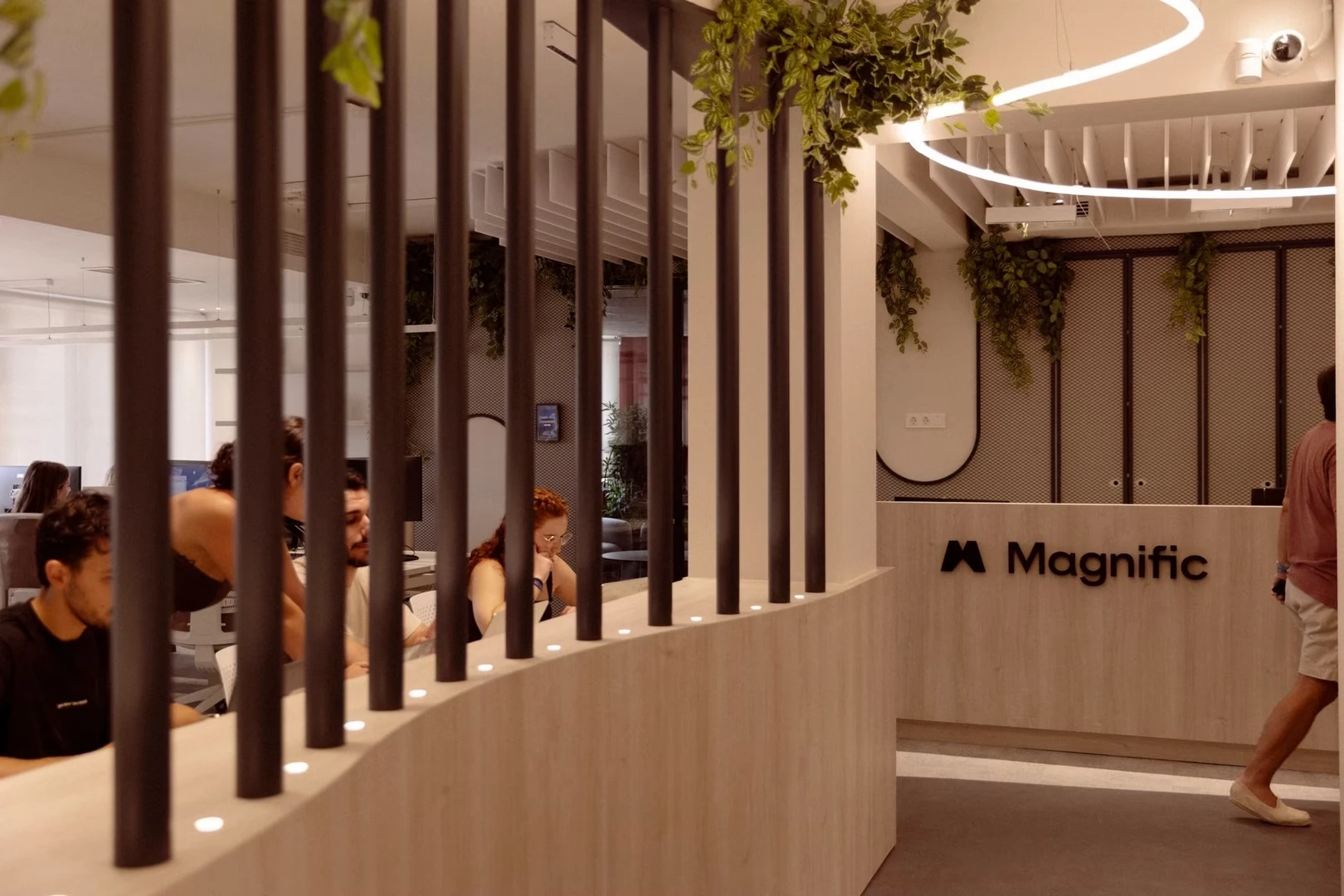
Transition from self-serve to enterprise sales
Magnific reports exceeding one million paying subscribers alongside over 400 enterprise accounts. The most significant transformation over the past year concerns enterprise customer composition, Cuenca noted: film production companies, major advertising agencies and corporate marketing divisions. The organization has transitioned from organic customer discovery to structured sales operations, he stated. Approximately 45 of its 370 personnel focus on pre-sales, post-sales, demonstrations and customer support functions. The company additionally deploys "forward-deployed creatives" for client training.
Most artificial intelligence laboratories lack this infrastructure, he observed, and the subscriber community continues serving as the enterprise pipeline: individuals utilize Magnific for extended periods before introducing it into their organizational environments.
Being funded by customers forces a discipline I don't want to lose: you only build what people will pay for
Joaquín Cuenca
Source: The Next Web