Mobility startup NOVUS has secured a double-digit million funding round led by Berlin- and San Francisco-based venture capital firm 468 Capital. The round brings together over 30 investors spanning technology, automotive, fashion, and consumer goods sectors, alongside venture capitalists and family offices. The company plans to use the capital to expand production of its lightweight electric two-wheeler and develop a lower-cost second model.
The NOVUS One: between e-bike and motorcycle
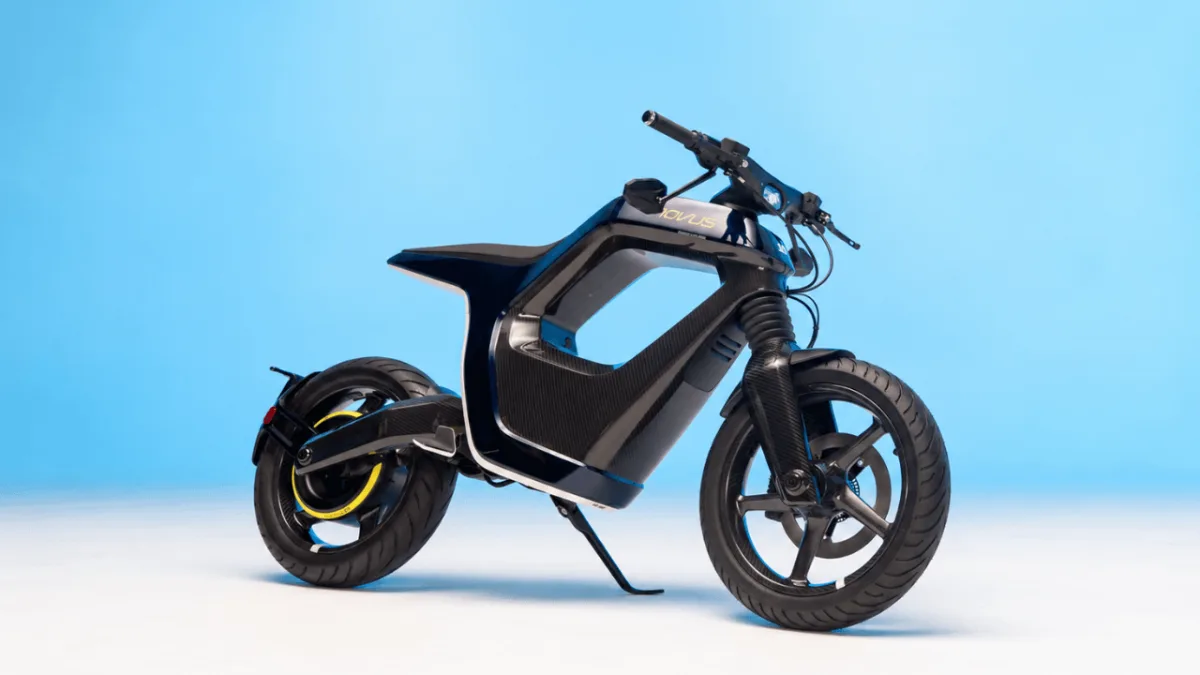
The NOVUS One occupies a distinct category in urban mobility—neither quite an e-bike nor a conventional motorcycle. The vehicle delivers motorcycle-level performance with the accessibility of an electric bicycle, eliminating the need for a clutch or traditional gears. Founded in 2019 by former Volkswagen designer René Renger and Hannes A. H. Krieger, the Braunschweig-based company began shipping to European customers in spring 2026.
Performance specifications include acceleration from 0 to 50 km/h in under two seconds, up to 430 Nm of torque, and 25 kW (33 hp) of peak power. The 6.2 kWh battery delivers a claimed range of up to 150 km, charging from 0 to 80 per cent in 90 minutes. A self-supporting carbon frame houses a hub-mounted drivetrain, while the vehicle offers three riding modes, over-the-air software updates, smartphone integration, and keyless operation. Most first-time riders master basic controls within three minutes. The NOVUS One Founders Edition starts at €21,300 excluding tax.
From design project to production vehicle
Renger's path to founding NOVUS began with his upbringing in central Germany, where mobility meant independence. "The first thing you did when you turned 16 was get a small motorcycle licence so you could get out of town," he recalls. "It wasn't just about mobility. It was about having something of your own, something you could identify with. You also wanted to impress the girl in the next town. That's genuinely how it started."
After studying industrial and automotive design, Renger worked on Volkswagen's Golf 8 and ID. Buzz before pursuing his own venture. A university project called Lightweight Future Mobility provided the conceptual foundation. "At university, we had a project called Lightweight Future Mobility. It was around the time the first electric bicycles were appearing, but they weren't particularly exciting products. They were largely associated with older people and weren't lifestyle products. However, they demonstrated that new technologies were becoming available, including electric drivetrains and different wheel architectures. We saw an opportunity to create something entirely new."
Design as emotional appeal
Rather than targeting mass-market commuters, NOVUS positioned itself as a premium brand where design carries equal weight with functionality. Renger emphasizes that user experience encompasses first impression, handling, operation, and the emotional connection users develop with the product. "We strongly believe a successful product must first convince people emotionally. You need to love it and love using it. Initially, that might appeal to a relatively small group of people, but you can grow from there."
This philosophy shapes NOVUS's market strategy. "We're approaching the market the other way around. First, we create a product that people desire. Then, with our second and third models, we can address a broader customer base and make the technology more accessible." Hundreds of test rides across Europe revealed demand from car drivers and people unfamiliar with powered two-wheelers. Krieger notes that "For them, an e-bike wasn't fast enough, a scooter wasn't exciting enough, and a conventional motorcycle was too heavy or intimidating. NOVUS combines the advantages of all three. You can ride slowly through a city, but you also have the performance for much faster riding."
Engineering challenges and manufacturing location
Renger arrived at NOVUS without formal engineering credentials, a gap he filled through fortunate circumstance. "I was a designer without the necessary engineering expertise. One of my neighbours happened to be a battery engineer, and another was a CAD engineer. I convinced both of them to help." When approaching Bosch to develop a custom motor, the company quoted approximately €1.5 million—a figure that gave Renger pause after leaving his corporate job. "I'd just quit my job, so that was a slightly terrifying moment. But you find solutions."
NOVUS manufactures in Braunschweig, leveraging proximity to Volkswagen's Wolfsburg headquarters and the region's established automotive ecosystem. The vehicle's architecture—closer to an e-bike than a traditional motorcycle—simplifies production by eliminating gears, liquids, and conventional cooling systems. This streamlined design reduces mechanical complexity and creates room for production scaling.
An investor network beyond mobility
NOVUS's shareholder base spans sectors far beyond traditional two-wheeler manufacturing. Investors include executives and founders associated with Kembara VC, Adidas, Audi, BMW, Chrono24, FINN, Grover, Mercedes-AMG, New Balance, Vay, and Xiaomi, alongside Formula E driver Sophia Flörsch, Silicon Valley and European venture investors, and several family offices. No established two-wheeler manufacturer holds equity.
This cross-industry composition reflects deliberate strategy. In 2023, Renger and Krieger began seeking expertise beyond conventional mobility specialists. "We realised we needed people who had already solved parts of the challenges we were facing. Nobody had built exactly what we were building, but there were people with relevant experience in automotive engineering, premium consumer products, technology, finance, fashion, and brand development. So we deliberately built an ecosystem across those industries."
Key advisers include Eric Bach, former Senior Vice President of Product and Chief Engineer at Lucid Motors and former Director of Engineering at Tesla, who contributes to vehicle engineering and development. Martin Hoffmann, former CFO and co-CEO of Swiss sportswear company On, brings experience scaling and taking companies public. Krieger describes this approach as intentionally distinct from seeking traditional mobility investment. "We did not go looking for traditional mobility investors. We built something closer to our own Y Combinator: a network of leaders who have scaled and disrupted markets in tech, automotive and consumer."
Resisting the scaling trap
Despite new funding and ongoing deliveries, NOVUS deliberately avoids the aggressive production targets that have derailed other vehicle startups. "I've seen many manufacturers make the same mistake: they try to scale too quickly. They want to produce thousands or tens of thousands of vehicles almost immediately. Then a supply-chain problem emerges, and suddenly thousands of customers are waiting for delayed deliveries." Instead, the company prioritizes smaller initial volumes and cultivates relationships with early adopters.
Several NOVUS investors purchased vehicles before deciding to back the company financially. The startup also established the NOVUS Club to connect shareholders, customers, and industry partners. "My advice to any hardware founder is never to walk alone. In the beginning, you're relatively isolated. Nobody knows your company, your brand, or your product." A partnership with Hugo Boss, initiated before the vehicle received certification, brought premium fashion materials into the design and lent brand credibility. "Boss lent a bit of their brand trust to us."
European expansion and US entry
NOVUS has delivered vehicles to customers in Germany and Spain, with further European rollout planned for the UK, France, and Italy. A US launch is scheduled for late 2027, beginning in California before expanding to additional states. The new funding supports wider European distribution and development of the NOVUS Two, a higher-volume model with a lower entry price than the original. Production of the second model begins in late 2027.
Beyond its next two-wheeler, NOVUS intends to apply its lightweight vehicle architecture to other urban mobility categories, including four-wheel vehicles. Renger envisions software and AI playing expanded roles in future vehicles, with systems that adapt to riding patterns and provide assistance—ambitions that remain longer-term rather than current production features.
Distribution strategy combines retail partnerships in major cities with direct-to-consumer sales and delivery support in locations without retail presence. Krieger identifies potential in the corporate market, particularly through employer-supported mobility schemes that offer tax advantages to employees in Germany and similar jurisdictions.
Advice for hardware founders
When asked to counsel aspiring hardware and vehicle startup founders, Renger offers candid perspective. "If you're looking for an easy career, you should probably do something else. But if you're willing to work harder than almost everyone you know, and you're prepared for a journey that could take years, then it's possible." While AI tools have democratized access to technical information, he argues that real obstacles lie in persistence, relationship-building, and inspiring others to support a vision.
Renger strongly recommends gaining experience at established automotive or manufacturing companies before launching a mobility venture. "There's a narrative in the startup world that traditional companies are boring, but I think that's nonsense. You learn from highly professional teams, understand production processes, and discover what it means to deliver against deadlines that cannot simply be postponed."
Source: Tech.eu