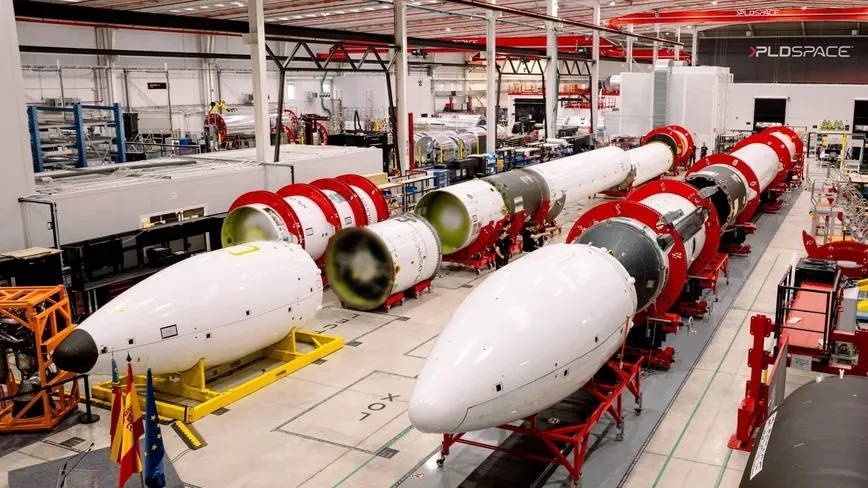
PLD Space, the Spanish launch venture, has commenced system-level testing of Miura 5 and finished construction of its first three rockets, the company announced. The Elche-based firm is building two qualification units designated for testing purposes, alongside a third vehicle that will serve as the initial flight-ready rocket, which remains under assembly. Developing all three in tandem enables the engineering team to integrate findings from qualification tests directly into the production flight vehicle.
At PLD Space's testing facility in Teruel, eastern Spain, a fully integrated second stage—combining structural components, avionics, propellant systems, control mechanisms, and the engine—stands vertical and ready for evaluation. The stage will undergo a wet dress rehearsal involving a simulated countdown sequence using actual propellants, followed by a static fire test in which the engine operates while the stage remains secured in place.
These testing phases are designed to mitigate technical risk ahead of Miura 5's planned demonstration flight in the first half of 2027. The company has already validated stage separation procedures during flight and tested two prototype nose cone designs that will shield the payload.
PLD Space has manufactured seven complete engines and 13 fuel tanks to date, encompassing the liquid-oxygen tanks required for both stages of the first-flight vehicle. Flight-ready avionics have been prepared for four complete rockets.
Having manufactured three vehicles in parallel allows us to accelerate this learning process
Raúl Torres, PLD Space chief executive and co-founder
The company is scaling up its infrastructure across multiple locations. Its Elche facility encompasses 17,000 square metres of manufacturing space, while the Teruel site operates ten test stands, including a newly constructed 10.2-metre stand designed specifically for testing complete second stages.
At the Guiana Space Centre in Kourou, French Guiana—where Miura 5 will launch—PLD Space has received approximately 60 containers of ground support equipment. The company is collaborating with the French space agency CNES to establish launch safety protocols.
Launch pad systems are undergoing their own validation cycle. These systems encompass the strongback mechanism that positions the rocket vertically, the retention clamps that secure it until ignition, and the umbilical connections supplying power and propellant.
PLD Space has invested €42.7M across 493 suppliers in its development efforts. The programme benefits from the company's selection for the European Space Agency's European Launcher Challenge and a €288mn Series C funding round.
The company previously demonstrated its capabilities by launching Miura 1, a smaller suborbital test vehicle, in October 2023.
Source: The Next Web