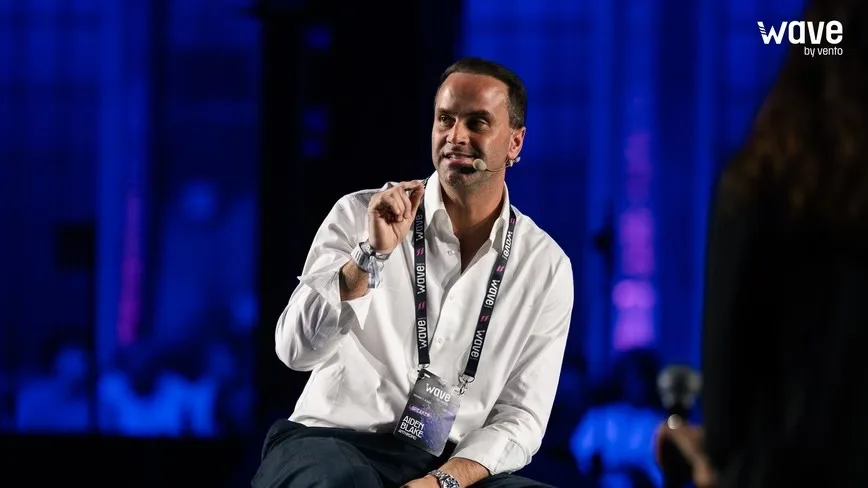
Despite making it technically feasible to launch ventures from anywhere on the globe, the recent surge in AI development is drawing founders back into shared spaces. This observation emerged from a discussion at Wave by Vento in Turin on Thursday, where Station F director Roxanne Varza and Aiden Blake, head of startup sales for Europe, the Middle East and Africa at Anthropic, explored why in-person collaboration remains crucial even as digital tools become increasingly sophisticated.
Varza noted a visible shift at Station F, the Paris-based startup campus that hosts roughly 1,000 early-stage companies. "What's really interesting is we're seeing more and more people coming since the 'AI boom'. I think actually a lot of teams are really embracing physical presence," she said. Blake, whose previous employers included Google and Notion—both Station F partners—emphasized that while online product development and customer engagement have become easier than ever, something fundamental still requires face-to-face interaction. "The ability to build a product and to engage with prospective customers online has never been easier. What that actually means for people is that the real trust, I think, happens in person," Blake explained.
An AI programme with set days on campus
Station F launched F/ai in February, a dedicated initiative for artificial intelligence startups backed by partners including Anthropic, OpenAI, Mistral AI and Meta. While the programme accommodates hybrid arrangements, Varza stressed that physical attendance at specific programme moments is non-negotiable for teams seeking to build momentum. The current cohort reflects European diversity, with roughly two-thirds of participants hailing from outside France, including groups from Asia, Stockholm, the United Kingdom and Poland.
Blake cited Anthropic's commitment to embedding itself within the startup ecosystem as the reason for joining the initiative. His career trajectory—spanning Google, Notion and now Anthropic—has kept him connected to Station F's evolution as a partner institution.
People, information and chance
When asked to distinguish between proximity's value in connecting people, sharing information or enabling unexpected encounters, Varza identified all three as essential. Many contemporary founders bring repeat experience and expansive professional networks; being physically present with them unlocks opportunities that would otherwise remain closed. Relationships, she argued, cannot be manufactured through strategy alone—they require space for spontaneity and chance encounters.
Blake observed that founders gathering at Anthropic events seek two things: peers wrestling with identical challenges and mentors further along their journey. He also highlighted capital access as a tangible benefit of geographic proximity, pointing to emerging startup ecosystems in Stockholm and Warsaw. At the same event, Luca Ferrari of Bending Spoons suggested that funding constraints no longer represent Europe's primary competitive disadvantage.
Anthropic operates its European operations from Dublin, where 150 staff members work across multiple teams. Blake explained that the location provides both talent availability and a time zone positioning that spans markets from South Africa through France and Germany.
Remote, then back together
Varza acknowledged that exceptional companies can originate anywhere in today's environment, yet physical togetherness retains significance. Blake cited ElevenLabs as an example of this pattern: the company began entirely distributed before establishing offices as it scaled, most recently opening a Brussels location last month. Many remote workers, Blake noted, now prefer returning to in-person team settings, particularly those in go-to-market functions where peer learning accelerates development. Not all companies have embraced this shift—Dropbox's new co-CEO announced in August that the company intends to maintain its remote-work approach.
Looking ahead, Varza identified technology infrastructure and relationship-building velocity as differentiators for startups seeking competitive advantage over the next five years. Blake expressed skepticism about making predictions even five days into the future, instead emphasizing that winning companies will maintain clarity about their core problem while remaining attentive to customer priorities.
Source: The Next Web