When allergies flare up, sufferers often feel blindsided. The culprits accumulate silently—pollen, dust, pet dander, pollution, fatigue—before the body finally reacts. Thea, a wearable device created by students at SUPSI's Master of Arts in Interaction Design programme in Switzerland, takes a different approach: it monitors the total burden of environmental exposures and personal factors to warn users before symptoms arrive. The prototype, built on Arduino's UNO Q board, debuted at Maker Faire Rome 2026.
Beyond single triggers: cumulative load
Conventional allergy applications track one trigger at a time. Thea instead models cumulative load—the sum of everything a person has encountered and how close it brings them to their personal threshold. The team calls the space between current exposure and that threshold the "action window": a calculated estimate of when the user might benefit from taking preventive steps.
Rather than bombarding users with alerts, Thea adopts calm technology principles, staying quietly in the background and communicating through multiple senses:
- Light: A gauge fills clockwise to display remaining headroom.
- Vibration: Pulses indicate how quickly the window is narrowing or expanding, always paired with the light display.
- Voice: Deployed sparingly and never unprompted. Users initiate conversations to report unmeasurable factors ("I just petted a dog"), and the device responds in a measured tone. When the window approaches closure, light and vibration request acknowledgment before voice provides information.
A single tap delivers a status update without requiring an app. Thea remains silent unless the user initiates contact or acknowledges a signal first.
Dual processing on a single board
The team selected UNO Q because Thea requires two distinct computational systems. The board combines a Qualcomm Dragonwing™ QRB2210 processor running Linux with a real-time STM32U585 microcontroller, allowing both layers to coexist.
- Microcontroller layer: Handles the button, light gauge, and haptic motor, plus the cumulative load model that calculates the action window. This layer operates deterministically and in real time.
- Linux layer: Runs the voice agent connected to microphone and speaker, engaging when light and vibration prove insufficient.
This architecture embodies a crucial design choice: the language model never determines available headroom. That calculation belongs exclusively to the load model on the microcontroller. Voice merely translates that state into words, ensuring responses remain grounded in the model's actual output.
Privacy by design
The team views allergy data as health data and believes it should remain with its owner. Thea is therefore designed for local operation: the risk model and voice functionality live on the device itself, with intended future implementations processing health information entirely on-board.
UNO Q supports this architecture, capable of running small open-source language models, speech recognition, and text-to-speech directly at the edge. During the Rome demonstration, the voice agent still relied on a cloud model to allow rapid iteration on conversation design. The system is structured so this component can be replaced with an on-device version without altering the user experience. Full on-device voice functionality represents the next development phase.
Local processing offers benefits beyond privacy. Should voice functionality move entirely on-device, the architecture is intended to enable operation without server connectivity and local handling of sensitive health data.
From classroom to public stage
Thea emerged from "More Than Me," a five-week MAInD module on multimodal experience design led by Serena Cangiano and Enrico Bassi. Every participating team designed and constructed its prototype using UNO Q.
From October 23 to 25, Thea was one of two MAInD projects featured at the Arduino booth during Maker Faire Rome. The team spent three days engaging with makers, families, students, and visitors.
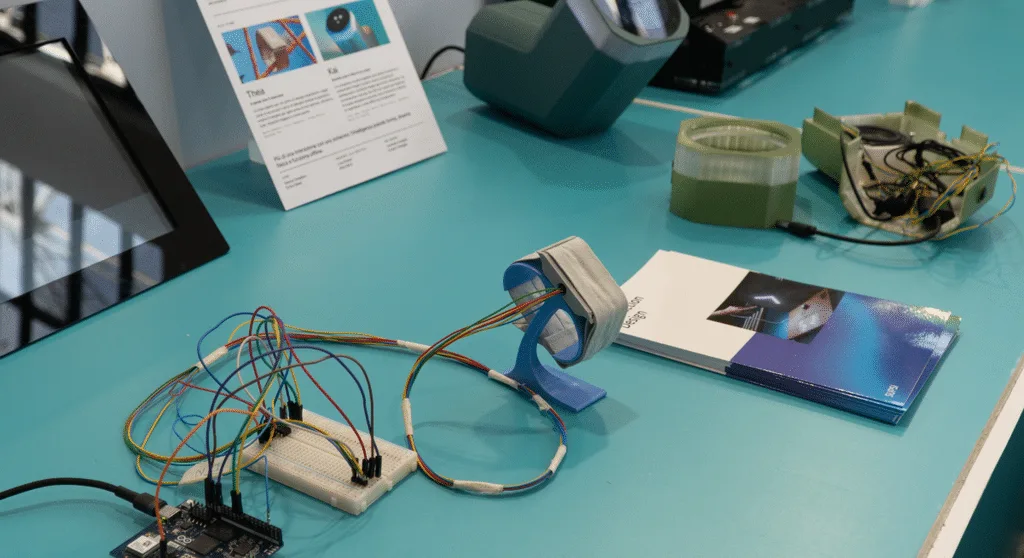
The displayed prototype retained its classroom form: a 3D-printed enclosure housing the light gauge and vibrating button, wired to UNO Q alongside a speaker and microphone, running on simulated exposure data. A companion phone application completed the demonstration, guiding visitors through the onboarding process.
Looking ahead
Following Rome, the team is advancing Thea beyond its academic origins. Plans include gathering feedback from people living with allergies, medical professionals, and technical experts as development of the next iteration proceeds. Interested parties can reach out at info.thea.ch@gmail.com
Underlying the entire project is a question the team posed repeatedly in Rome: "what could technology feel like if it lived on the body instead of on a screen?"
Thea was designed and built by Nerea Asensio, Nicholas Vos, Lucia Ciapessoni, and Jérémy Martin at MAInD SUPSI.
Source: Arduino Blog