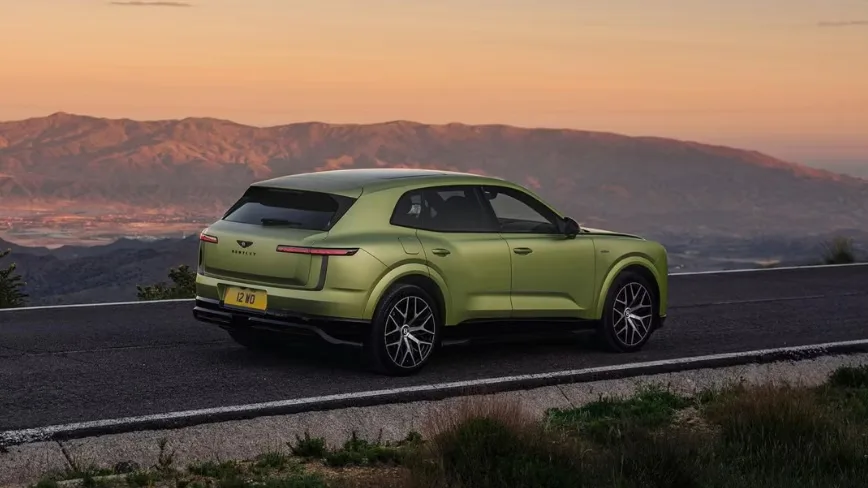
Bentley has introduced the Torcal, marking the brand's entry into the electric vehicle market. The midsize SUV delivers 876 horsepower from a 113 kWh battery pack, achieving a 375-mile range under the WLTP testing standard. Charging at up to 400 kW allows the battery to reach 80% capacity in under 20 minutes, with pricing starting at £173,300.
The vehicle's London launch came with a significant announcement: the company has postponed its target for an all-electric lineup from 2030 to 2035. Chief executive Frank-Steffen Walliser stated that "no further electric model is planned before 2030 at the earliest" and that "the era of the decade-long roadmap is over at Crewe."
Walliser attributed the shift to regulatory volatility, explaining that "regulators have new ideas every week," making long-term planning unreliable. Rather than committing exclusively to battery power, Bentley has developed a new family of plug-in hybrids and suspended its combustion engine phase-out, citing both weakening demand for ultra-luxury electric vehicles and evolving emissions standards.
The company completed a £350 million investment at its Crewe facility, which includes a new production line for the Torcal. This line was engineered to manufacture both electric and hybrid vehicles on the same assembly, allowing output to adapt to market demand and regulatory requirements. The facility supports approximately 4,000 jobs.
Britain's zero emission vehicle mandate, revised in April of the previous year, exempts manufacturers producing fewer than 1,000 vehicles annually from 2030 requirements, with negotiated targets for those under 2,500 units. Competitors including Aston Martin, McLaren, Lotus, Morgan and Caterham qualify for these exemptions. Bentley, which delivered 10,643 cars in 2024, does not.
The Torcal is built on Porsche's Premium Platform Electric, an 800-volt architecture developed within the Volkswagen Group. It shares the same 113 kWh battery as the Cayenne Electric, which charges to 80% in under 16 minutes. Porsche itself abandoned its own 80% electrification target for 2030 in July 2024, as its operating profit declined 93% in the previous year.
The Torcal represents a significant step down from Bentley's earlier promises. In 2022, the company had announced its first electric vehicle would arrive in 2025 with up to 1,400 horsepower and accelerate to 60 miles per hour in 1.5 seconds. The production model, arriving as a 2028 model year vehicle, delivers 876 horsepower and achieves that acceleration in 2.8 seconds. The manufacturing line that produces it was designed to build petrol engines alongside electric and hybrid variants.
Source: The Next Web