What transformations are reshaping our world, and how might orbital vantage points illuminate Earth's trajectory? Running from October 8, 2026 to February 9, 2027, Mirades orbitals. El planeta a vista de satèl·lit (Orbital Views. Our Planet from Space) at CaixaForum Girona opens a window into Earth observation's role in understanding planetary systems. Ars Electronica Solutions designed and executed the exhibition, which emerged from an initiative by the "la Caixa" Foundation working alongside the European Space Agency (ESA) and the German Aerospace Center (DLR). After its Girona debut, additional CaixaForum locations across Spain will host the show.
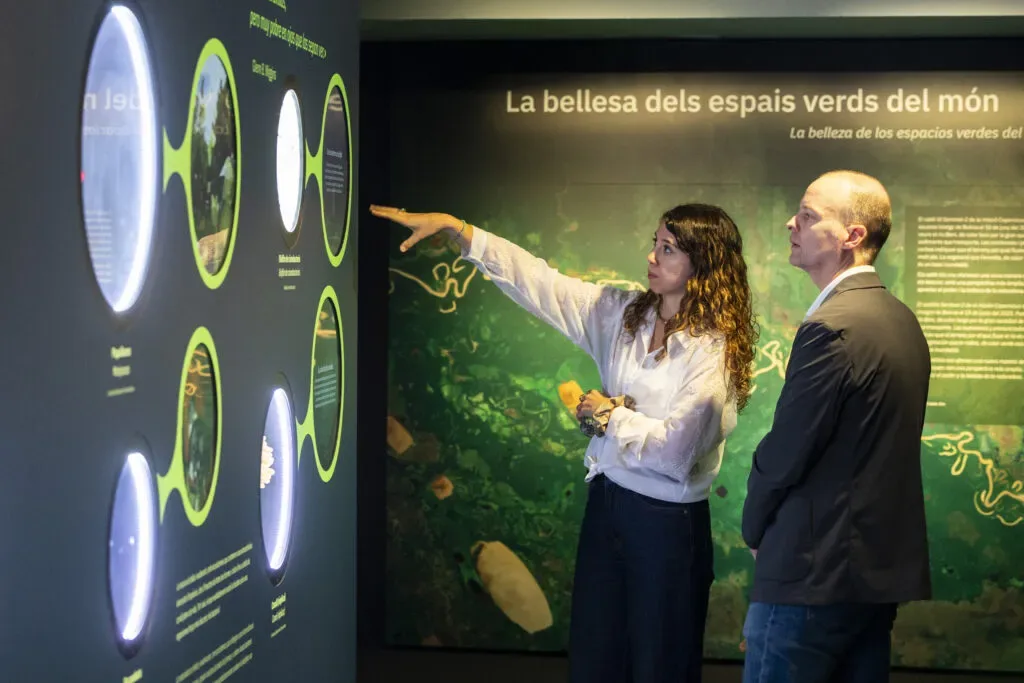
Spanning two levels, the exhibition journeys outward from our world into the cosmos and inward to Catalonia's specifics. The upper floor examines the fundamentals underlying Earth observation—how satellites function, what technologies they employ, and the scientific principles guiding them. Below, visitors encounter Earth's interconnected systems: atmosphere, water, ice, life and geology. The design weaves together digital and physical elements, visual and tactile dimensions, ensuring accessibility across all ages.
Satellite data opens perspectives on our planet that often remain invisible in everyday life. Our task was to translate these complex scientific interrelationships into spatial, interactive and tactile experiences. In this way, Earth observation becomes not only understandable but also personally tangible – transforming data into curiosity, understanding and a new perspective on our planet.
Michael Mondria, Managing Director of Ars Electronica Solutions
Understanding our planet from space
The exhibition's opening section probes fundamental questions: how do satellites reach orbit, which instruments they carry, and what revelations their measurements yield about climate, weather and environmental conditions? Focusing on atmospheric observation and ESA's contributions, the display traces humanity's journey from early space ventures to contemporary Earth monitoring. A full-scale replica of Robert Goddard's pioneering liquid-fueled rocket stands alongside the first photograph of Earth captured from space in 1946, alongside present-day satellite systems. The Half-Dome Globe presents a data-informed portrait of our world, rendering planetary shifts perceptible. Using the ozone layer as a case study, the exhibition demonstrates how scientific discovery can catalyze tangible policy shifts: coordinated global action against ozone-depleting compounds has enabled sustained restoration.
Earth observation is more than just technology – it is a powerful tool for sustainable and inclusive development. Sound knowledge forms the basis for effective action to protect our planet.
Simonetta Cheli, Director of Earth Observation Programmes and Head of ESRIN at the European Space Agency ESA
From satellite image back to Earth – and to Catalonia
The lower floor organizes its content around four spheres: water systems and frozen regions, living ecosystems, and rock formations. Digital Windows merges photographic data with tangible specimens—butterflies, fungi, beetles, seeds, fossils—revealing connections between organisms and their environments. A monumental lenticular photograph documents the Sau Reservoir, contrasting its state before and during the severe drought spanning 2021 to 2024. As viewing angles shift, the image transitions between these two moments, making the dramatic drop in water levels immediately apparent.
At the Geosphere Station, visitors handle rocks and minerals directly. Engagement with these physical materials unlocks supplementary details regarding Earth's internal structure and mineral composition.
How do we envision our future?
The exhibition concludes with the Sphere Mixer, which synthesizes the show's various viewpoints and redirects attention from scientific measurement toward the visitors themselves. Offering multiple choices, this interactive element poses a central question: what aspects of environmental futures matter most to us? Personal declarations such as "We need bees," "I want a clean city," or "I want to ski" bridge the distance between planetary-scale transformations and individual daily concerns. In this way, Earth observation functions as a mechanism for recognizing shifts and acquiring knowledge that can guide subsequent choices.
Mirades orbitals is an exhibition of immediate relevance, as it addresses one of the major concerns of our time: the climate. Climate issues are a matter of concern for us all and demand our attention. Through this exhibition, we aim to convey an optimistic and hopeful perspective, because knowledge, science, and technology provide us with the tools to better understand what is happening, anticipate risks, make decisions, and take action.
Anna Colomer, director of CaixaForum Girona
About Ars Electronica Solutions
Ars Electronica Solutions designs and builds interactive, multisensory exhibition environments. Established in 2011 as a division of Ars Electronica, the organization develops bespoke exhibition concepts, brand experiences, trade fair installations and event designs through close partnership with clients. Beyond conceptual innovation, the team oversees implementation and provides ongoing operational support. Its expertise draws from decades of work at the Ars Electronica Center and the Ars Electronica Festival.
About the Fundación "la Caixa"
Spain's foremost philanthropic organization, the Fundación "la Caixa" pursues a mission of fostering a more just society and generating prospects for vulnerable populations. Its programming spans social development, scientific inquiry, cultural expression and learning. Through CaixaForum cultural venues and the CosmoCaixa science museum, the foundation brings science, culture and socially pressing subjects within reach of broad audiences. Creating original content and exhibitions, alongside partnerships with global organizations, forms a cornerstone of its approach.
About the European Space Agency ESA
Established in 1975, the European Space Agency now encompasses 23 member nations. Its mandate centers on peaceful space exploration and utilization benefiting humanity universally. Earth observation ranks among its principal endeavors. Orbital measurements enable weather prediction, climate science, agricultural management and emergency response, while enabling perpetual surveillance of forest cover, marine systems, atmospheric composition and polar ice.
Source: Ars Electronica