Munich's city council has officially selected the Ars Electronica Futurelab to create an interactive memorial installation at the Square for the Victims of National Socialism, set to open in 2028. The project, titled "Das Feld" (The Field), emerged from a competition launched by the city in spring 2025 to design a media art work that would honor approximately 12,000 people murdered in Munich between 1933 and 1945. In a conversation with Horst Hörtner, Senior Director of the Linz-based studio, he walks through the conception, design and deeper meaning of an installation that bridges individual remembrance with collective responsibility.
From Competition to Concept
When Munich approached the Futurelab about participating in the competition, the city outlined a vision for what it called a "digital participatory memorial of names." A central archive was to be created, bringing together victim databases for the first time and incorporating them into the artwork. The city also posed practical questions about the site itself: tree locations, emergency access routes, ground conditions and load-bearing capacity all needed consideration before any design could take shape.
Two priorities emerged from initial workshops with city officials. The city insisted on involving victims' associations in the development process, and it explicitly rejected the idea of a traditional stone monument with added media technology. Instead, it sought something genuinely participatory and new.
When Hörtner met with representatives from victims' associations at a second workshop, he encountered sobering feedback. "I asked whether they felt their concerns were being heard by the public and whether their work resonated with people," Hörtner recalls. "I also asked how much trust and hope they themselves had in 'society.'" The associations expressed limited optimism about public engagement. Yet educators working with young people identified a specific gap: students showed genuine interest in learning about fascist atrocities but lacked accessible ways to channel that awareness into meaningful participation in remembrance culture.
Before designing anything, Hörtner and his team spent weeks studying the square itself. They examined sightlines, vegetation, accessibility and fire department routes. They also observed how people naturally moved through the space, where they paused and how they interacted. Understanding the site's rhythm proved essential to creating an installation that would function as both artwork and gathering place.
The Design: Wheat, Light and Metaphor
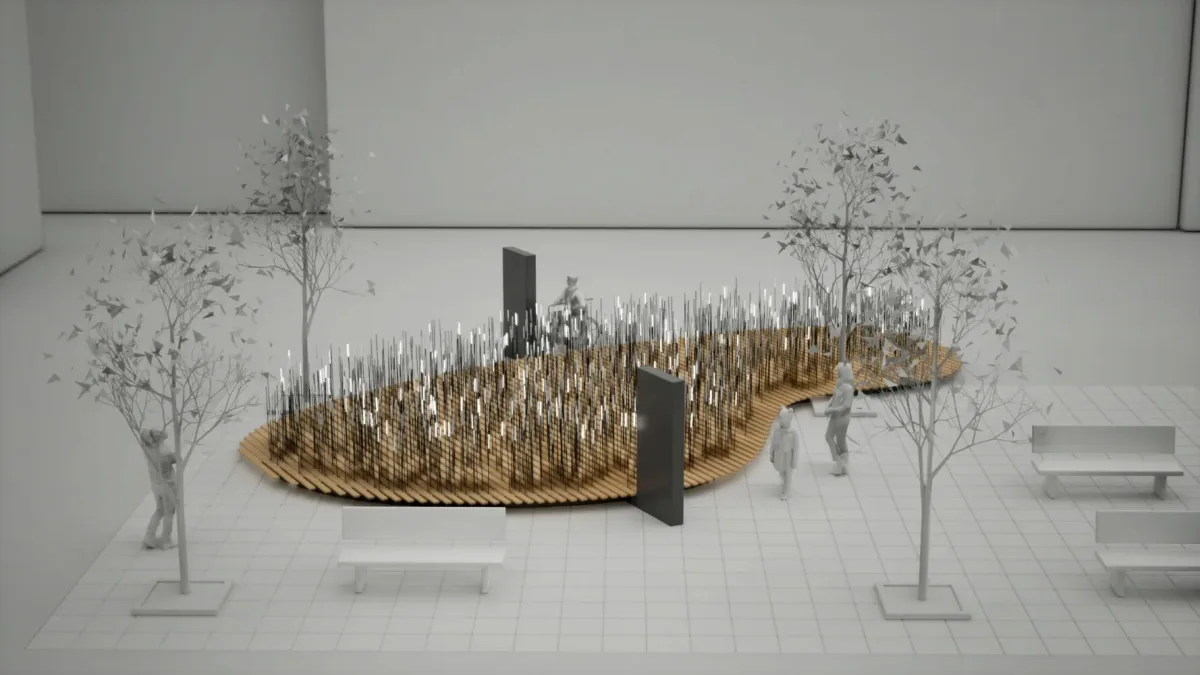
After exploring concepts involving talking stones and illuminated nets, the team settled on a wheat field with glowing ears of grain. The symbolism resonated across multiple levels: grain represents rural heritage while light evokes urban space, and Munich uniquely bridges both. The agricultural metaphor also carried deeper meaning—what grows in a field depends on what is sown, and growth requires ongoing care. These ideas aligned perfectly with themes of remembrance and democracy.
The field's physical dimensions encode historical data. Its length spans the years 1933 to 1945, while its width varies to reflect the number of people murdered in each year. Viewed from above, the entire structure resembles a footprint. The installation rests on a platform of untreated larch boards that will gradually gray over time. When boards require replacement, the lighter new wood will visibly contrast with weathered neighbors, making maintenance work transparent and intentional.
Over 1,200 stalks rise from the platform, each one's height determined by the number of victims on or near a particular date. At the top of each stalk sits an ear of wheat that visitors can illuminate.
Interaction Through Heartbeat
Two interactive terminals flank the field, each displaying names, photographs, biographies and death dates of murdered individuals. Pulse sensors on the terminals measure a visitor's heartbeat when they place their hand on them—a gesture mimicking the gentle touch of sympathy on a friend's arm. That heartbeat then transmits to the ear of wheat associated with the person being remembered, illuminating it for all to see.
This mechanism transforms private remembrance into public visibility. "This interplay between individual remembrance and collective awareness, and thus a shared culture of remembrance, is the central element of our architectural design," Hörtner explains. "It is our answer to the City of Munich's question of how a participatory memorial of names can work."
The design carries an implicit challenge. As more people engage with the memorial, more ears glow. Conversely, if remembrance wanes, the field darkens. No single person bears responsibility for keeping the light alive; the burden rests collectively on society. "Remembering the victims must not be a one-time act, but an ongoing process that will never be complete," Hörtner says. "Just as our memories fade over time, the ear of wheat I once lit up will eventually stop glowing. It is our collective responsibility to make sure the field never goes dark."
Fragility as Strength
The installation's delicate appearance contrasts sharply with the weight of its subject. Rather than dominating the square with monumental authority, the field invites visitors to participate in everyday remembrance. It functions not as accusation but as invitation. The focus remains on victims and their individual stories, not perpetrators. The goal is to reach living people today with a message about preventing future atrocities and sustaining democracy through active remembrance.
For Hörtner, this project represents something fundamentally different from previous work. "A project that seeks to contribute to democracy, highlight the consequences of fascist ideology and actively counter it is fundamentally different from a visualization that simply aims to look impressive," he reflects. "This is about creating meaning that extends beyond art itself." Unlike earlier remembrance projects by the Futurelab, which were temporary, Das Feld will be permanent. Its location in the city center ensures it will reach a broad public audience.
About Horst Hörtner
Horst Hörtner is a media artist and researcher focused on human-computer interaction, holding several patents particularly for swarm drone flight technology known as "Spaxels," which his lab debuted as a world premiere in 2012. His career in media art spans since the 1980s. He co-founded the group x-space in 1990, which won recognition at the Prix Ars Electronica. Joining Ars Electronica in 1995 as Technical Director, he co-founded the Ars Electronica Futurelab with Gerfried Stocker and led it until 2024. He currently serves as Senior Director and, since 2020, as CTO of Ars Electronica. His work consistently bridges art, technology and society, and he speaks and publishes internationally on these intersections.
Source: Ars Electronica