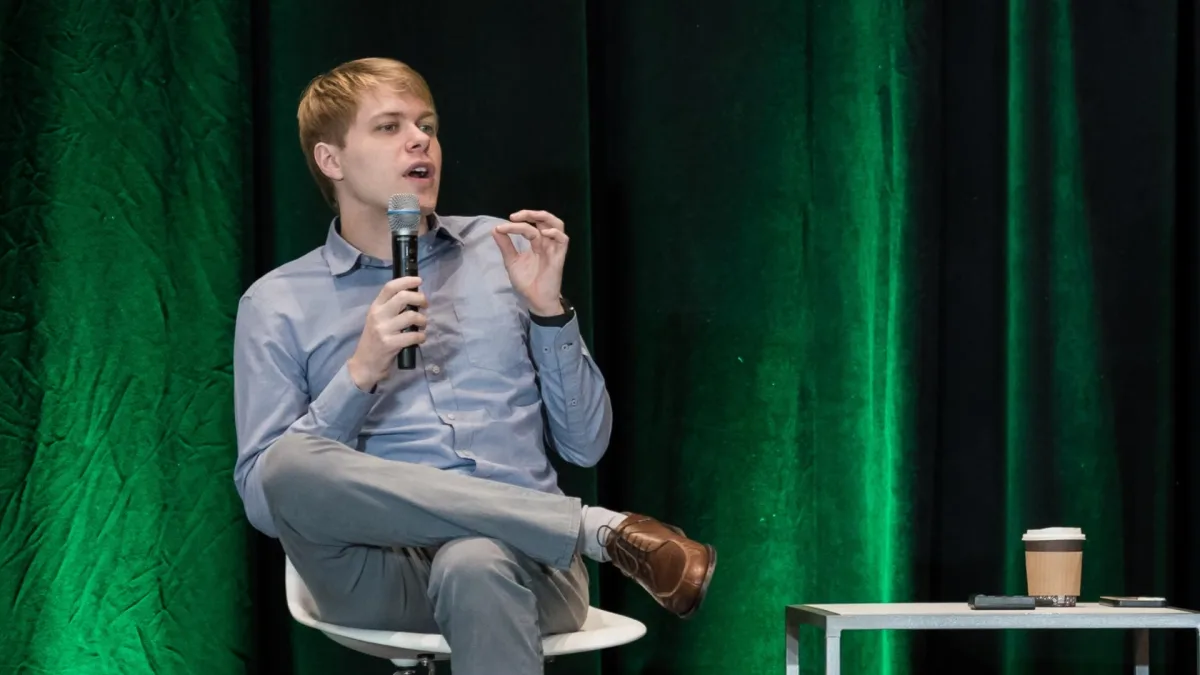
The DealBook AGI panel at The New York Times' DealBook Summit in New York on Wednesday brought together competing visions for AI governance. Moderated by Michael Barbaro of The Daily, the discussion featured Dan Hendrycks of the Center for AI Safety, Max Hodak of Science Corporation (co-founder of Neuralink), Lila Ibrahim of Google DeepMind, Mati Staniszewski of ElevenLabs, and Clem Delangue of Hugging Face, who arrived with 18 minutes remaining. Hendrycks had served as a safety adviser to several AI companies until hours before the panel.
'A more blunt intervention'
Hendrycks pointed to the US midterms as evidence that voters care deeply about artificial intelligence, creating political space for open discussion of development restrictions in Washington. He predicted 2027 would prove significant for regulatory action. Previously, he explained, he had advocated for narrow technical constraints, but industry resistance over years convinced him a different approach was necessary.
So now it's, we're going to need a more blunt intervention. That's how it is.
Dan Hendrycks
His proposal calls for an indefinite pause on the largest training operations, with exceptions for specialized applications like DeepMind's AlphaFold and voice synthesis tools. Companies could continue offering inference services, he suggested, while dedicating resources to improving model reliability and security, eliminating jailbreaks and backdoors, and strengthening critical infrastructure defenses. Hendrycks also noted that frontier laboratories, excluding Google, allocate minimal resources to healthcare applications, with some maintaining zero or one-person healthcare teams, since their business models depend on coding capabilities.
'An exhaustive surveillance state'
Barbaro raised the concern that Nvidia chief Jensen Huang would likely voice: China would not respect a moratorium. Staniszewski acknowledged that a pause could succeed with worldwide cooperation but identified this as the central uncertainty. Without global participation, Barbaro noted, such a pause would prove ineffective.
Hodak countered that the past eight months have already seen extensive critical infrastructure patching, with organizations using AI systems to identify new vulnerabilities in their code. Enforcing a training restriction, he argued, would demand governmental powers as invasive as the concerns people harbor about technology companies themselves.
You're setting up like an exhaustive surveillance state on the internet to enforce this.
Max Hodak
Hodak asserted that current leading models—Mythos, Fable, Astra and Sol—already satisfy his definition of AGI. He predicted governments would maintain their own superintelligence capabilities while permitting an "industrial intelligence frontier" accessible to broader markets.
I don't think that the genie is going to be put back in the bottle.
Max Hodak
His solution centers on antitrust enforcement. Frontier laboratories should restrict themselves to selling intelligence services rather than expanding into pharmaceuticals, automotive manufacturing and other sectors, he argued. He characterized AI as the inverse of nuclear weapons: whereas nuclear safety depends on limiting proliferation, AI safety requires widespread distribution. The scenarios he finds most troubling involve a small number of actors controlling all AI capabilities.
Ibrahim, Google DeepMind's chief AI readiness officer, rejected the binary framing. Safety cannot be "bolt on to the end" of development, she stated. Drawing on 35 years in technology, she observed that public confidence in technology has never been lower than at present.
Anthropic's IPO
Anthropic was scheduled to begin trading the following day. Hendrycks reiterated accusations from a statement his organization had circulated against the company and introduced an additional charge. Multiple safety organizations privately agreed with the statement but declined to sign publicly, he claimed, fearing retaliation through lost funding or restricted access.
What they're doing is reckless and they don't have a safety plan. They know it.
Dan Hendrycks
Anthropic did not participate in the panel. In its IPO filing, the company stated it does not plan to permit Claude to independently develop its successors without substantial human involvement.
Delangue identified concentration of talent, computational resources and capital as his primary concern. When Barbaro questioned his credibility given Nvidia's acquisition of Hugging Face, Delangue responded that both Nvidia and Hugging Face work to democratize AI access among developers. He noted that Hugging Face never pursued acquisition discussions with Anthropic due to fundamental mission misalignment.
Fighting AI with AI
Barbaro concluded by asking Delangue about the Hugging Face breach conducted by OpenAI's research agents. Rather than diminishing his confidence in AI, the four-day attack strengthened it, Delangue explained. The organization deployed an open-source Chinese model to examine attack logs, as the scale of data required artificial intelligence for effective analysis.
People only see that we got attacked by AI and they rarely see that we defended ourselves with AI.
Clem Delangue
Barbaro summarized the panel's positions as opposing a moratorium and favoring reduced power concentration, with Hendrycks as the notable exception. Hodak delivered the final remark, suggesting that antitrust law could accomplish most objectives without requiring new regulatory bodies.
Source: The Next Web