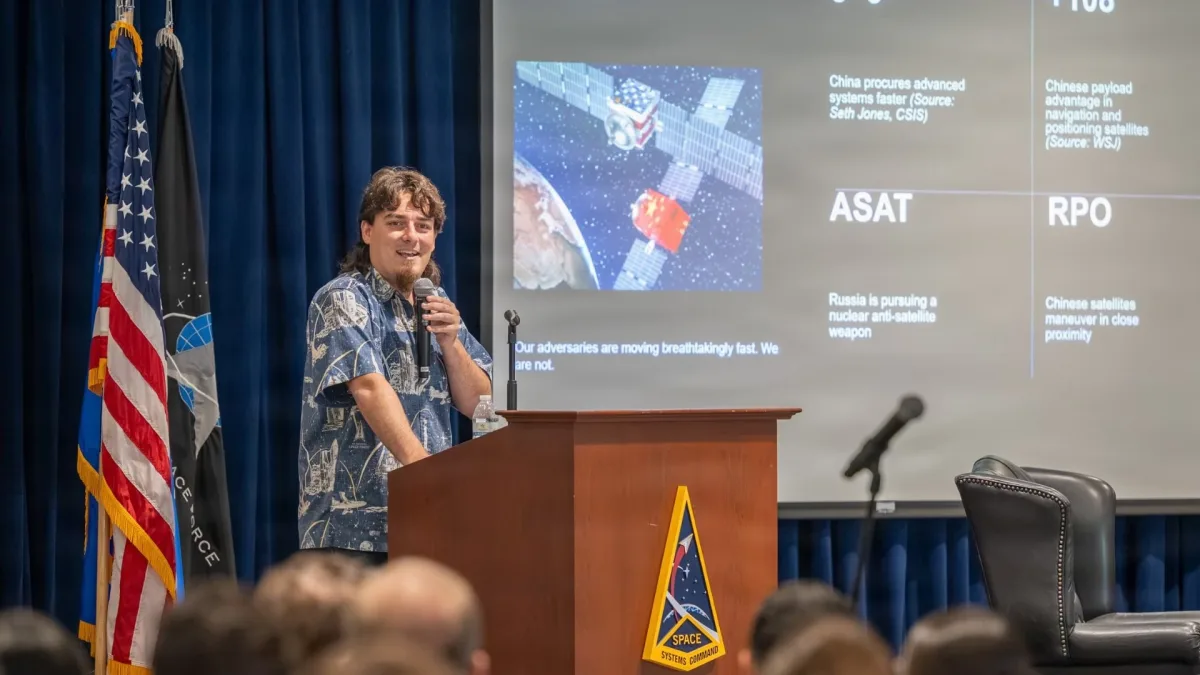
Speaking at DealBook in New York on Wednesday, Palmer Luckey outlined his view that geopolitical caution is preventing Ukraine from accessing the Pentagon's full military capabilities. The Anduril founder made his remarks to Andrew Ross Sorkin while defending Elon Musk, who had spoken earlier that day about Starshield, the military satellite constellation operated with SpaceX's involvement.
Luckey contended that the US government blocks Ukrainian access to Starshield out of fear that Russia might retaliate by destroying the network. He framed this as part of a broader pattern of Western hesitation.
The US government isn't even willing to stand up for Ukraine because they're afraid of losing their constellation
Palmer Luckey
Luckey's reasoning centred on the vulnerability of civilian infrastructure. Russia has threatened to target the Starlink network if Ukraine continues using it for military operations, he noted. Since the same satellites that serve Ukraine also pass over American territory, Luckey argued that Musk should not bear alone the burden of risk that Washington itself refuses to take.
The West's ambiguous commitment
Nobody in the West actually wants Ukraine to win. They just want them to not lose for as long as possible, which is a bizarre and absurd warfighting position
Palmer Luckey
Despite this stark assessment, Luckey stated his own full backing for Ukraine and noted that Anduril has maintained operations there since the second day of the invasion. He also acknowledged the limits of his own influence over American military policy.
I'm a dog on a chain and I need to be kept that way
Palmer Luckey
Future warfare and weather manipulation
Luckey co-leads Project Meridian, a Pentagon initiative examining warfare scenarios in 2050, alongside Elon Musk and Newt Gingrich. The MITRE Corporation administers the 120-day study, which convened at Cheyenne Mountain the day before Luckey's DealBook appearance. The project focuses on concepts currently lacking champions within the Pentagon bureaucracy.
Among the speculative technologies under examination is weather control—specifically, techniques to alter precipitation patterns over ocean areas to improve targeting visibility for military forces. Luckey also claimed credit for encouraging the Trump administration to rebrand the Defense Department as the Department of War.
When Sorkin raised criticism from Wes Bryant, the former Pentagon official responsible for assessing civilian casualties, who characterized Meridian as evidence of oligarchic influence in government, Luckey countered that the group comprises more than 20 members, including retired military leadership. He noted that no similar objections were raised when Eric Schmidt joined the Defense Innovation Board under the Biden administration, and emphasized that the final report will be made public.
Nuclear testing and artificial intelligence in warfare
Luckey advocated for resuming American nuclear tests, primarily to understand how electromagnetic pulses affect contemporary electronics. Current modelling, he argued, relies on data from transistors vastly larger than those found in modern devices.
They were designed for the type of cell phone that Abraham Lincoln would have used
Palmer Luckey
On artificial intelligence in weapons systems, Luckey rejected the notion that AI can be reliably controlled, pointing out that every major model has been compromised through jailbreaking within months of release. Data centres remain a potential vulnerability, he acknowledged. However, he distinguished between AI deployed in weapons—which he characterized as more dependable than legacy targeting systems—and consumer chatbots.
I am way more afraid of the civilian collateral side for dumb weapons than I am for smart weapons
Palmer Luckey
Luckey referenced unnamed companies that have employed chatbots for targeting with poor results. He expressed support for Jensen Huang's continued leadership at Nvidia, citing Chinese efforts to remove him, while maintaining his opposition to semiconductor sales to China.
Public executions and unresolved grievances
Luckey also addressed capital punishment, arguing that while the state should rarely resort to execution, when it does, the process should occur publicly and without medical involvement, allowing citizens to evaluate whether justice was properly administered.
Executions should be brutal. They should be violent
Palmer Luckey
Returning to his 2017 departure from Facebook—which followed his $9,000 donation to a pro-Trump political group—Luckey attributed the firing to former Oculus colleagues rather than Mark Zuckerberg. He now collaborates with Meta on a combat headset for the US Army. Despite this professional reconciliation, his emotional relationship with the episode remains unresolved.
It's probably better for everybody that I got fired, but I have not let it go
Palmer Luckey
Source: The Next Web