Researchers at Beijing's leading military institution have raised alarms about how US artificial intelligence capabilities might threaten China's nuclear strategy. The New York Times, on 23 November, reported on findings reviewed by Chris Buckley, the publication's chief China correspondent, who examined more than 100 recent studies from Chinese military sources and consulted with experts and former American officials.
The core of Beijing's nuclear deterrent depends on sufficient missiles surviving an initial strike to enable retaliation. Chinese researchers contend that artificial intelligence could enable American forces to locate, monitor and attack those missiles with unprecedented speed. Two scholars from the Academy of Military Science in Beijing specifically examined how AI might reshape US nuclear decision protocols.
The United States could compress the decision-making process from the traditional 15 to 30 minutes to 90 seconds or less
Two researchers from the Academy of Military Science in Beijing
Fear of a first strike
Gerald C. Brown, a former State Department analyst specializing in China's nuclear doctrine, told The Times that Beijing perceives artificial intelligence as significantly reducing the survivability of its missile force. Sun Chenghao from Tsinghua University's Center for International Security and Strategy conveyed to the publication that these risks loom large in Chinese strategic thinking.
According to the Federation of American Scientists, as cited by The Times, China maintains approximately 620 nuclear warheads. Projections suggest this arsenal could expand to roughly 1,000 by 2030. By comparison, the United States and Russia each have around 1,800 warheads in deployed status.
To enhance survivability, Beijing has dispersed its forces across the country. In July, the nation conducted a test launch of a long-range missile from a submarine. Additionally, The Times reported that China has constructed approximately 320 launch silos across its northern desert regions.
Jacob Stokes of the Center for a New American Security highlighted to The Times that America's technological edge in advanced semiconductors intensifies these concerns. A US commission disclosed last week that China's military is actively pursuing Nvidia's most cutting-edge chips.
Beijing's own AI push
China is simultaneously accelerating its own artificial intelligence development. According to The Times, Xi Jinping convened a gathering of top officials in July to discuss military applications of the technology. The Rocket Force, which oversees the majority of China's nuclear arsenal, has commissioned research into how AI might enable hypersonic and ballistic missiles to evade defensive systems.
Some researchers within the People's Liberation Army have urged caution regarding rapid deployment. A study released this year by two military research institutes cautioned that AI systems amplifying false information pose significant dangers to command and control infrastructure.
Nobody's turning launch decisions over to A.I., but everything that tells you whether you should launch is now going to be shaped by A.I.
Philip Reiner, Institute for Security and Technology
No talks on safeguards
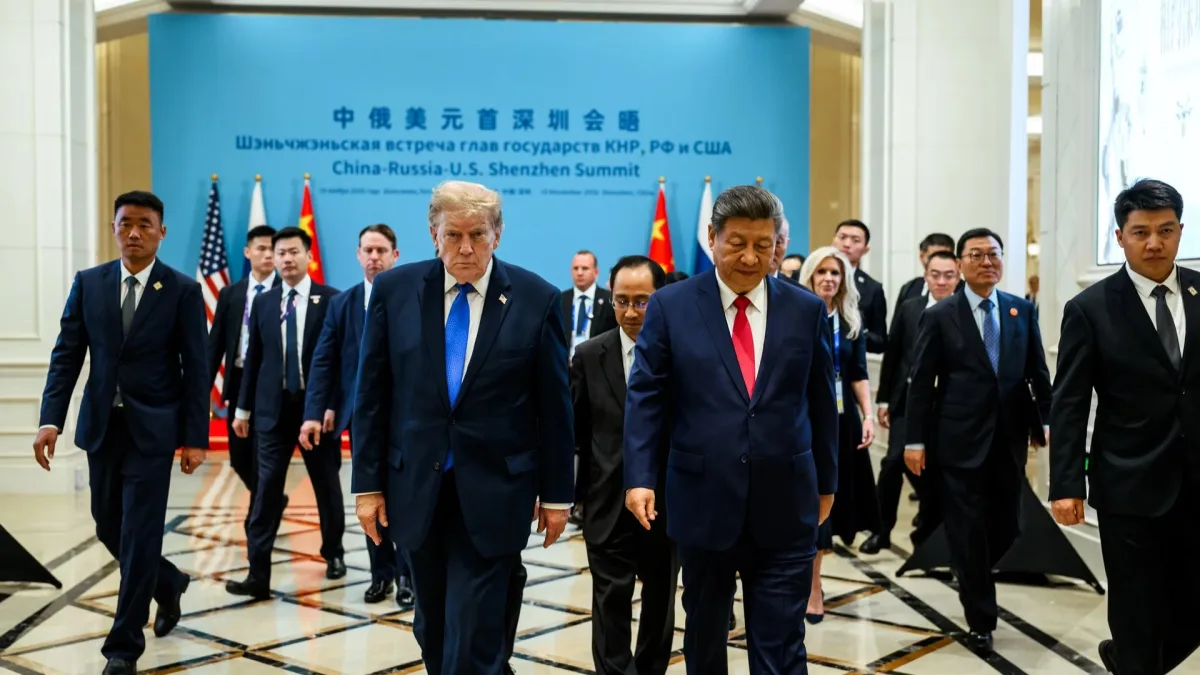
In 2024, Xi reached an understanding with then-President Joe Biden to preserve human authority over decisions to deploy nuclear weapons. The Times reported that no formal discussions on this matter have taken place since. At the Shenzhen summit last week, where Xi, Donald Trump and Vladimir Putin gathered, artificial intelligence in nuclear weapons systems did not feature in their agenda.
Last month, Pope Leo called for a prohibition on lethal autonomous weapons systems ahead of negotiations in Geneva.
Source: The Next Web