The market for single-board computers is undergoing rapid transformation, driven by the convergence of edge AI, computer vision, real-time control, and dense sensor integration at the local level. This expansion opens remarkable opportunities—yet one fundamental principle remains unchanged: you must clarify your project's goals before selecting hardware.
No single platform can or should attempt universal excellence. A low-power embedded sensor node, an autonomous robot, and a video processing server each require fundamentally different technical approaches. Developers choosing between general-purpose Linux systems and hybrid microcontroller architectures need to match their design philosophy to their specific constraints.
To understand what's possible, examining concrete implementations across different application areas proves invaluable. The Arduino UNO Q board—with its dual-processor design—demonstrates how developers are bridging sophisticated AI workloads with deterministic physical control across several key domains.
Perception-driven robotics
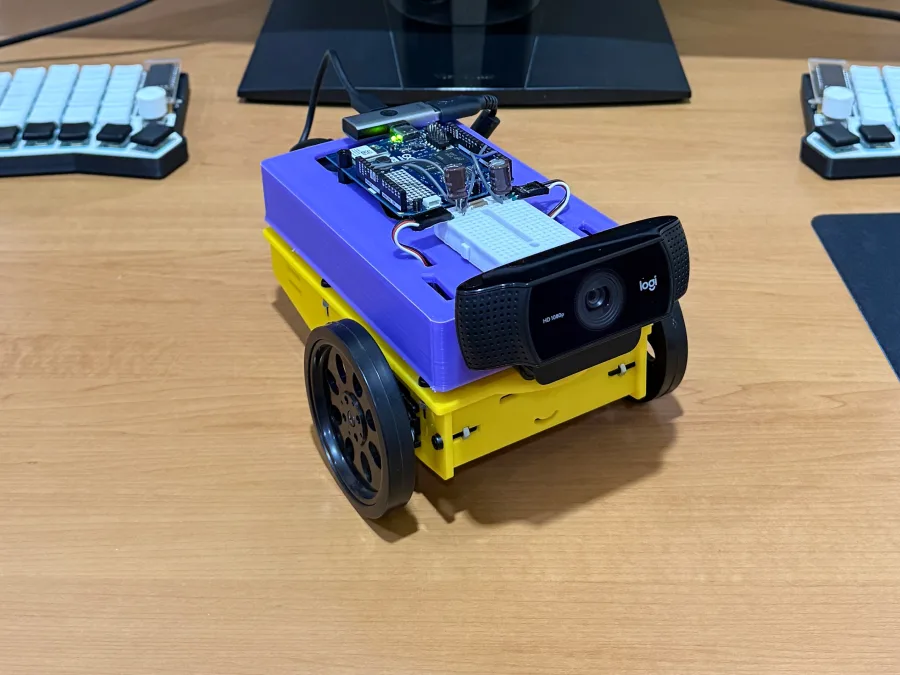
Hybrid platforms excel in robotics because the field demands both tight, real-time microcontroller timing for movement and substantial AI processing for visual understanding.
- A robot arm that sees you: Combines camera-based person recognition with a robotic arm for item delivery, using a Modulino LED Matrix for feedback
- UNO Q Braccio: Merges Edge Impulse AI and ROS 2 to control robotic arms, including simulation capabilities in Gazebo
- Face-following robot: Employs Edge Impulse computer vision to track faces and translate that data into servo motor commands
- AI agent robot: Runs a local AI agent for physical navigation and decision-making in real environments
Computer vision and spatial sensing
Rather than simply transmitting video streams, on-device machine learning transforms cameras and sensors into local environmental perception systems.
- Gesture-controlled input system: Processes standard webcam feeds through Edge Impulse to convert hand movements into digital application inputs
- Real-time LiDAR room mapper: Combines LiDAR sensors with Edge Impulse ML to interpret spatial data and room layouts without cloud dependency
Smart environments with interactive AI
Local AI execution enables devices to complete full "sense, interpret, decide, act" cycles independently, eliminating reliance on cloud latency or external infrastructure.
- Talk to your house: An integrated smart home hub supporting wake-word detection, voice commands, sensor integration, and web-based control
- Clawrophyll: A smart plant care system that runs a local AI agent directly on the board
Specialization over universality
The expanding technological landscape provides more specialized tools rather than a single dominant platform. Success comes from matching your project's unique requirements to the appropriate architecture. Whether building a raw Linux computing hub or deploying a dual-processor system like the UNO Q, starting with clear objectives accelerates development and improves outcomes. The current era of single-board computing offers unprecedented choice—and that diversity may be the most compelling aspect of all.
The UNO Q is available through the Arduino Store and can be purchased from DigiKey, Farnell, Mouser, Newark, RS Components, Robu.in, and other authorized distributors globally.
Source: Arduino Blog