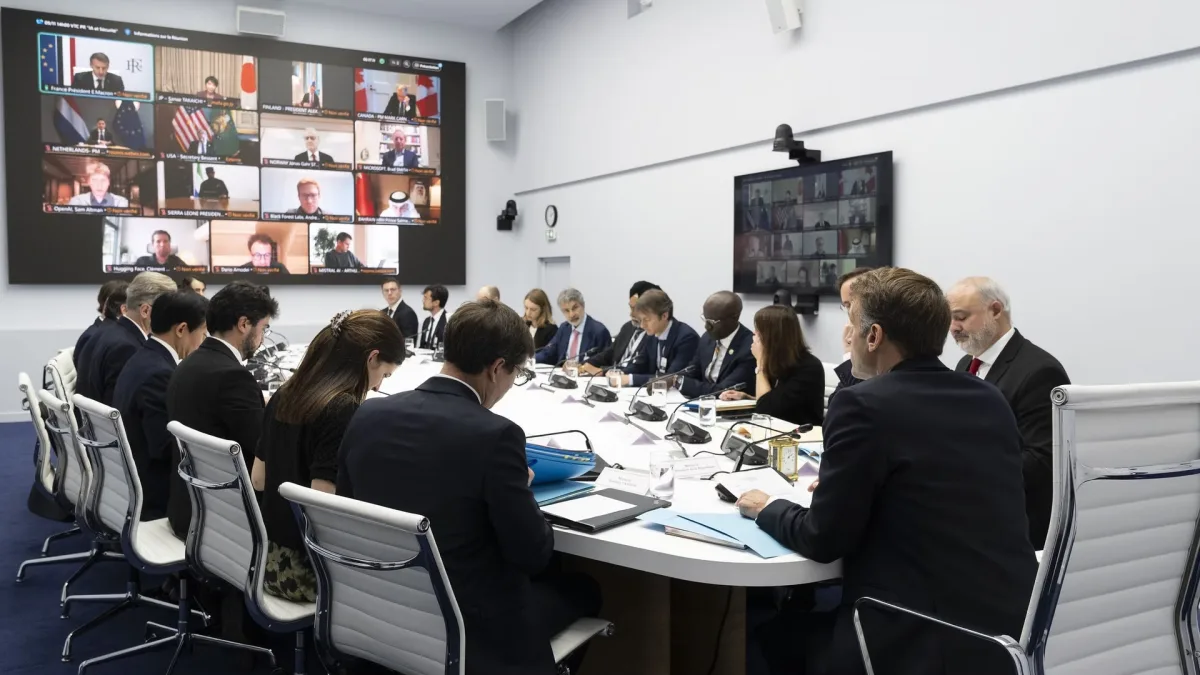
Ten artificial intelligence companies, including OpenAI, Anthropic, Microsoft and Mistral, have endorsed the Paris Call for AI Safety and Security, a new framework agreed at a gathering convened by French President Emmanuel Macron on Monday. The declaration emerged as a centerpiece of discussions at the Paris Peace Forum, where artificial intelligence dominated the agenda.
Alongside the four leading firms, Hugging Face, Cohere, Black Forest Labs, Domyn, Sakana AI and Synthesia also signed on. Six nations—France, Canada, Finland, Norway, the Netherlands and Bahrain—became signatories, while research organisations including Yoshua Bengio's LawZero lent their support. The gathering drew roughly 50 participants via video conference, among them OpenAI's Sam Altman, Anthropic's Dario Amodei and Microsoft's Brad Smith. US Treasury Secretary Scott Bessent attended despite the United States not being a signatory. Google, Meta and China remained absent from the agreement.
https://x.com/EmmanuelMacron/status/2119871179746107884?ref_src=twsrc%5Etfw
Macron framed the initiative as a response to accelerating AI development, stating that the technology carries "real risks to our collective security" and requires coordinated action between the public and private sectors.
What the declaration commits to
Signatories have pledged to implement safeguard systems capable of deactivating their models, whether during development phases or operational deployment. They will furnish greater transparency regarding system capabilities and limitations, and permit qualified external researchers to conduct assessments as warranted.
The agreement promotes a unified methodology for evaluating and controlling frontier AI risks, encompassing harmful applications such as cyber operations and military applications, alongside concerns about systems operating autonomously or escaping human oversight. Non-confidential evaluation outcomes will be released using standardised formats.
Additional provisions include mechanisms for governments and firms to exchange alerts regarding significant incidents and protected pathways for individuals to report concerns without fear of retaliation.
Gaps in the framework
The French safety organisation CeSIA, despite backing the declaration, has raised substantial objections about its limitations. The agreement establishes no uniform thresholds for determining whether a model warrants development or deployment, nor does it ensure that independent assessors or state actors will obtain the necessary access to conduct thorough evaluations.
CeSIA contends that governments should possess the power to halt a model when dangers exceed acceptable levels. The group further maintains that developers require explicit responsibilities and concrete timelines for compliance.
These decisions must rest with public authorities
Charbel-Raphaël Ségerie, CeSIA's executive director
Broader context and next steps
The Paris Call extends work initiated by Norway and Finland in September to strengthen governance of frontier AI systems, an effort France subsequently joined. It also builds upon earlier commitments made by AI companies in Seoul and conversations held during France's G7 presidency in Evian.
The declaration welcomes additional signatories but imposes no target dates for accession. The collaborative testing structure outlined in the agreement remains to be constructed.
Focus on child safety
On Tuesday, Macron shifted attention to another priority: protecting children from AI's effects. At a summit dedicated to children in the AI era, he advocated for mandatory safety reviews of AI applications before they reach young users.
We will push for pre-certification of all artificial intelligence solutions
President Emmanuel Macron
Drawing a parallel to safety standards applied to children's toys, Macron reasoned that just as parents would not provide untested playthings to their children, AI systems should meet equivalent scrutiny before reaching young audiences.
Macron also highlighted emerging concerns about AI's influence on adolescent wellbeing, noting that increasing numbers of young people interact with chatbots capable of shaping their emotional states and worldviews. A charter addressing safer AI for children was scheduled for signing later that day.
Macron received a report titled "Protect without preventing" from a government-convened expert panel investigating generative AI and its effects on human vulnerability.
Source: The Next Web