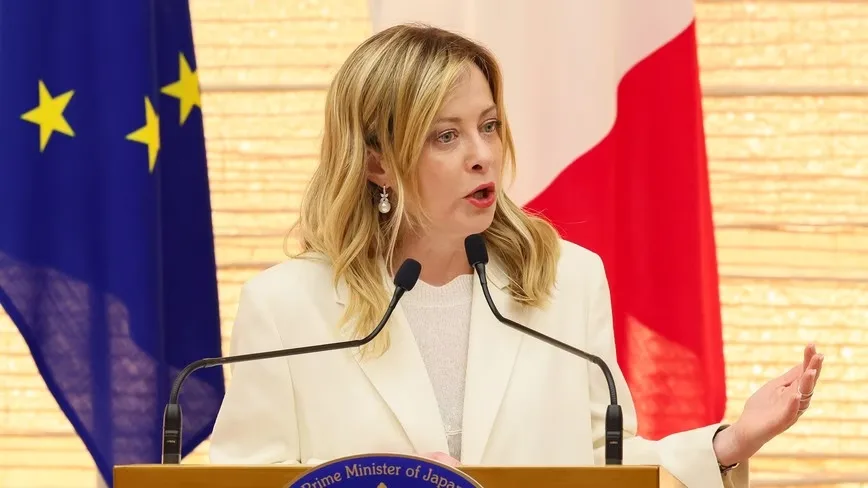
Italian Prime Minister Giorgia Meloni has submitted an application to register her voice as a trademark with the European Union Intellectual Property Office (EUIPO). Filed on 5 October through the Italian intellectual property firm Praxi Intellectual Property, the sound mark was still under examination as of 9 October, according to EUIPO records filed in her personal capacity.
The trademark consists of a four-second audio recording featuring Meloni repeating the phrase "Io sono Giorgia Meloni" ("I am Giorgia Meloni"). Her office confirmed the filing, explaining it as a protective measure against artificially generated deepfakes, Reuters reported.
The application encompasses three categories of goods and services: downloadable multimedia content and audio recordings; publication of books, periodicals and newspapers; and organisation of conferences, cultural events, live performances and political gatherings.
Origins of the phrase
The catchphrase "Io sono Giorgia" originated from a 2019 rally address by Meloni, which was subsequently remixed into a dance composition. She adopted it as the title for her 2021 memoir, according to Reuters.
Meloni has previously taken legal action against deepfake content. In 2024, she initiated a civil lawsuit against a Sardinian resident accused of creating and distributing sexually explicit deepfake images of her, a case that remains unresolved according to Reuters. Earlier in May, fabricated images of the prime minister surfaced online, including one depicting her partially clothed. She responded via Facebook, stating: "I can defend myself. Many others cannot."
Political context and precedent
While entertainers such as Taylor Swift and Italian vocalist Giusy Ferreri have previously registered voice trademarks, Meloni represents the first prominent political figure known to pursue such protection, according to the Financial Times.
The timing coincides with Italy's general election scheduled for next year. Misleading deepfake videos purporting to show Meloni endorsing fraudulent investment schemes have circulated across Italian digital platforms, the FT reported. Additionally, synthetic reproductions of her voice have featured in political advertisements designed to encourage voters to vote against her.
Even if approved by the EUIPO, the trademark registration would not automatically prevent others from using her voice in deepfakes, Reuters noted, citing Italian media sources. However, it could establish additional legal grounds for challenging unauthorised use of her voice.
Source: The Next Web