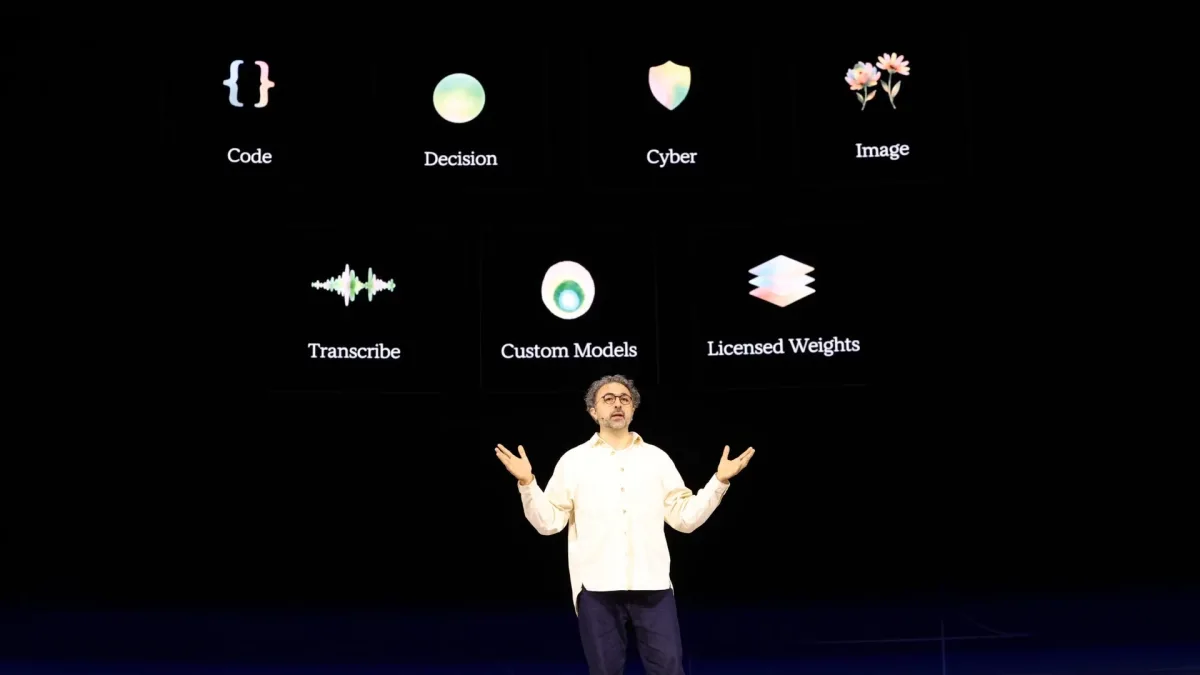
Microsoft unveiled MAI Code 2 during its Ignite conference in San Francisco on Tuesday, positioning the in-house coding model as a cost-effective alternative to established competitors. The company claims the model achieves 98% of the performance delivered by OpenAI's GPT-6.1 Sol while charging only 40% of the price. Alongside the main model, Microsoft also released MAI Code 2 Flash, a smaller variant, as well as new offerings for security and image editing.
The pricing comparison against OpenAI's offering applies a 50% promotional discount that remains valid through 17 May 2027. Following the expiration of this launch rate, input token costs will double from $0.50 to $1 per million, while output tokens will increase from $2.50 to $5 per million. When measured against Anthropic's Claude Opus 5.5, Microsoft reports MAI Code 2 delivers 96% of performance at just 5% of the cost, with both figures derived from averages across four coding benchmarks selected by Microsoft.
Both MAI Code 2 and MAI Code 2 Flash are now accessible through GitHub Copilot. The Flash variant reportedly matches OpenAI's GPT-6 Luna at 65% of the price and performs comparably to Anthropic's Claude Haiku 5.5 at 20% of its cost. Mustafa Suleyman, chief executive of Microsoft AI, presented the launch and noted that the company recognizes token spending as a mounting concern among technology leaders.
Right now, token spend is going through the roof
Mustafa Suleyman, chief executive of Microsoft AI
Microsoft acknowledges that both coding models remain unoptimized for complex applications, including fundamental science research and extended agentic workflows. The company is simultaneously developing a general-purpose frontier model, with Suleyman disclosing to Axios that Microsoft has achieved state-of-the-art results in pre-training and is making substantial strides in reinforcement learning, though no launch timeline was provided.
My team is building true superintelligence
Mustafa Suleyman, speaking to Axios
Suleyman declined to specify what portion of Copilot traffic might eventually shift to Microsoft's proprietary models but predicted meaningful uptake. He did not establish a concrete adoption target.
Security and image editing capabilities
MAI Cyber 2 Flash, Microsoft's security-focused model, outperforms OpenAI's GPT-6 Astra while costing less than 2% as much per task, according to Suleyman. A full-scale version of MAI Cyber 2 is currently in preview within MDASH, Microsoft's agentic code scanner. On the image editing front, MAI Image 2.7 now ranks as the leading model in its category and is priced at one-fifth the cost of competing solutions.
Customizable model weights for enterprise customers
Microsoft is introducing MAI Licensed Weights, enabling select customers to take possession of a Microsoft AI model and adapt it using proprietary data. These customized versions operate within customers' own Azure infrastructure, with support provided by Microsoft's Frontier Company team. Suleyman characterized the initiative to Axios as delivering an experience that would "feel like open source" while maintaining enhanced security and control.
No one wants to pour their IQ into somebody else's model
Mustafa Suleyman, speaking at the conference
AT&T has already built a tailored version of Code 2 Flash that surpasses GPT-6.1 Sol on standard 5G network analysis tasks and operates at one-fiftieth the cost, Suleyman reported.
Continued partnerships with OpenAI and Anthropic
Despite launching its own models, Microsoft continues to offer solutions from both OpenAI and Anthropic. Satya Nadella announced the availability of OpenAI's GPT-6.2 for Microsoft Foundry during the same presentation. Earlier remarks from Microsoft's commercial leadership emphasized Copilot's pricing advantage relative to both ChatGPT and Claude.
The company's focus on cost efficiency reflects recent strategic shifts. In May, Microsoft reduced Claude Code licenses for its own engineering staff due to token expenses. That September, Suleyman publicly challenged Anthropic regarding Claude's training methodology.
Source: The Next Web