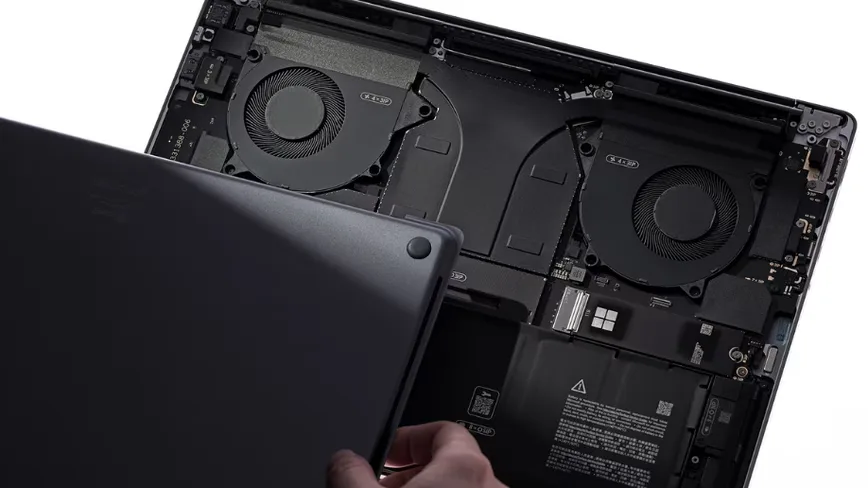
Starting at $2,599.99, Microsoft's new Surface Laptop Ultra features Nvidia's latest chip and comes with bold performance assertions. The company stated during a San Francisco event on Wednesday that the device handles locally executed AI prompts twice as quickly as an Apple MacBook Pro M5 and renders video content six times faster. However, Microsoft has not released any methodology explaining how these comparisons were conducted.
The laptop marks Microsoft's entry into the Nvidia-powered portable computer segment. Inside runs Nvidia's RTX Spark processor, which pairs a Blackwell graphics unit with the Grace CPU, co-designed alongside MediaTek. Nvidia claims the chip delivers up to one petaflop of AI computing capacity. The device offers configurations with up to 20 Nvidia Grace cores, 128GB of unified memory, and 2TB of storage.
The only specification Microsoft has substantiated with detailed measurement is the display. The screen reaches a peak brightness of 2,000 nits, measured across a 10% window while displaying HDR content, benchmarked against laptops available in October 2026. No equivalent technical footnotes accompany the Apple performance comparisons.
At $2,599.99, the Surface Laptop Ultra undercuts a 16-inch MacBook Pro by approximately $400. This pricing emerges as memory shortages have elevated hardware costs across the industry. Nvidia itself raised the price of its DGX Spark by roughly 75%, to $6,950, reflecting broader supply pressures.
The Architecture Question
Grace operates on Arm's instruction set architecture, licensed from the Cambridge-based company. Nvidia had agreed to acquire Arm for $40 billion but abandoned the deal in February 2022 after regulatory opposition and SoftBank's confirmation that the transaction would not proceed. Every RTX Spark laptop now requires Arm licensing payments.
Dell, HP, Lenovo, Asus, and MSI are already shipping machines built on the RTX Spark platform, marking Nvidia's significant push into a laptop market that Intel and AMD have dominated for decades.
Market Headwinds
European laptop shipments face headwinds, with forecasts predicting a 6.4% decline this quarter and a 20% drop in the fourth quarter. Desktop shipments are expected to fall by nearly 30%. Rising memory costs are pushing system prices higher while companies extend their replacement cycles. According to Gartner, AI-capable PCs will not represent a majority of shipments until 2028.
The Local Processing Argument
Microsoft's marketing emphasizes that processing AI workloads directly on the device proves more economical and secure than relying on cloud-based services. This argument resonates with some organizations: the Dutch tax office recently reached the same conclusion regarding its email systems and is transitioning them from Microsoft's cloud infrastructure to its own on-premises servers.
Source: The Next Web