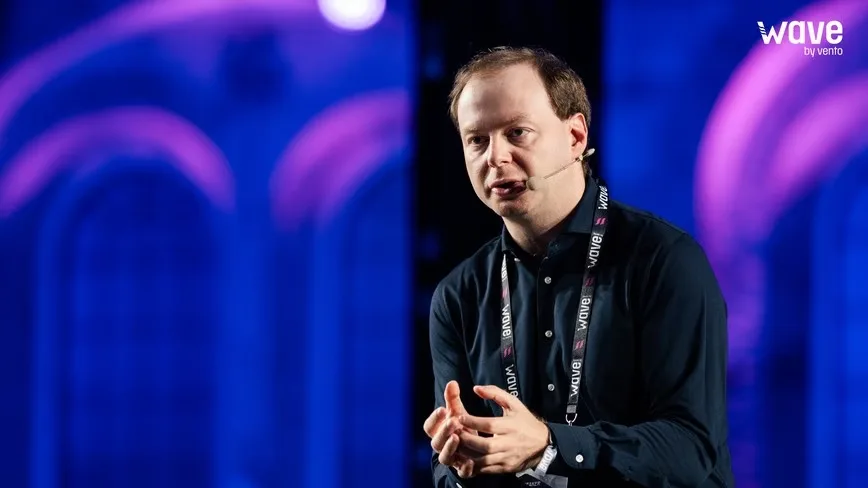
At Wave by Vento in Turin on Wednesday, Miro co-founder and chief executive Andrey Khusid outlined a vision of organizational transformation centered on AI integration. His remarks came roughly one month after Milan-based Bending Spoons announced plans to acquire Miro for $1.355bn, with the transaction expected to complete in the fourth quarter pending regulatory approvals.
Khusid contended that merely layering AI capabilities onto existing team structures and operational systems will not produce the productivity improvements organizations seek. Rather, he argued, companies must fundamentally reimagine their workflows before introducing human contributors into those redesigned processes.
One of the big challenges is how not to put AI on top of the existing teams or operational systems, but actually, from first principles, design the workflow and then only add humans to add value on top of that workflow
Andrey Khusid
The discussion, moderated by Charlie Perreau of Les Echos' tech, media and startups division, was titled "Thinking Together in the Age of AI." Khusid noted that Miro, which generates approximately $600m in annual recurring revenue, was valued at $17.5bn when it raised $400m in January 2022. He declined to elaborate on the Bending Spoons acquisition but expressed enthusiasm about Italy as a potential future base for the company.
Why personal gains do not add up
While individual workers increasingly rely on AI assistants like Claude and ChatGPT, transforming entire organizational operations presents a far greater challenge, Khusid observed. Companies function through intricate workflows where tasks move sequentially between team members, each holding distinct contextual knowledge that rarely exists in a centralized location. Consolidating this scattered context becomes the essential first step before teams can operate effectively.
Deploying AI across an established operating model will not deliver anticipated results, he cautioned. At Miro itself, the company created parallel teams executing identical work using AI tools, constructed processes around those teams, and subsequently expanded the approach across the organization.
More voices, more noise
AI democratizes idea-sharing by enabling less vocal team members to rapidly convert prompts into shareable prototypes, Khusid noted. However, this capability simultaneously generates vastly more content. When team members distribute AI-generated outputs indiscriminately, the resulting information deluge paralyzes teams and reduces overall velocity. The Harvard Business Review cautioned against this phenomenon—termed AI 'workslop'—in June. Khusid's solution centers on accountability: individuals must take ownership of everything they contribute.
Intelligence at the centre
Traditional organizations developed around hierarchical structures with knowledge concentrated in individual employees. Contemporary companies, particularly startups, operate differently: a centralized intelligence system maintains visibility into nearly all organizational activity, enabling team members to access this information for rapid decision-making. Established enterprises must construct comparable intelligence infrastructure and reassess their role requirements, Khusid argued. This architectural advantage allows newer companies to move faster and make superior decisions, creating competitive pressure for incumbents. UK data from July revealed that businesses had tripled their AI adoption rates, though most implementations remained limited in scope.
At 15 years old, Miro has already incorporated AI into much of its codebase and consolidated systems to provide AI with richer context. Khusid observed that recent model developments have been incremental rather than revolutionary, making it possible to forecast capabilities over the next three years with reasonable confidence. Consequently, Miro builds around known capabilities rather than pursuing every new release.
Humans and AI agents already collaborate in both startup and enterprise environments while maintaining human accountability, Khusid noted. Miro is constructing a platform where people and agents operate on the same canvas. Within three years, he anticipates the platform will emphasize voice and conversation interfaces, with visual decision-making becoming the primary mechanism through which teams make choices.
Khusid founded Miro in 2011 but experienced meaningful growth only beginning in 2016. His counsel to other founders emphasizes pursuing work they genuinely care about and trusting their own judgment.
Source: The Next Web