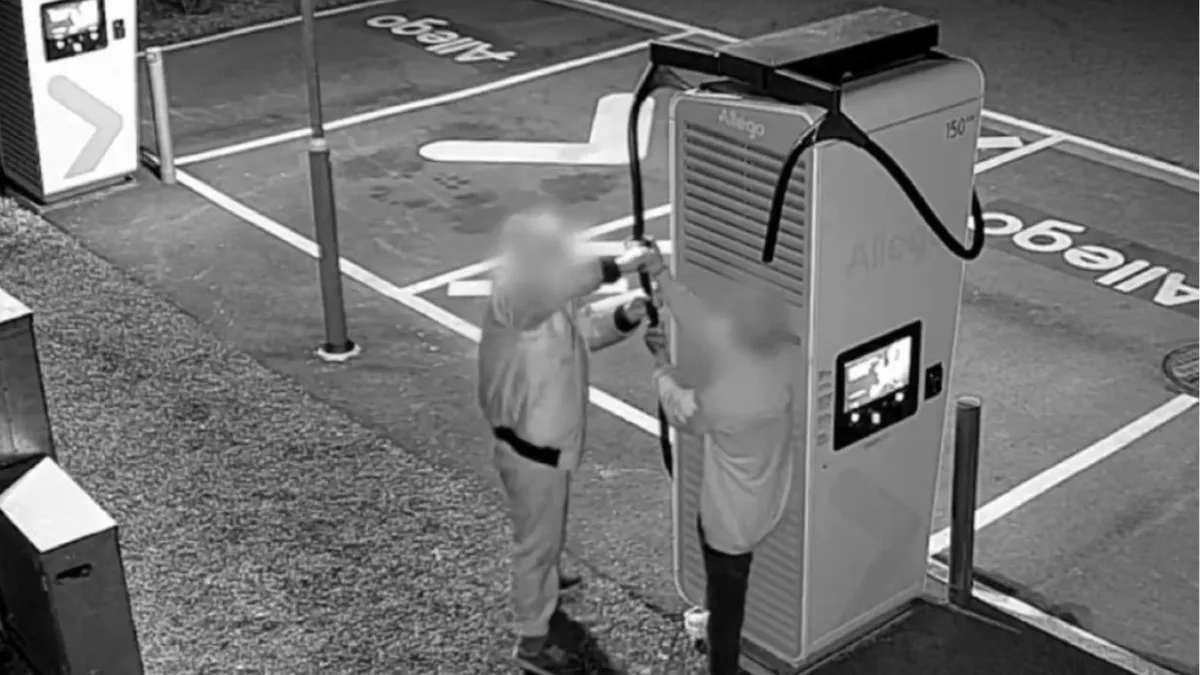
What began as opportunistic theft—a couple on a mobility scooter with a hacksaw—has transformed into something far more organised. Criminal networks now conduct coordinated raids across Europe, striking multiple charging stations in a single evening with stolen vehicles, power tools, and disguises.
According to Vern Pollard, cable theft response expert and director at Formula Space, a Canterbury company developing protective technology for EV charging cables, the tactics have become increasingly sophisticated. "Perpetrators work in teams, arrive in stolen vehicles and wear balaclavas or masks to avoid identification. They use high-powered cutting tools that complete the cut quickly, and a single group can hit 5 or more sites in one night," Pollard said.
The scale of the problem is staggering. InstaVolt, a UK charge point operator, lost roughly 260 cables from 130 chargers during 2025. EnBW, the German operator, reported theft at 120 locations since early 2025, with damages exceeding €1 million. France has seen approximately 10 per cent of its national charging network affected, while Spanish authorities have arrested thieves caught with 34 kilometres of stolen copper charging cables.
Police contacts have informed Formula Space that these gangs have established supply chains for moving stolen copper, with some groups also involved in telecommunications network theft. The copper is stripped, chopped, and sometimes melted into ingots to remove identifying marks, then mixed into larger shipments of legitimate scrap and sold across borders.
Making copper theft more trouble than it's worth
Formula Space's response is CableGuard, a protective sleeve wrapped around charging cables to slow cutting while preserving the flexibility drivers need. The company has now introduced a V4 cut protection variant specifically engineered to resist angle grinders and other power tools.
Rather than rendering cables impossible to steal, the technology increases the time, equipment, and effort required, making the operation more visible and raising the likelihood of detection. A theft that once took seconds can become a prolonged operation. The sleeve can be retrofitted to existing chargers in approximately 20 minutes and has been verified by manufacturers including Nidec, Wallbox, and Kempower.
Operators tell us the problem isn't just the theft, it's the escalation in the severity of the attack and the extent of the damage. As thieves get more sophisticated, charge point operators need us to apply the same thinking to the theft prevention solutions we create. V4 cut protection is our direct answer to that: a new technology that not only protects cables from being taken in high-risk areas but also acts as a deterrent for the future.
Vern Pollard, Formula Space
CableGuard is now deployed across thousands of locations worldwide, with adoption from operators including TotalEnergies, Atlante, InstaVolt, Allego, E.ON, RAW Charging, and Sainsbury's Smart Charge.
Where does the stolen copper end up?
European countries have tightened regulations on scrap metal dealing. Belgium requires dealers to identify and register sellers of scrap metal from private individuals, and cash payments for used copper cable were banned in 2013, with the restriction extended to all scrap metal in March 2024.
Yet organised groups have found workarounds. According to Pollard, "Cable is stripped and chopped, and in some cases melted into ingots, which removes any markings that could trace it back to the site it came from." Once processed, the copper blends into larger consignments of legitimate scrap and crosses borders, obscuring its origins. A minority of scrap dealers still accept material without proper verification, creating outlets for criminal networks despite stricter rules.
Why some charging sites are easy targets
Not all charging locations face equal risk. Pollard notes that thieves care less about charger manufacturer than about the physical environment. "The sites targeted most often share the same conditions, regardless of the charger manufacturer or the network operator. They sit in quiet locations with little or no layered protection, such as monitored CCTV or good site lighting," he explained. Charging bays positioned in car park corners, away from foot traffic and nearby structures, are particularly vulnerable.
Replacing stolen cables does not guarantee future security. At one UK site, thieves returned within 24 hours of each cable replacement, stealing the new cables three times in succession. After the operator installed Formula Space's highest-level CableGuard protection, no further thefts occurred in the three months that followed.
Some groups actively monitor sites to identify when replacement cables have been installed. At one location, an offender with a hand tool spent so long attempting to cut through CableGuard that Formula Space's 24-hour monitored surveillance service detected the attack and alerted police. Pollard recounted: "Officers arrived and caught him with the tool still in his hand."
Not all attempted thefts end in arrest. Pollard acknowledges that particularly determined groups with sufficient time and appropriate equipment have succeeded in removing protected cables. "Any cable protection has to leave the cable flexible and easy for drivers to use, so with this constraint we believe no design can make theft impossible," he said.
Instead of making theft impossible, Formula Space aims to alter the economics of cable theft, making the potential reward less attractive than the time and risk involved. "CableGuard is designed to make an attack slow enough that the time on site and the risk of being caught outweigh what the copper is worth," Pollard explained. The protection can be paired with forensic marking to link recovered cables, tools, and vehicles to the original theft location, and GPS tracking to monitor stolen cables after removal.
A growing problem for charging networks
InstaVolt UK collaborated with Formula Space on earlier CableGuard versions. Delvin Lane, CEO at InstaVolt UK, commented: "As the UK's leading ultra-rapid EV charging network, we're always pursuing opportunities to enhance the reliability and security of our sites. Partnering with Formula Space on the development of CableGuard has allowed us to directly support a solution to the growing industry challenge of EV cable theft. I'm pleased to see the collaboration delivering a solution that we believe will make a real difference, not just for InstaVolt as a business, but for our loyal customers who rely on our network."
Beyond the direct cost of replacing stolen copper, cable theft creates a broader challenge for Europe's EV transition: charging stations that drivers cannot access. Each attack damages equipment, incurs repair costs, and removes charging bays from service, potentially eroding confidence in infrastructure that Europe is investing heavily to expand.
While the image of thieves on a mobility scooter may seem almost absurd, the emergence of organised networks equipped with stolen vehicles, power tools, and established copper resale operations is considerably more serious. For charging operators, the challenge is no longer simply replacing stolen cables—it is ensuring that thieves do not view those replacements as their next target.
Source: Tech.eu