More than 30 European energy organisations, among them investment firms World Fund, Wind Capital, and Natural Hydrogen Ventures, have sent an open letter to European Commission President Ursula von der Leyen. The message urges backing for natural hydrogen exploration and cautions that Europe could fall behind as the United States, Australia and other regions accelerate their own efforts.
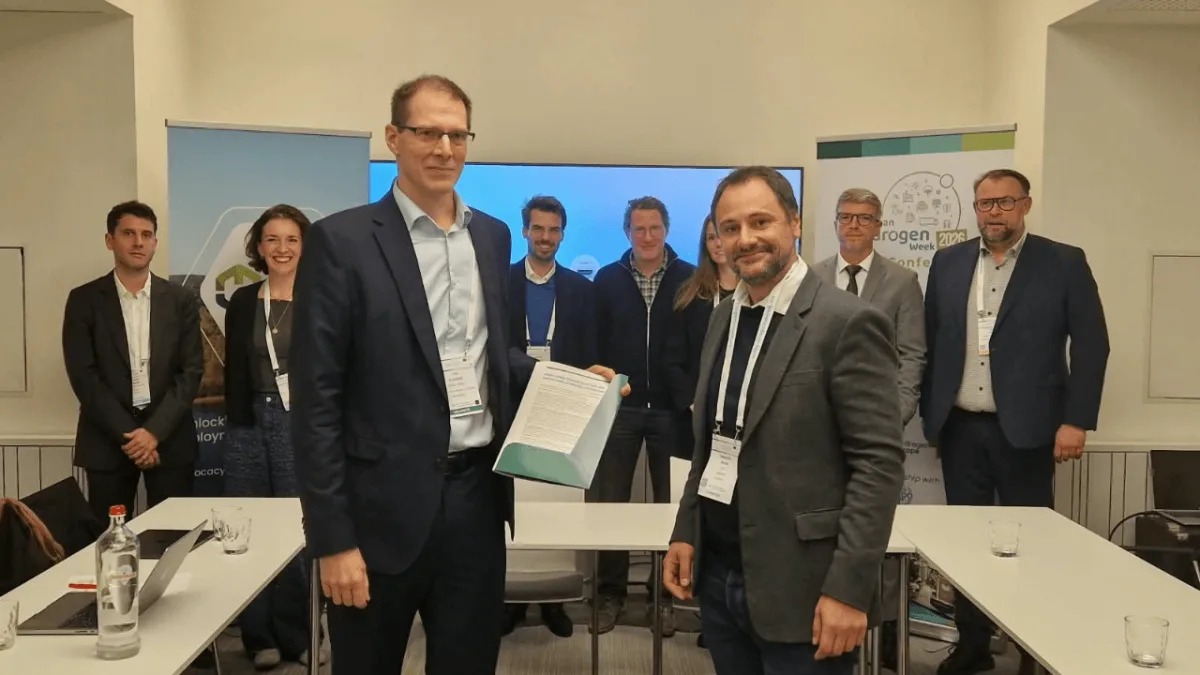
Spearheaded by natural hydrogen exploration firm Mantle8, the letter requests clearer EU regulations and a proposed €1 billion exploration initiative to fund approximately 50 wells across no fewer than 10 Member States. The letter was handed over at European Hydrogen Week in Brussels on 28 October, with Mantle8 CEO Emmanuel Masini and European Commission officials taking part in the formal presentation. A formal submission to the relevant Commission director-generals and commissioners is scheduled for the following week.
The push arrives as the European Commission develops its updated EU Hydrogen Strategy, with a call for evidence released on 26 October that explicitly names natural hydrogen as an emerging area for research and innovation.
Europe risks falling behind in natural hydrogen exploration
Established in 2019, Mantle8 has developed techniques to locate naturally occurring hydrogen before drilling takes place. While natural hydrogen finds have traditionally occurred by chance, the company applies geological analysis and sophisticated subsurface data processing to pinpoint active hydrogen-generating processes and areas where the resource might build up in commercially attractive amounts.
The company counts among its backers Sandwater, Breakthrough Energy Ventures, BPI, IP Group, Wind Capital and Calderion. Mantle8 is currently testing its techniques across an expanding set of field projects to show that natural hydrogen can be discovered methodically and consistently.
We initiated this letter because Europe needs to give natural hydrogen a fair opportunity to be explored. The industry has the scientific expertise and technological capabilities to investigate the resource, but progress depends on having the right regulatory conditions in place. Clear rules, predictable permitting and investment in exploration would allow us to establish where natural hydrogen can be found, whether it can be recovered commercially and what role it could play in Europe's energy future.
Emmanuel Masini, Founder and CEO of Mantle8
From geological potential to commercial viability
Natural hydrogen forms through geological processes deep underground and can gather in subsurface reservoirs. Distinct from hydrogen made using electricity or fossil fuels, it exists naturally below ground and might serve as a source of primary energy, provided that exploration, extraction and processing prove successful.
The field remains in its infancy, with additional fieldwork required to determine the extent, output and financial feasibility of possible reserves. While the European Commission has begun studying natural hydrogen via schemes such as the EU-backed H2-QUEST research project and a DG GROW pilot study, firms working on exploration continue to encounter obstacles regarding regulatory standing, permitting rules and availability of geological information.
The coalition contends that these hurdles make it harder to make investment choices and put Europe at risk of lagging behind other parts of the world that are pursuing methodical exploration.
Four priorities to unlock natural hydrogen exploration
The open letter asks the European Commission to formally acknowledge natural hydrogen in the 2026 Energy Union package and the upcoming update of the EU Hydrogen Strategy. It also proposes a European Natural Hydrogen Initiative structured around four key areas:
- Clear regulatory recognition: Develop a technology-neutral policy framework for natural hydrogen, including qualification for relevant EU certification and backing where applicable emissions-reduction standards are satisfied.
- Exploration funding: Set up a €1 billion funding pool to finance around 50 exploration and appraisal wells in at least 10 Member States, helping draw in more public and private funding.
- Predictable permitting: Urge Member States to put in place open permitting systems with set timeframes, offering firms more confidence when arranging exploration activities.
- Access to geological data: Strengthen availability of publicly financed subsurface data and create a European natural hydrogen atlas to steer exploration and deepen geological knowledge.
The proposed funding would pay for geological study, drilling, flow testing and pilot production, as well as tools needed to handle and move any viable resource. The goal is to lower the risk of early-stage exploration and verify whether commercially extractable deposits are present, rather than take their existence for granted.
This means establishing a common policy approach, improving access to geological data and giving exploration projects a clearer route through permitting. A coordinated European effort would help build the evidence base needed to determine where natural hydrogen can make a meaningful contribution to Europe's energy mix.
Jorgo Chatzimarkakis, CEO of Hydrogen Europe
For Mantle8, more transparent European rules would permit exploration firms to deploy their methods, secure funding and assess whether natural hydrogen might turn into a commercially feasible energy source. The coalition maintains that the EU does not have to decide in favour of natural hydrogen as part of its future energy mix before its promise is demonstrated. Rather, it must put in place the regulatory framework, geological data availability and funding mechanisms required to make that determination.
The coalition includes Hydrogen Europe, Cleantech for Europe, France Hydrogène, Earth2, BEV, Calderion, Natural Hydrogen Ventures, NaturalHy, World Fund, Wind Capital, KIKO, Sandwater, La Française de l'Énergie (FDE), 45-8 Energy, Storengy, Teréga, H2Site, CVA Group, Technip Energies, Smart Seismic Solutions (S³), AXENS, Geolinks, Vallourec, thyssengas, IPGP, UPPA (Isabelle Moretti), CERTH, IFPEN, the European Federation of Geologists (EFG), Hyreveal and Mantle8.
Source: Tech.eu