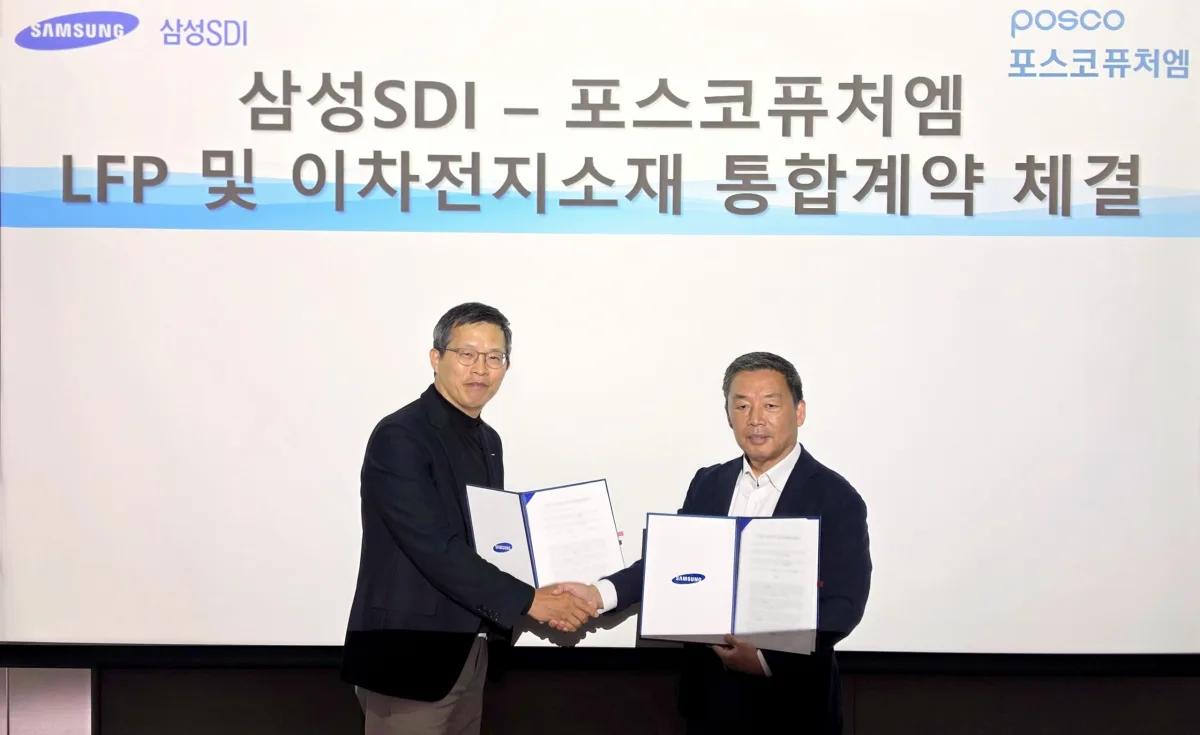
A significant expansion of battery material cooperation between POSCO Future M and Samsung SDI took shape on October 6, 2026, when the two companies formalized a long-term supply arrangement valued at six trillion South Korean won—equivalent to roughly $4.5 billion. The agreement consolidates earlier individual contracts and introduces new product categories to their existing partnership framework.
The volume of lithium iron phosphate materials covered under the revised terms represents a substantial increase from what the companies had previously negotiated. In August, POSCO Future M and Samsung SDI had committed to 190,000 metric tons of LFP deliveries spanning 2027 through 2032. The October agreement more than doubles this quantity, though POSCO Future M has not released the specific revised tonnage in its public statements.
Broadening the Product Portfolio
Rather than creating entirely new arrangements, the October contract merges several standalone supply agreements into a unified framework. It builds on a 2023 supply contract that originally covered NCA cathode materials, now incorporating LFP alongside those existing products.
The partnership extends further to encompass lithium manganese oxide cathode materials and synthetic graphite anode materials. By diversifying across these material categories, POSCO Future M projects that its total supply volume to Samsung SDI will grow by approximately 45% relative to current levels.
Strategic Supply Chain Positioning
Samsung SDI's motivation for deepening this relationship centers on securing cathode and anode materials from suppliers that fall outside the classification of prohibited foreign entities. POSCO Future M designates these compliant sources as non-PFE materials.
For POSCO Future M, the long-term volume commitments offer tangible operational benefits. The guaranteed demand supports higher utilization of existing production capacity and strengthens planning certainty, while also providing a foundation for evaluating future factory buildouts and sourcing strategies for raw materials.
Source: Battery-News