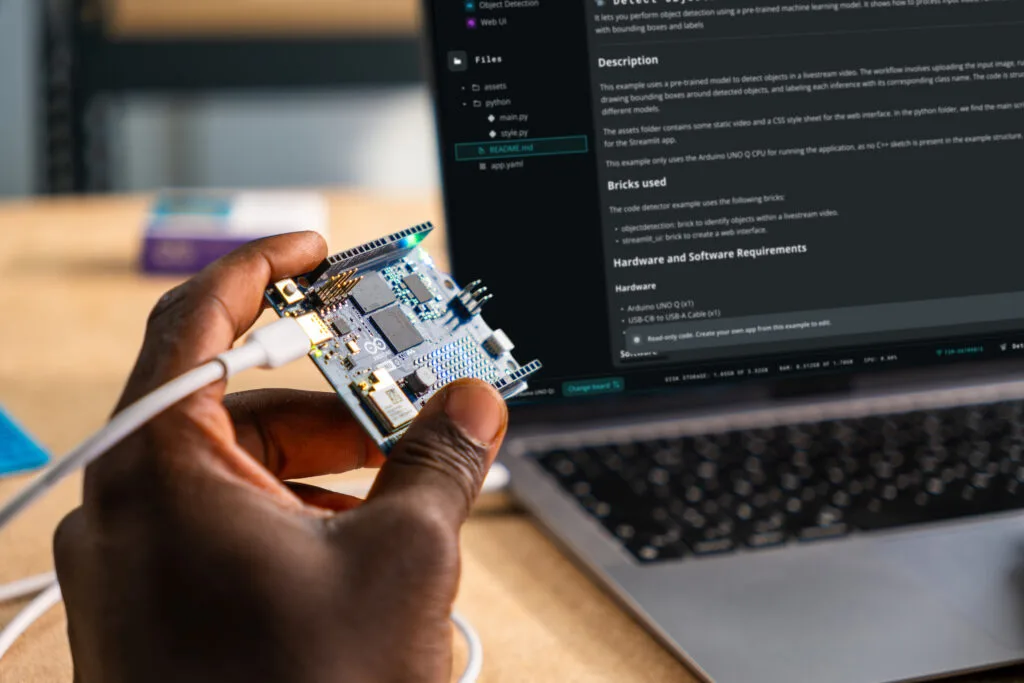
Qualcomm Academy has unveiled its AI Associate Certification: Model to App, a second-level training initiative aimed at engineers and developers seeking practical experience in building and deploying machine learning solutions on edge hardware. The program centers on the Arduino UNO Q board and covers the full machine learning lifecycle, from data preparation through on-device inference.
Structured as a self-paced, online course requiring approximately five to six hours of guided instruction, the certification balances technical rigor with hands-on application. Participants emerge equipped to design accurate, efficient, and production-ready AI systems optimized for edge deployment.
Three projects spanning voice, vision, and motion
To earn the certification, learners complete three distinct projects that demonstrate the end-to-end ML workflow:
- Wake Word Detection: Participants create and fine-tune a voice application capable of recognizing specific wake words.
- Person Recognition: Learners build a computer vision system that analyzes images and runs inference directly on edge hardware.
- Gesture Recognition: Using inertial measurement unit sensor data, participants train models to detect and classify physical movements in real time.
Each project integrates model architecture decisions, training procedures, validation techniques, quantization strategies, deployment processes, and application integration, allowing learners to experience the complete machine learning lifecycle in practice.
Skills and prerequisites
The program targets developers, embedded systems engineers, IoT and robotics specialists, students, and industry professionals. Successful completion builds competency in ML model development, data preparation, model optimization across accuracy and latency tradeoffs, power consumption analysis, model graph visualization, AI toolchain usage, microcontroller and microprocessor capabilities, real-time application development, and FastRPC communication for AI workloads.
Prospective participants should possess basic Python proficiency, familiarity with an integrated development environment, introductory understanding of PyTorch and machine learning fundamentals, and hands-on experience equivalent to Qualcomm Academy's foundational AI certificate programs.
Self-paced learning and credentials
The certification operates entirely online with no fixed schedule, allowing each learner to progress according to their own timeline. Enrollment occurs through Qualcomm Academy. Upon successful completion, participants receive a Qualcomm Technologies certificate and digital badge suitable for professional profiles and LinkedIn.
Maker Faire Rome showcase
The program will be featured at Maker Faire Rome, taking place October 23rd through 25th. Arduino will maintain a booth where attendees can learn more about the certification and discuss enrollment options with team members.
Source: Arduino Blog