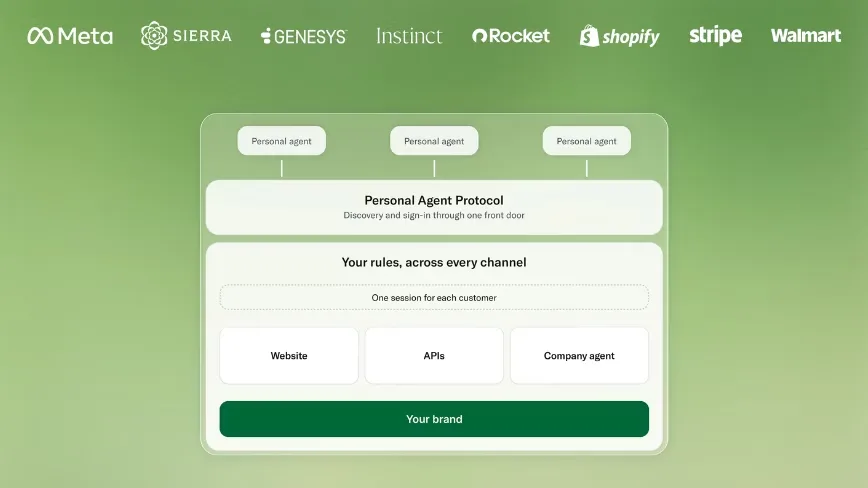
Sierra and Meta are jointly developing Personal Agent Protocol, an open standard that establishes the rules for how personal AI agents verify their identity with businesses and determine what actions they are permitted to perform. The initiative brings together Genesys, Instinct, Rocket, Shopify, Stripe and Walmart as founding partners. The v0.1 specification is scheduled for release this month, with payments designated as a future addition rather than part of the initial release.
The protocol aims to handle authentication and provide visibility into agent activity on company systems, according to a post by Bret Taylor and Clay Bavor. The architecture rests on OAuth and allows agents to begin interactions as guests—checking inventory or return procedures, for example—before customers authenticate. Once a user logs in, they control whether the agent receives read-only access or permission to make changes. A single session persists across channels, meaning inquiries made before login and transactions completed afterward are treated as part of the same interaction.
Businesses retain flexibility in how they integrate with agents. Companies can choose whether agents interact through their website, connect via APIs using standards like MCP and OpenAPI, or operate through their own proprietary agent infrastructure.
Notably, both Stripe and Shopify have already committed to a competing standard. In June, Visa introduced the Trusted Agent Protocol, which enables agents to transact with approximately 175 million merchants through ChatGPT. Microsoft, Stripe, Shopify and Worldpay had already joined that initiative. The two major payments companies are now participating in both frameworks.
Real-world agent deployments are outpacing the standards infrastructure meant to govern them. Rocket's announcement highlights Meta's Muse agent, which launched four weeks ago and is already moving across its platform from property search to financing arrangements. Muse processes payments using saved cards through Stripe's Link. Separately, Hark released an agent this morning capable of purchasing groceries, booking vehicles and settling bills—a full year before the company's hardware product arrives.
A significant regulatory hurdle remains unresolved. Strong customer authentication rules, designed for transactions where a person explicitly approves a payment to a named recipient for a specific amount, contain no exemption for payments authorized by software on a user's behalf. Sierra has positioned payments as future work rather than part of the initial specification, with push notifications and granular permission controls also deferred.
The partnership roster reveals a geographic gap. Stripe, which maintains dual headquarters in San Francisco and Dublin, is the sole partner with a European base. No European retailer, financial institution or payments provider has been announced as a participant in the initiative.
Source: The Next Web